
After Reading This Article You Can Solve This UPSC Mains Model Question:
The scrapping of the proposed Parandur Greenfield Airport highlights the complex trade-off between infrastructure-led growth, environmental sustainability and livelihood security. Discuss the major issues involved and suggest a sustainable way forward. 10 marks (GS3, Indian Economy)
Context
Tamil Nadu’s decision on August 24, 2026 to scrap the proposed Parandur greenfield airport has reopened the debate on infrastructure-led growth versus agricultural livelihoods, environmental sustainability, land acquisition, federal clearances and long-term urban planning.
Introduction
The Parandur episode highlights the difficulty of developing large infrastructure in densely populated and environmentally sensitive regions. It raises a fundamental governance question on how India pursuing rapid infrastructure expansion without compromising livelihoods, ecological security and its social legitimacy.
What was the Parandur Airport project?
- Parandur was proposed as a greenfield international airport to serve Chennai’s rapidly growing passenger, cargo and industrial requirements and to eventually function alongside the existing Chennai International Airport at Meenambakkam.
- The project emerged from Tamil Nadu’s long-standing search for a second airport, with earlier proposals including Sriperumbudur and other locations before Parandur was selected in 2022.
- The proposed project was envisaged as a large-scale, multi-phase aviation infrastructure project, with substantial supporting road, Metro, logistics and commercial infrastructure.
- The project had received site clearance and in-principle approval-related clearances, and the Union Ministry of Civil Aviation formally granted in-principle approval subject to compliance with conditions and other statutory clearances.
Reasons behind the need for such an airport
1. Rising passenger and cargo traffic
- Chennai is a major aviation and economic hub in South India, and the existing airport at Meenambakkam is facing increasing pressure from rising passenger and cargo traffic.
- The projected growth in aviation demand necessitated additional long-term airport capacity, as continuous expansion of an existing airport within a densely urbanised region has inherent spatial and operational limitations.
2. Supporting Tamil Nadu’s industrial and manufacturing ecosystem
- Chennai and its surrounding industrial corridors have a strong presence in automobiles, electronics, engineering, IT and manufacturing, generating substantial demand for efficient domestic and international connectivity.
- A modern international airport could facilitate the movement of high-value cargo, business travellers, skilled professionals and time-sensitive goods, thereby strengthening Tamil Nadu’s position in global value chains.
3. Strengthening global connectivity
- Additional airport capacity could enable Chennai to expand its international air connectivity and strengthen its position as a global business and investment destination.
- Improved aviation connectivity is particularly important for attracting FDI, multinational enterprises, tourism and high-value services, thereby contributing to India’s broader objective of becoming a globally competitive manufacturing and services economy.
4. Promoting regional and polycentric development
- A second airport could promote polycentric urban development by distributing economic activity beyond the existing metropolitan core.
- Airport-led development could generate supporting infrastructure such as highways, Metro/rail connectivity, logistics parks, commercial centres and industrial clusters, creating new regional growth centres.
Reasons and factors behind scrappage of the project
1. Large-scale land acquisition
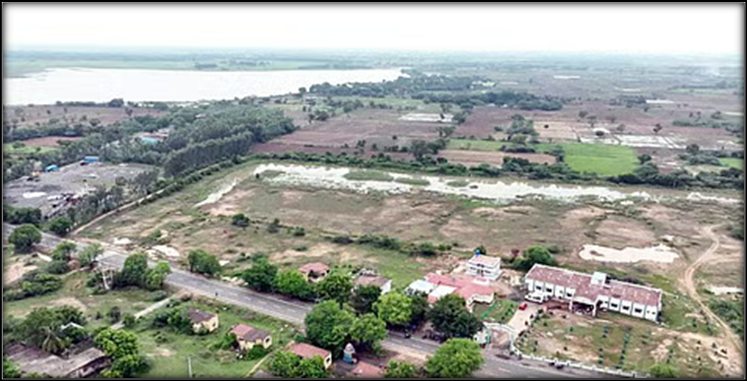
- The proposed airport required approximately 5,846 acres of land, including substantial private agricultural land, creating concerns regarding displacement, loss of farmland and livelihood insecurity.
- The State government indicated that around 3,774 acres constituted private patta land, including approximately 2,681 acres of fertile agricultural land, making the project particularly sensitive from a livelihood perspective.
2. Impact on farmers and rural livelihoods
- Farmers opposed the project because agricultural land was not viewed merely as a financial asset but as a source of livelihood, social identity, inter-generational wealth and community security.
- One-time monetary compensation cannot always adequately compensate for the loss of land-based livelihoods and established rural socio-economic networks.
3. Water bodies and ecological concerns
- The proposed site contained water bodies, canals and natural drainage systems, raising concerns regarding alteration of the area’s natural hydrology.
- Large-scale construction could potentially interfere with water storage, drainage and groundwater systems, increasing the risk of waterlogging and flooding.
4. Environmental clearance concerns
- Despite considerable progress in land acquisition and project planning, the project had not secured all necessary statutory approvals, particularly environmental clearance, according to the State government’s position.
- The episode demonstrates that land acquisition and administrative approvals should not precede comprehensive environmental and social feasibility assessments.
- It also highlights the importance of integrating Environmental Impact Assessment (EIA), hydrological assessment and disaster-risk assessment at the initial planning stage.
5. Persistent public resistance
- Villagers, particularly in and around Ekanapuram, had sustained opposition to the project over several years.
- Prolonged protests demonstrated that social legitimacy is an important component of infrastructure feasibility, alongside financial and technical feasibility.
6. Land acquisition had progressed substantially but the project remained contested
- The project had moved beyond the conceptual stage, with the State government stating that around 1,802 acres, or approximately 48% of the required land, had already been acquired.
- However, the continuation of social and environmental concerns despite substantial land acquisition demonstrates the limitations of treating land availability alone as an indicator of project readiness.
7. Development versus environmental sustainability
- The Parandur controversy represents a classic development–environment dilemma, where infrastructure intended to generate economic growth can simultaneously impose ecological and social costs.
- It demonstrates the need to incorporate ecological carrying capacity, climate risks, hydrological systems and livelihood concerns into infrastructure planning rather than treating them as secondary considerations.
Implications due to the scrapping decision
A. Positive implications
1. Protection of agricultural livelihoods
- Scrapping the project prevents further acquisition of agricultural land and reduces the possibility of large-scale displacement and disruption of rural livelihoods.
- It provides greater security to farmers whose livelihoods and socio-economic networks were closely associated with their land.
2. Environmental and ecological protection
- Avoiding construction over a landscape containing water bodies and natural drainage systems can reduce potential ecological and hydrological disruption.
- It provides an opportunity to prioritise climate-resilient and environmentally sensitive infrastructure planning while selecting an alternative site.
3. Reduction in social conflict
- Cancellation can address prolonged opposition from affected villages and reduce the possibility of continuing protests, litigation and administrative conflict.
- It reinforces the importance of public participation and social consent in large infrastructure projects.
4. Greater emphasis on sustainable infrastructure
- The decision can encourage policymakers to adopt a broader definition of infrastructure feasibility that includes environmental sustainability, social impact and disaster resilience along with economic returns.
B. Negative implications and challenges
1. Chennai’s long-term aviation capacity gap remains unresolved
- Scrapping Parandur does not eliminate Chennai’s growing requirement for additional aviation capacity.
- The government must therefore identify an alternative site that can meet future passenger and cargo demand without reproducing the problems associated with Parandur.
2. Delay in infrastructure expansion
- The cancellation may postpone the creation of additional airport capacity and potentially constrain Chennai’s ability to accommodate future industrial, logistics, tourism and international business growth.
- A prolonged search for an alternative site could result in capacity bottlenecks and higher future infrastructure costs.
3. Sunk costs and resource wastage
- Considerable resources had already been committed towards land acquisition, planning, surveys, compensation and project preparation.
- Scrapping the project creates the possibility that some of these expenditures may become sunk costs, raising questions about the efficiency of infrastructure planning.
4. Policy and investment uncertainty
- Repeated changes in major infrastructure projects can create perceptions of policy uncertainty and project risk among investors.
- Since airports require substantial capital and have long gestation periods, maintaining credible and predictable infrastructure policies is important for attracting private investment.
Way Forward
1. Adopt scientific multi-criteria site selection
- The alternative site should be selected through a transparent framework assessing aviation feasibility, land availability, ecological sensitivity, hydrology, flood risk, population displacement, connectivity and financial viability.
2. Follow “environmental assessment before acquisition”
- Comprehensive EIA, Social Impact Assessment (SIA), hydrological studies and disaster-risk assessments should precede large-scale land acquisition.
- This can prevent a situation where substantial resources are committed before fundamental environmental and social concerns are resolved.
3. Adopt participatory land acquisition
- Local communities should be involved through Gram Sabhas, public consultations and transparent disclosure of project impacts.
- Compensation should be supplemented with livelihood restoration, rehabilitation, skill development and long-term income-support mechanisms.
4. Protect agricultural and ecological assets
- Productive agricultural land, wetlands, lakes and natural drainage channels should receive greater weight during site selection.
- The principle of “avoid, minimise and compensate” should guide infrastructure development in environmentally sensitive areas.
5. Strengthen interim capacity
- Existing airport capacity should be optimised through terminal expansion, improved passenger-processing technology, operational efficiency and better multimodal connectivity.
Conclusion
The way forward is neither indiscriminate infrastructure expansion nor blanket opposition to development. India needs participatory, environmentally sensitive and economically viable infrastructure planning that converts development from a source of displacement into an instrument of inclusive and sustainable growth.
| Important Current To Concept Covered From This Article For UPSC: Airports Authority of IndiaMinistry of Civil AviationBuild-Own-Operate-Transfer model |