
Context
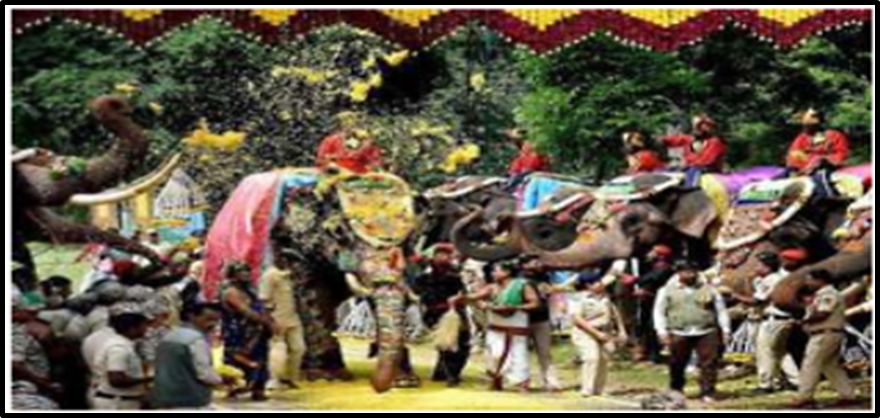
Recently, the Karnataka Forest Department conducted Gajapayana at Veeranahosahalli, on the outskirts of Nagarahole Tiger Reserve, marking the beginning of preparations for Mysuru Dasara; veteran tusker Abhimanyu was given a ceremonial farewell.
The ceremony marks the movement of selected elephants from forest camps towards Mysuru for training ahead of the Vijayadashami Jamboo Savari, following traditional rituals before departure.
What is Mysuru Dasara?
- Historical Origins: The tradition of elephants participating in the royal procession dates to 1610 AD at Srirangapatna, with celebrations traced further to the Vijayanagara Empire and later continued by the Wadiyar dynasty of Mysuru.
- State Festival Status: Mysuru Dasara is designated Karnataka’s Nadahabba (state festival) and is celebrated over ten to eleven days, culminating in the Jamboo Savari on Vijayadashami.
Gajapayana: The March to Mysuru
- Ritual Purpose: Gajapayana, literally the “elephant march,” is the ceremonial journey of selected elephants from forest camps to Mysuru, marking the formal start of Mysuru Dasara preparations.
- Rituals Performed: Before departure, the elephants undergo purification rites and are offered a traditional naivedya, with prayers directed to the forest deity and Goddess Chamundeshwari.
- The 2026 Gajapayana included a ceremonial farewell to tusker Abhimanyu, recognising his service as a member of the Dasara jumbo squad and the Forest Department.
Jamboo Savari and the Golden Howdah
- Golden Howdah: The Jamboo Savari procession on Vijayadashami carries the idol of Goddess Chamundeshwari in a 750-kg golden howdah borne by a specially trained lead elephant.
- Mahout & Kavadi: Each Dasara elephant is cared for by a dedicated mahout (handler) and kavadi (assistant), who train and accompany the animal throughout the festivities.
Why is this article important for UPSC?
- Understanding Gajapayana and Jamboo Savari as recurring Art & Culture topics tied to Karnataka’s Mysuru Dasara festival.
- Awareness of the historical and mythological basis of regional Dasara traditions, a frequent source of Prelims distractors.
- Familiarity with state-designated cultural festivals (Nadahabba) and their administrative and heritage significance.
| Important CTC from this article for UPSC Mysuru Dasara Nagarhole Tiger Reserve |
Q. With respect to the following statements:
I. Gajapayana refers to the ceremonial elephant march that marks the beginning of Mysuru Dasara preparations.
II. The Golden Howdah used to carry the deity during the Jamboo Savari weighs approximately 750 kg.
III. Mysuru Dasara is celebrated primarily to commemorate Lord Rama's victory over Ravana, as described in the Ramayana.
Which of them given above is/are correct?
(a) I and II only
(b) II and III only
(c) I and III only
(d) I, II and III
Answer: (a). I and II only
Explanation
Statement I is Correct: Gajapayana, the ceremonial journey of elephants from forest camps to Mysuru, formally marks the start of preparations for the Mysuru Dasara festivities.
Statement II is Correct: The idol of Goddess Chamundeshwari is carried in a 750-kg golden howdah during the Jamboo Savari procession on Vijayadashami.
Statement III is Incorrect: Mysuru Dasara primarily commemorates Goddess Chamundeshwari's (a form of Durga) victory over the demon Mahishasura, not Lord Rama's victory over Ravana.