
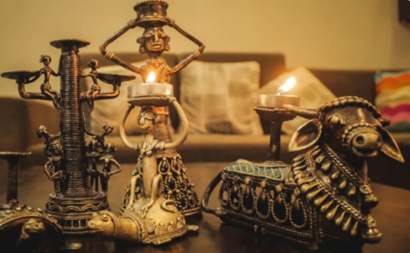
About Dhokra Art
- Dhokra is a traditional non-ferrous metal casting technique, primarily using brass and other copper-based alloys.
- It is traditionally associated with tribal and folk artisan communities of central, eastern and southern India.
- Common products include figurines, animals, lamps, jewellery, utensils and decorative objects.
- Dhokra objects are characterised by handcrafted forms, textured surfaces and intricate detailing.
Lost-Wax Casting Technique
- Dhokra traditionally uses the lost-wax (cire perdue) technique, one of the oldest known methods of metal casting.
- A basic process involves:
- Preparing a wax model of the desired object.
- Covering it with layers of clay to form a mould.
- Heating the mould so that the wax melts and escapes.
- Pouring molten metal into the cavity.
- Breaking the clay mould to obtain the final metal object.
- Since the mould is generally broken after casting, each piece is essentially unique.
Key Features
- Material: Mainly brass/copper-based alloys.
- Technique: Lost-wax casting.
- Character: Handmade and highly detailed.
- Design motifs: Animals, human figures, deities, folk life and nature.
- Cultural significance: Reflects the material culture, beliefs and everyday life of artisan and tribal communities.
Dhokra in India: Key Regions
| Region/State | Important Dhokra Tradition |
| West Bengal | Bankura–Bikna tradition |
| Odisha | Dhokra craft among traditional artisan communities |
| Chhattisgarh | Tribal metal craft traditions |
| Jharkhand | Traditional Dhokra metalwork |
| Madhya Pradesh | Bastar-region metal craft traditions |
| Telangana | Dhokra artisan traditions |
GI Significance
- Dhokra craft traditions from different regions have received Geographical Indication (GI) recognition, reflecting their distinctive regional identity and craftsmanship.
- Bikna Dhokra of Bankura, West Bengal, is particularly associated with the traditional Dhokra craft of the region.
Conclusion
Dhokra represents the continuity of India’s ancient lost-wax metal-casting tradition, combining indigenous craftsmanship, cultural expression and livelihood generation.
| This concept has been elaborately discussed in the Dhokra Craft and Tribal Heritage of Chhattisgarh |