
Context
- A recent study has estimated the Total Economic Value (TEV) of the Pichavaram Mangrove Ecosystem at ₹2,485.38 crores, highlighting the economic importance of mangroves through ecosystem services and blue-carbon storage.
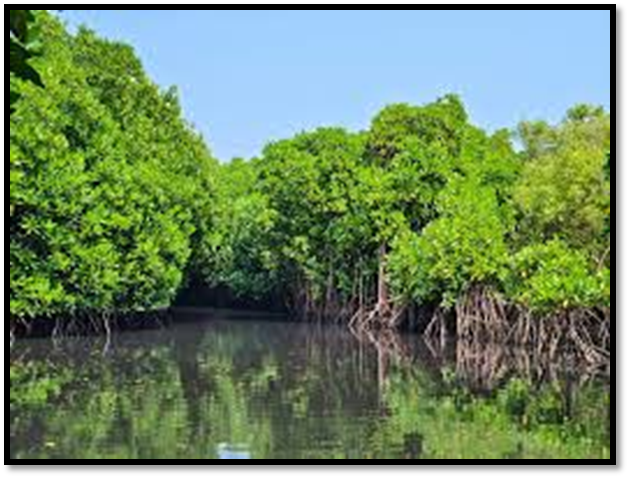
Pichavaram Mangroves Ecosystem
- Location: Cuddalore district, Tamil Nadu, near Chidambaram.
- Ecosystem: Mangrove and coastal wetland with interconnected backwaters and channels.
- Importance: Supports biodiversity, fisheries, coastal protection and climate regulation. It is a designated as a Ramsar Site
Mangrove: The Coastal Ecosystem
- Mangroves are salt-tolerant woody plants found mainly in tropical and subtropical intertidal zones.
- These ecosystems thrive in high-rainfall areas (1,000–3,000 mm) with temperatures ranging from 26°C to 35°C.
- They occur along estuaries, deltas, tidal creeks, lagoons and sheltered coastlines.
- They are adapted to salinity, waterlogging and low-oxygen soils.
- Special adaptations include pneumatophores, prop roots and salt-excretion mechanisms in different species.
- Ecological Importance
- As per World Wildlife Fund mangroves store 7.5–10 times more carbon per acre than tropical forests.
- Provide breeding and nursery grounds for fish, crustaceans and other organisms.
- Protect coastlines from erosion, storm surges and cyclones.
- Support fisheries and coastal livelihoods.
- Store significant amounts of carbon in biomass and sediments.
- Contribute to biodiversity conservation and climate adaptation.
About Carbon Sequestration, Carbon Storage & Carbon Sink
| Concept | Meaning |
| Carbon Sequestration | Process of capturing CO₂ from the atmosphere and storing it in biomass, soil, oceans or geological formations. |
| Carbon Storage | Carbon already held in biomass, soil, sediments, oceans or geological formations. |
| Carbon Sink | A natural or artificial system that absorbs more carbon than it releases. |
Green Carbon vs Blue Carbon
| Green Carbon | Blue Carbon |
| Mainly associated with terrestrial ecosystems | Associated with coastal and marine ecosystems |
| Forests, grasslands, agricultural ecosystems | Mangroves, seagrass, salt marshes |
| Stored in vegetation and soils | Stored significantly in biomass and coastal sediments |
Key Important Terms
- Total Economic Value (TEV): A framework used in environmental economics to value both market (use) and non-market (non-use) benefits of an ecosystem, including provisioning, regulating, supporting, and cultural services.
- Payment for Ecosystem Services (PES): A market-based mechanism where beneficiaries of ecosystem services pay providers (often local communities) to maintain or restore the ecosystem.
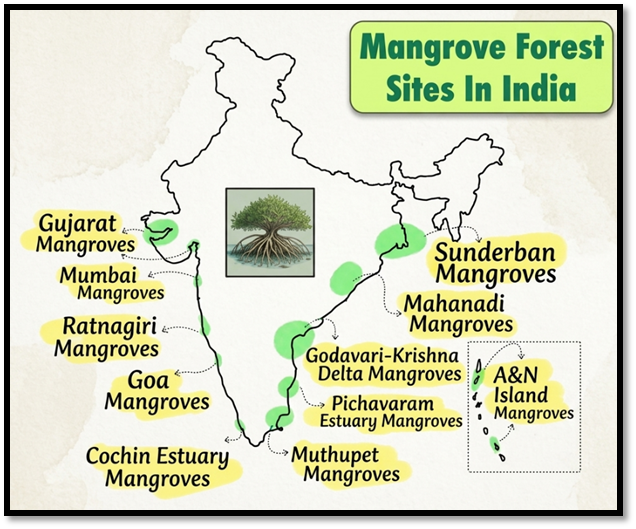
India’s Progress in Mangrove Conservation: As per the India State of Forest Report 2023 (ISFR-2023)
- Total Mangrove Cover (2023): 4,991.68 sq. km, covering 0.15% of India’s geographical area.
- Long-term growth: Increased by 363.68 sq. km (7.86%) between 2013–2023.
- Overall growth: Increased by 509.68 sq. km (11.4%) between 2001–2023.
- Largest share: West Bengal – 42.45%, followed by Gujarat – 23.32% and Andaman & Nicobar Islands – 12.19%.
- Gujarat’s progress: Mangrove cover increased by 253.06 sq. km (2001–2023), supported by plantations, community participation and public-private partnerships.
| Important CTC from this article for UPSC: Pichavaram Mangroves Carbon Sequestration |
Q. With reference to mangroves and blue carbon, consider the following statements:
1. Mangroves are important blue-carbon ecosystems because they store carbon in both biomass and sediments.
2. Pichavaram Mangroves are located in Tamil Nadu and are associated with the Vellar–Coleroon river system.
3. Blue carbon refers exclusively to carbon stored in terrestrial forests and grasslands.
Which of the statements given above is/are correct?
A. 1 and 2 only
B. 2 and 3 only
C. 1 and 3 only
D. 1, 2 and 3
Answer: A. 1 and 2 only
• Statement 1 is Correct: Mangroves store substantial carbon in vegetation, roots, soils and sediments.
• Statement 2 is Correct: Pichavaram is a major mangrove ecosystem of Tamil Nadu, located between the Vellar and Coleroon river systems.
• Statement 3 is Incorrect: Blue carbon is associated with coastal and marine ecosystems such as mangroves, seagrasses and salt marshes.