
Introduction
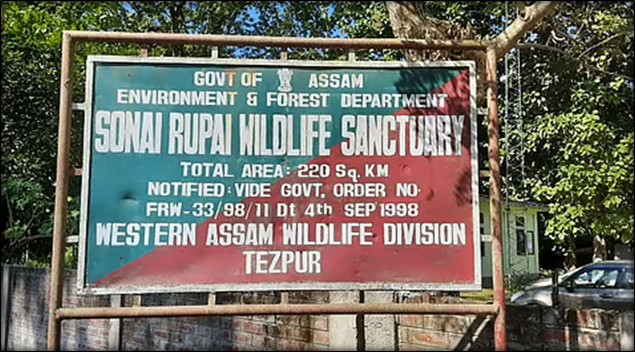
Sonai Rupai Wildlife Sanctuary, situated in Assam’s Eastern Himalayan foothills, is a 220-km² protected landscape linking forest, grassland and riverine ecosystems, supporting elephants and diverse wildlife.
Location
- It is located in Sonitpur district of Assam, along the foothills of the Eastern Himalayas adjoining Arunachal Pradesh.
- The sanctuary covers 220 km² and was formally notified as a Wildlife Sanctuary in 1998.
- It forms part of the wider North Bank Brahmaputra ecological landscape and is contiguous with forested areas towards Arunachal Pradesh.
Features
- The landscape contains four perennial rivers—Dolsiri, Gabharu, Gelgeli and Belsiri, along with seasonal wetlands locally called bheels.
- Its Eastern Himalayan foothill setting creates a transition between plains and hill ecosystems, enhancing habitat diversity.
- 120 km² of the sanctuary was notified in 2015 as a Satellite Core of Nameri Tiger Reserve, strengthening its role in tiger and elephant conservation.
Ecological Significance
- Elephant landscape: Sonai Rupai and Nameri together form part of the Sonitpur–Kameng Elephant Reserve, providing habitat and movement space for Asian elephants.
- Large herbivores: The sanctuary supports Asian elephant, gaur, sambar, hog deer and barking deer, sustaining important herbivore–carnivore interactions.
- Carnivore habitat: Leopard and dhole (wild dog) occur in the sanctuary, while tiger movement has been documented during recent ecological recovery.
- Avian significance: Species of conservation importance include White-winged Wood Duck, Great Hornbill, Wreathed Hornbill, Oriental Pied Hornbill and Bengal Florican.
- Vegetation diversity: Forest types include tropical evergreen, semi-evergreen and moist deciduous forests, alongside cane brakes, swamp forests, savanna woodland and alluvial grasslands.
- Key native vegetation: Important species include Hollong, Hollock, Nahar, Mekai, Dhuna and Udiyam, while riverine grasslands provide feeding grounds for herbivores.
- Landscape connectivity: Its location between Nameri–Pakke and other North Bank Brahmaputra forests makes it significant for maintaining wildlife movement and genetic connectivity.
Conservation Efforts & Legislative Framework
- Wildlife (Protection) Act, 1972: The sanctuary receives statutory protection against hunting and habitat exploitation as a notified Wildlife Sanctuary.
- 2015 Satellite Core status: The 120-km² core under Nameri Tiger Reserve brought enhanced protection and scientific management for tiger habitat.
- Eco-Sensitive Zone (ESZ): Notification of an ESZ around Sonai Rupai provides an additional regulatory buffer against environmentally damaging activities.
- Project Tiger framework: Integration with the Nameri Tiger Reserve landscape enables camera-trapping, patrolling, habitat management and monitoring of tiger movement.
- Landscape-level conservation: Protection of elephant corridors and connectivity with Arunachal Pradesh forests is particularly important for reducing fragmentation of large-mammal habitats.
Conclusion
Sonai Rupai represents a critical Eastern Himalayan–Brahmaputra ecological link; restoring degraded habitats, securing wildlife corridors, controlling encroachment and strengthening community-based protection can enhance long-term biodiversity resilience
| This Concept Has Been Mentioned In The Article: Pygmy Hog Conservation: From Species Recovery to Alluvial Grassland Restoration |