
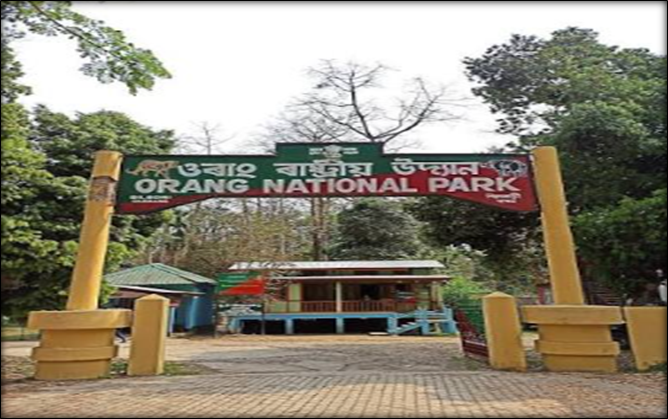
Introduction
Orang National Park, a Brahmaputra floodplain ecosystem in Assam, is renowned for its one-horned rhinoceros, grasslands, wetlands and high avian diversity, making it a significant biodiversity refuge.
Location
- Located on the northern bank of the Brahmaputra, primarily across Udalguri and Sonitpur districts of Assam.
- The National Park presently covers about 78.81 sq km in its original notified area; subsequent additions have expanded the broader Orang Tiger Reserve landscape to 279.28 sq km.
- It forms part of the Brahmaputra floodplain ecosystem, characterised by seasonal flooding, wetlands and alluvial grasslands.
Key Features
- Oldest game reserve of Assam, subsequently notified as a National Park in 1999.
- The landscape comprises alluvial grasslands, wetlands, riverine vegetation and woodland patches, supporting diverse terrestrial and aquatic fauna.
- It is now recognised as Orang National Park & Tiger Reserve, strengthening its importance for large carnivore conservation.
Ecological Significance
- Rhino conservation: Orang supports a significant population of the Greater One-horned Rhinoceros (Rhinoceros unicornis); Assam records show 101 rhinos in Orang in 2018, compared with 46 in 1999.
- Tiger habitat: Grassland–wetland mosaics provide prey and habitat for tigers, making Orang an important component of Assam’s tiger landscape.
- Avifaunal hotspot: About 222 bird species have been recorded, including Bengal Florican, Greater Adjutant, Lesser Adjutant, Spot-billed Pelican and Brahminy Duck.
- Aquatic biodiversity: Wetlands support diverse fish populations and function as breeding grounds for several aquatic species.
- Native wildlife: Besides rhino and tiger, the park supports hog deer, wild pig, elephant, civets, porcupine, Gangetic dolphin, Indian rock python, king cobra and seven turtle/tortoise species.
- Native vegetation: Predominantly tall alluvial/riverine grasslands, interspersed with wetland vegetation and tropical deciduous/riverine woodland, providing feeding and breeding niches for herbivores and birds.
Ecological Conservation & Legislative Framework
- Wildlife (Protection) Act, 1972: Provides the principal legal framework for National Park protection, anti-poaching measures and species protection. A
- Environment (Protection) Act, 1986: Enables regulation of activities that may adversely affect fragile ecosystems surrounding protected areas.
- Forest (Conservation) Act, 1980: Restricts diversion of forest land for non-forest purposes, supporting habitat conservation.
- Biological Diversity Act, 2002: Strengthens conservation and sustainable use of biological resources and associated knowledge.
- Indian Rhino Vision 2020: Assam’s rhino-conservation programme promoted rhino population expansion through translocation to suitable habitats, demonstrating landscape-level conservation.
- Protected Area Network: Orang forms part of Assam’s wider protected-area system comprising National Parks, Wildlife Sanctuaries, Tiger Reserves and Elephant Reserves.
Conclusion
Orang exemplifies floodplain conservation, where grasslands, wetlands and flagship species coexist; strengthening habitat connectivity, scientific monitoring, community participation and climate-resilient management can secure its ecological future.
| This Concept Has Been Mentioned In The Article: Pygmy Hog Conservation: From Species Recovery to Alluvial Grassland Restoration |