
Context
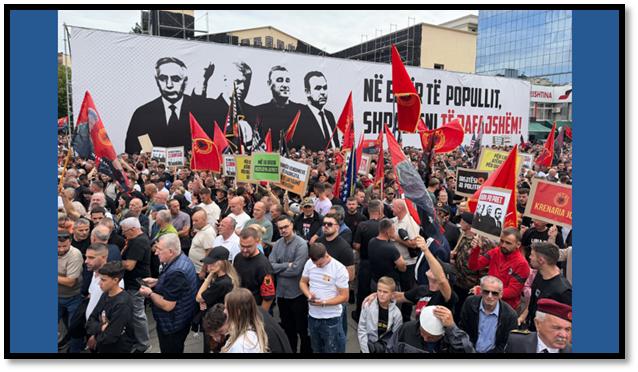
- Hashim Thaçi, the former President of Kosovo and a prominent former leader of the Kosovo Liberation Army (KLA), has been sentenced to 25 years in prison by special European Union-backed court at The Hague.
Escalation of Conflict & Kosovo’s Independence
- The Kosovo Liberation Army (KLA) was formed — an ethnic Albanian militant force seeking Kosovo’s independence from Serbia and Yugoslavia.
- War & Intervention: KLA attacks triggered a Serbian military crackdown, causing the displacement of hundreds of thousands and nearly 13,000 deaths, mostly ethnic Albanians.
- NATO Intervention: The hostilities ended after NATO launched air strikes and bombardments against Serbian targets, forcing Serbian forces to withdraw.
- Declaration of Independence: In 2008, Kosovo unilaterally declared independence from Serbia. While recognized by the United States and several European nations, it is not recognized as an independent state by Serbia, India, or the United Nations.
What Was the Trial For?
- The case was heard by the Kosovo Specialist Chambers, a special tribunal backed by the European Union and constituted in The Hague in 2016.
- Its mandate was to examine crimes linked to the KLA’s insurgency and the broader conflict of the 1990s.
- The tribunal’s creation followed a Council of Europe report (the “Marty report,” 2010) that alleged the KLA had run secret detention centres where Serbians were subjected to inhumane treatment, including claims of organ trafficking from prisoners.
What is the Kosovo Specialist Chambers?
- The KSC is a specialized domestic (national) court of Kosovo, not a UN or international tribunal.
- While legally attached to Kosovo’s judicial hierarchy, it is physically located in The Hague, Netherlands.
- The KSC was created following an Exchange of Letters between Kosovo and the European Union in 2014.
- The Kosovo Assembly subsequently adopted Article 162 of the Kosovo Constitution and the Law on Specialist Chambers and Specialist Prosecutor’s Office on 3 August 2015.
Structure of the KSC; The KSC consists principally of:
1. Chambers
- Perform the judicial functions.
- Include international judges.
- Have panels for Pre-Trial, Trial, Appeals, Supreme Court and Constitutional Court functions.
2. Registry
- Provides administrative and judicial support
- Handles functions including detention, legal aid, victims’ participation, interpretation and translation.
| Important CTC from this article for UPSC: Court of Justice of the European Union (CJEU) |
Q. Consider the following statements regarding the recent verdict involving Hashim Thaçi:
1. Hashim Thaçi was a former President of Kosovo and a former commander of the Kosovo Liberation Army (KLA).
2. The Kosovo Specialist Chambers that delivered the verdict is located in The Hague, Netherlands.
3. The Kosovo conflict primarily took place during 1998–1999 and involved the KLA and Serbian/Yugoslav forces.
4. The Kosovo Specialist Chambers is a judicial organ of the European Union.
Which of the statements given above are correct?
(a) 1, 2 and 3 only
(b) 1 and 4 only
(c) 2 and 3 only
(d) 1, 2, 3 and 4
Answer: (a) 1, 2 and 3 only
• Statement 1 is Correct: Hashim Thaçi was a prominent KLA leader and later served as President of Kosovo.
• Statement 2 is Correct: The Kosovo Specialist Chambers (KSC) is based in The Hague, Netherlands.
• Statement 3 is Correct: The Kosovo War occurred mainly in 1998–1999, involving the KLA and Serbian/Yugoslav forces.
• Statement 4 is Incorrect: The KSC is not an EU judicial organ. It was established under Kosovo's legal framework and operates with substantial international, including EU, support.