

Context
- Building on the successful implementation of Semicon 1.0, the Union Cabinet approved Semicon 2.0 with an outlay of Rs 1,27,500 crore.
About Semicon 2.0
- Semicon 2.0 is the next phase of India’s semiconductor development programme, building upon the foundation established under Semicon 1.0.
- Semicon 1.0, approved in December 2021, had an outlay of ₹76,000 crore and focused on establishing a domestic semiconductor and display manufacturing ecosystem.
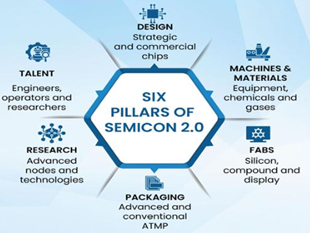
- Semicon 2.0 seeks to expand India’s capabilities beyond fabs and ATMP/OSAT facilities to create a complete semiconductor value chain.
- Semicon 1.0 concentrated mainly on fabs and ATMP/OSAT plants, Semicon 2.0 adds machines and materials, design, research and talent to the mission.
Why Semiconductor Autonomy Matters
- Strategic Importance: Semiconductors are a strategic resource for economic growth, technological leadership and national security.
- Global Concentration: Taiwan, South Korea, Japan, China and the United States dominate global semiconductor manufacturing.
- Taiwan’s Dominance: Taiwan accounts for over 60% of global chip production and nearly 90% of advanced chips.
- India’s Approach: India is focusing on trusted international partnerships alongside strengthening domestic semiconductor capabilities.
What is a Semiconductor?
- A semiconductor is a material whose electrical conductivity can be controlled, enabling it to switch, amplify, sense and control electrical signals.
- Conductors allow current to flow easily, insulators resist it, while semiconductors can be engineered to switch, amplify, sense and control electrical signals.
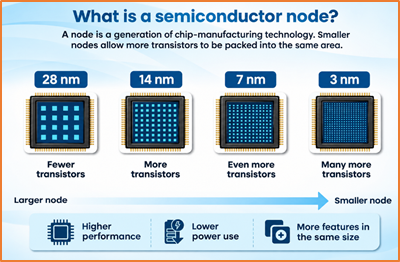
- A transistor is a microscopic electronic switch. Modern chips integrate millions or billions of transistors, enabling computing, communication, sensing, memory and power management.
- Semiconductors power smartphones, computers, automobiles, medical devices, defence systems, satellites and data centres-the building blocks of modern electronics.
Major Semiconductor Manufacturing Units in India
| Company | Location |
| Micron Technology | Sanand, Gujarat |
| Kaynes Semicon | Sanand, Gujarat |
| Tata Electronics | Dholera, Gujarat |
| Tata Electronics | Morigaon, Assam |
| CG Power + Renesas + Stars | Sanand, Gujarat |
| SiCSem | Odisha |
| CDIL | Mohali, Punjab |
| ASIP Technologies | Andhra Pradesh |
Conclusion
India is moving from chip design and consumption towards a complete semiconductor ecosystem, covering manufacturing, packaging, research and talent.
Semicon 2.0 can deepen domestic capabilities, strengthen supply-chain resilience and support India’s transition towards semiconductor self-reliance.
| Important CTC from this article for UPSC What are Semiconductors Semicon 2.0 |