
After Reading This Article You Can Solve This UPSC Mains Model Question:
Critically analyse the strategic implications of space weaponisation on global security and evaluate India’s preparedness to safeguard its orbital assets. 15 Marks (GS 3 Science & Tech )
Context
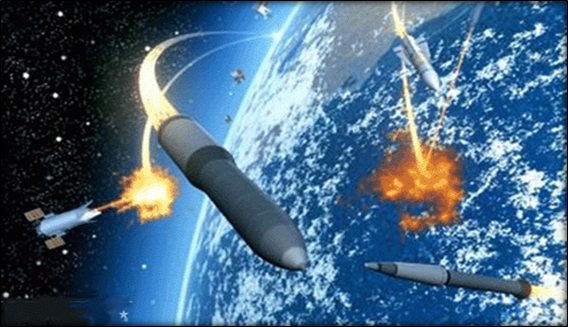
Although U.S. military doctrine has openly considered space control by 2025, recent admissions by defense officials regarding the deployment of “on-orbit space control weapons” to counter hostile actions have blurred the lines between defensive and offensive capabilities.
Introduction
Outer space is rapidly evolving from a domain of peaceful exploration into the “fourth frontier of war.” With modern civilian and military infrastructures highly dependent on dual-use satellite systems, unregulated orbital weaponisation threatens global stability and exposes critical voids in international humanitarian law.
Strategic Importance of Space Capabilities
- Critical Infrastructure Backbone: Space systems are indispensable for the continuous functioning of the global civilian economy, banking, and aviation.
- Military Force Multiplication: Modern defense forces rely entirely on space architectures for real-time intelligence, surveillance, and reconnaissance (ISR).
- Strategic Deterrence: Developing indigenous counter-space capabilities preserves national assets from unprovoked adversarial strikes and ensures strategic autonomy.
- Independent Treaty Verification: Autonomous reconnaissance assets allow nations to independently monitor global compliance with nuclear and arms control treaties.
- Real-Time Border Security: Advanced optical and radar imaging satellites enable continuous tracking of hostile troop movements and illegal maritime activities.
Militarisation vs. Weaponisation
- Militarisation: The use of space-based assets to assist terrestrial armies via command, control, communication, surveillance, and reconnaissance .
- Weaponisation: The transformation of outer space itself into a battlefield, involving the placement of orbital interceptors, direct-ascent missiles, or directed-energy weapons designed to attack enemy assets.
Why Space is a Security Domain
- Critical Infrastructure Reliance: Civilian services such as telecommunications, weather forecasting, and disaster management run entirely on space-based networks.
- Dual-Use Ambiguity: Commercial satellites frequently serve both civilian and military users, making them prime targets during geopolitical conflicts.
- Cyber & Electronic Vulnerabilities: Ground stations and satellites face growing non-kinetic threats, including signal jamming, spoofing, and cyberattacks.
Major Types of Counter-Space Weapons
- Direct-Ascent ASAT Weapons: Ground-launched missiles designed to physically intercept and destroy satellites in orbit.
- Co-orbital Weapons: Systems placed into orbit capable of approaching, inspecting, or disabling another satellite.
- Electronic & Cyber Warfare: Jamming and spoofing techniques that disrupt navigation signals without physically destroying the hardware.
- Directed-Energy Weapons: High-powered lasers designed to blind satellite sensors or damage onboard systems.
Global Legal Architecture & Treaties
- Outer Space Treaty (1967): Mandates peaceful use and prohibits deploying weapons of mass destruction (WMDs) in orbit or claiming national sovereignty over celestial bodies.
- Liability Convention (1972): Establishes that the launching state is absolutely liable for damages caused by its space objects on Earth or to aircraft.
- Registration (1975) & Rescue (1968) Agreements: Mandates the registration of space objects to improve transparency and requires states to assist astronauts in distress.
- Prevention of an Arms Race in Outer Space (PAROS): A UN framework stressing the avoidance of an arms race and promoting peaceful space exploration.
India’s Space Security Paradigm
- Institutional Evolution: Transitioned from INCOSPAR (1962) to ISRO, and more recently established the Defence Space Agency (DSA) in 2019 to act as an aerospace command.
- Mission Shakti (2019): Successfully demonstrated Anti-Satellite (ASAT) capabilities, making India the fourth nation globally to possess such deterrence.
- Space Situational Awareness (SSA): Enhancing tracking capabilities for satellites and debris via Project NETRA and the IS4OM management system to ensure safe orbital operations.
Challenges of Space Weaponisation
- The Kessler Syndrome: Destructive kinetic attacks generate massive, untrackable space debris, permanently threatening long-term orbital sustainability.
- Dual-Use Ambiguity and Law of War: Because interconnected commercial satellites increasingly serve military functions, distinguishing legitimate targets under international humanitarian law is exceedingly difficult.
- Regulatory Voids: The 1967 Outer Space Treaty prohibits WMDs but offers insufficient guardrails against modern conventional orbital weapons, cyberattacks, and AI-driven autonomous systems.
- Escalation and Miscalculation Risks: Unclear definitions of “hostile action” combined with automated defensive satellite strikes create extreme instability, risking rapid terrestrial escalation.
- Orbital Monopolization: Accelerated military deployment by advanced powers risks monopolizing limited orbital slots and radio frequencies, marginalizing developing nations’ access.
Way Forward
- Define Multilateral Thresholds: Governments must negotiate precise definitions of “hostile action” and escalation thresholds through the UN Open-Ended Working Group on PAROS.
- Modernize the Legal Framework: Revisit existing treaties to explicitly address accountability for autonomous, AI-driven defensive strikes and commercial dual-use assets.
- Enhance Space Situational Awareness (SSA): Nations must universally share unclassified tracking data to prevent accidental collisions and misinterpretations of proximity operations.
- Institute Transparency & CBMs: Implement mandatory Confidence-Building Measures (CBMs), such as pre-launch notifications and direct hotlines, to mitigate mutual suspicion.
- Democratize Technology and Access: Promote legitimate access to outer space and technology transfers to ensure orbital slots are not monopolized by a few hegemonic military powers.
- Integrate Cyber and Electronic Safeguards: Prioritize the resilience of space networks and ground stations against non-kinetic threats like signal jamming and cyber-intrusions.
Conclusion
The weaponisation of space threatens to convert the ultimate global commons into a highly volatile theater of conflict. Ensuring stability requires robust Space Situational Awareness, responsible deterrence, and an urgently updated multilateral legal framework to preserve orbital space for peaceful human advancement.
| Important Current to Concept (CTC) from this Article for UPSC: 1. Anti-satellite weapons (ASAT) 2. Kessler Syndrome |