
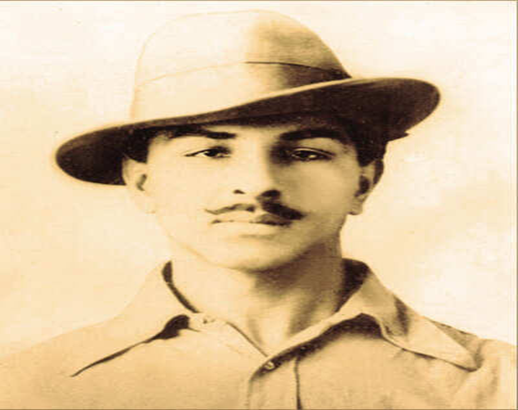
About Shaheed Bhagat Singh
- Shaheed Bhagat Singh (1907–1931), honoured as Shahid-e-Azam (“Great Martyr”), was a revolutionary nationalist and socialist thinker, executed by the colonial government at 23.
- Through the Naujawan Bharat Sabha and HSRA, he sought to transform revolutionary nationalism into a politically conscious, socialist mass struggle.
Early Life & Revolutionary Organisations
- Birth: 28 September 1907 (some sources cite 27 September) at Banga, Punjab (present-day Pakistan), in a Sikh family active in the independence movement.
- Ideological Awakening: Shaped by the 1919 Jallianwala Bagh massacre and the 1921 Akali protests; supported Gandhi’s Non-Cooperation Movement until its suspension after the Chauri Chaura incident (1922), then turned to revolutionary nationalism.
- Naujawan Bharat Sabha (1926): Founded to educate and rally youth, workers and peasants against British rule on secular, anti-imperialist lines.
- HSRA (1928): With Chandrashekhar Azad and Sukhdev, helped reorganise the Hindustan Republican Association into the HSRA, formally adopting an egalitarian socialist republic as its goal.
Major Anti-Colonial Actions
- Saunders Assassination (1928): To avenge Lala Lajpat Rai, who died of injuries from a police lathi charge, Bhagat Singh, Shivaram Rajguru and Chandrashekhar Azad targeted police chief James Scott but, by mistaken identity, shot Assistant Superintendent J. P. Saunders in Lahore.
- Central Legislative Assembly Bombing (8 April 1929): With Batukeshwar Dutt, threw two low-intensity, non-lethal smoke bombs in the Assembly at Delhi to protest the Public Safety Bill and Trade Disputes Bill; their stated aim was “to make the deaf hear”. They scattered pamphlets, shouted Inquilab Zindabad (“Long Live the Revolution”) and courted arrest to turn the trial into a platform.
Ideology & Writings
- Socialism & Rationalism: A reader of Karl Marx, Vladimir Lenin and Mikhail Bakunin; expressed his rejection of religious orthodoxy in the 1930 essay “Why I Am an Atheist”.
- Redefining Revolution: Held that liberation meant overthrowing capitalism and ending the “exploitation of man by man and nation by nation”, not merely transferring power from British administrators to Indian elites.
Hunger Strike, Execution & Legacy
- Prison Hunger Strike: In Lahore Jail, he and his comrades fasted for 116 days demanding humane treatment and political-prisoner status.
- Execution: Convicted in the Lahore Conspiracy Case, Bhagat Singh, Shivaram Rajguru and Sukhdev Thapar were hanged on 23 March 1931 in Lahore Central Jail.
- Shaheed Diwas: 23 March is observed as Martyrs’ Day in their honour.
Conclusion
Bhagat Singh combined revolutionary action, through the Saunders assassination and the 1929 Assembly bombing, with socialist and rationalist thought expressed in Why I Am an Atheist.
His 116-day hunger strike and execution on 23 March 1931 made him an enduring symbol of anti-colonial sacrifice, commemorated as Shaheed Diwas.
| This concept has been elaborately discussed in the following article — Tribute to Shaheed Bhagat Singh |