
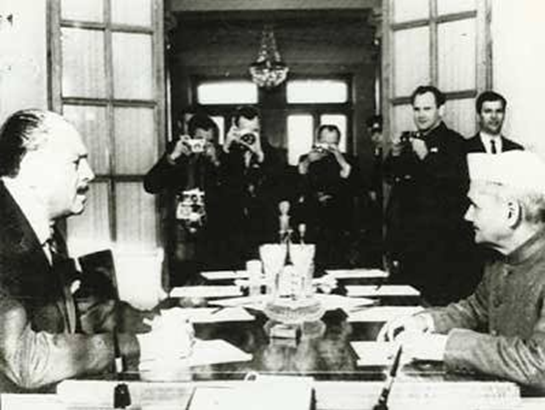
About the Tashkent Declaration
- The Tashkent Declaration is the peace agreement signed on 10 January 1966 at Tashkent (then in the Uzbek SSR, USSR) by Indian Prime Minister Lal Bahadur Shastri and Pakistani President Muhammad Ayub Khan, formally ending the 17-day Indo-Pakistani War of 1965.
- The summit was hosted and chaired by Soviet Premier Alexei Kosygin, and followed the ceasefire demanded by UN Security Council Resolution 211 (20 September 1965).
Background to the Tashkent Agreement
- Operation Gibraltar: Pakistan’s covert infiltration of armed personnel into Jammu and Kashmir in August 1965, which set off the conflict.
- Operation Grand Slam: Pakistan’s armoured thrust in the Chhamb–Akhnoor sector in September 1965, widening the war across the international border.
- Military Stalemate: Heavy fighting at Asal Uttar and Chawinda, together with India’s capture of the Haji Pir Pass, ended in a costly deadlock for both armies.
- International Pressure: UNSC Resolution 211 demanded a ceasefire; US–UK arms embargoes and economic strain pushed both states towards Soviet mediation, backed by US President Lyndon B. Johnson and British PM Harold Wilson.
Key Provisions of the Tashkent Declaration
- Troop Withdrawal: All armed personnel to be pulled back by 25 February 1966 to positions held before 5 August 1965, requiring India to return Haji Pir and Tithwal.
- Diplomatic Restoration: Return of High Commissioners and normal functioning of missions under the 1961 Vienna Convention, with resumption of trade, transport and communication links.
- Peaceful Settlement & Non-Interference: Reaffirmed the UN Charter obligation to settle disputes peacefully without use of force, to avoid interference in internal affairs and to discourage hostile propaganda.
- Prisoners & Refugees: Orderly repatriation of prisoners of war (POWs), with continued discussion on refugees and property.
- Kashmir: Clause I only noted that Jammu and Kashmir was discussed and that each side stated its position; Shastri refused to treat the issue as negotiable.
Aftermath & Impact
- Death of Shastri: Died at Tashkent on 11 January 1966, a day after signing; the official cause was a heart attack, though the circumstances remain debated.
- Reaction in India: Criticism for surrendering Haji Pir without securing a no-war pact or an end to Pakistan-backed infiltration in Kashmir.
- Reaction in Pakistan: Foreign Minister Zulfikar Ali Bhutto broke with Ayub Khan over the accord and founded the Pakistan People’s Party (PPP) in 1967; Ayub Khan’s government fell in 1969.
- Soviet Role: Marked the USSR’s emergence as a major mediator in South Asian affairs.
Conclusion
The Tashkent Declaration (10 January 1966) restored the pre-conflict territorial and diplomatic position between India and Pakistan after the 1965 war, under Soviet mediation by Alexei Kosygin. It committed both sides to UN Charter principles of peaceful settlement and non-interference, left Kashmir formally unresolved, and is also remembered for the death of Lal Bahadur Shastri on 11 January 1966.
| This concept has been elaborately discussed in the following article – Tribute to Lal Bahadur Shastri on his Birth Anniversary |