
Context
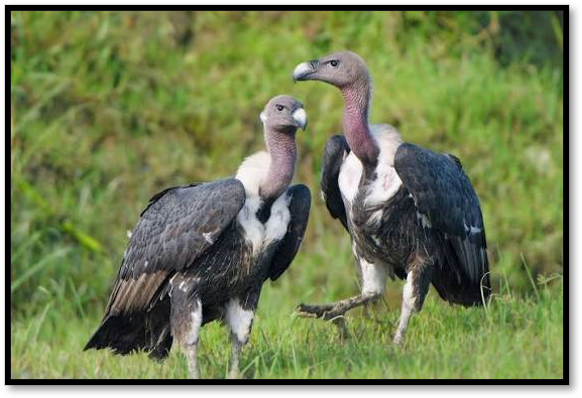
- Recently, a two-day synchronous vulture survey in the Wayanad Wildlife Sanctuary (WWS), Kerala, recorded 65 vultures, comprising 54 White-rumped Vultures and 11 Red-headed Vultures.
Vulture Species in India
India is home to 9 species of vultures, belonging mainly to the Accipitridae family:
| Species Name (Common & Scientific) | Resident / Migratory | IUCN Red List Status | Key Habitat / Features |
| White-rumped Vulture | Resident | Critically Endangered (CR) | Plains and open forests; builds nests on tall trees (Banyan, Peepal). |
| Indian Vulture / Long-billed Vulture | Resident | Critically Endangered (CR) | Prominent in hilly areas and peninsular cliffs; nests on rocky ledges. |
| Slender-billed Vulture | Resident | Critically Endangered (CR) | Found north of the Ganges, Sub-Himalayan belt, and Northeast India. |
| Red-headed Vulture / King Vulture | Resident | Critically Endangered (CR) | Distinctive bare red head and neck; solitary or paired feeder. |
| Egyptian Vulture | Resident & Migratory | Endangered (EN) | Small size, yellow face, white plumage; known for tool use (breaking eggs with stones). |
| Cinerous Vulture | Winter Migrant | Near Threatened (NT) | Massive wingspan; migrates from Eurasia to northern and western India. |
| Himalayan Griffon | Resident / High-altitude | Near Threatened (NT) | Trans-Himalayan and high-altitude regions; winters in northern plains. |
| Eurasian Griffon | Winter Migrant | Least Concern (LC) | Migrates from Europe/Central Asia to northern India during winter. |
| Bearded Vulture / Lammergeier | Resident (Himalayas) | Near Threatened (NT) | High Himalayas; unique diet consisting primarily of bone marrow. |
Why Are Vultures Important?
- Obligate scavengers that rapidly consume animal carcasses.
- Remove carcasses, recycle nutrients, and maintain ecosystem sanitation.
- Their decline can increase carcass accumulation, feral scavenger populations, and disease-transmission risks.
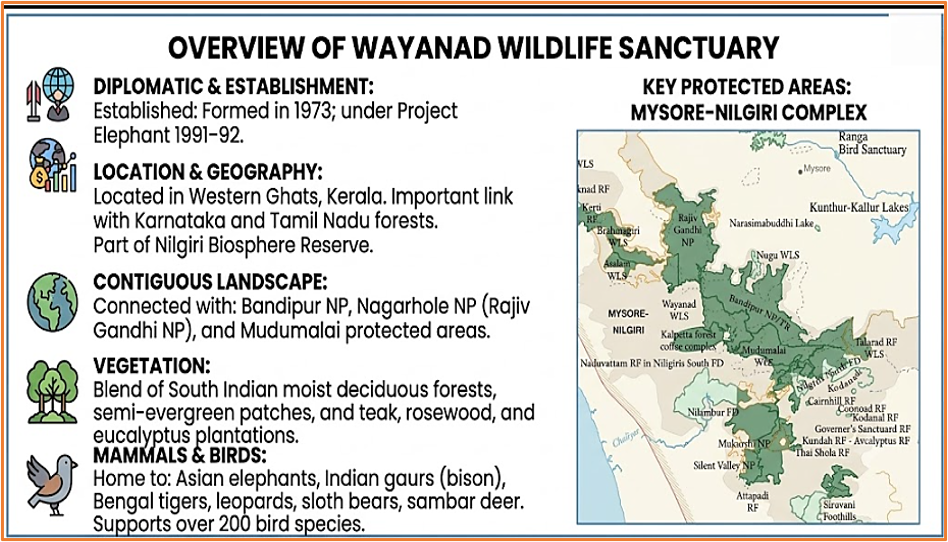
| Important CTC from this article for UPSC: Wayanad Wildlife Sanctuary |
Q. Consider the following statements regarding vultures in India:
1. White-rumped Vulture is classified as Critically Endangered in the IUCN Red List.
2. Red-headed Vulture is also classified as Critically Endangered.
3. Wayanad Wildlife Sanctuary forms part of the Nilgiri Biosphere Reserve.
4. Diclofenac was one of the major causes of the decline of South Asian Gyps vultures.
Which of the statements given above are correct?
A. 1, 2 and 3 only
B. 1, 3 and 4 only
C. 1, 2, 3 and 4
D. 2 and 4 only
Explanation:
• Statement 1 is Correct: White-rumped Vulture (Gyps bengalensis) is Critically Endangered.
• Statement 2 is Correct: Red-headed Vulture (Sarcogyps calvus) is also Critically Endangered.
• Statement 3 is Correct: Wayanad Wildlife Sanctuary is part of the Nilgiri Biosphere Reserve.
• Statement 4 is Correct: Veterinary diclofenac caused widespread mortality among Gyps vultures, contributing significantly to their population collapse.