
After Reading This Article You Can Solve This UPSC Mains Model Question:
The right to peaceful protest is an essential feature of democracy, but it must be balanced against public order and the rights of other citizens. Discuss in the light of constitutional provisions and judicial pronouncements. 10 marks (GS2, Indian Polity)
Context
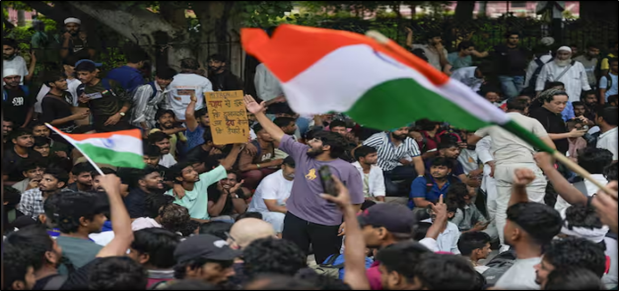
The restrictions imposed in Delhi during protests demanding the resignation of Chief Election Commissioner —including prohibitory orders, detentions, Metro restrictions, railway cancellations and the denotification of Jantar Mantar as a designated protest site—have reignited the debate over the constitutional balance between the right to peaceful protest and the State’s power to maintain public order.
Introduction
Peaceful protest is an essential instrument of democratic accountability, enabling citizens to question public authorities and express dissent. However, the State may regulate assemblies to protect public order, provided restrictions remain lawful, necessary, reasonable and proportionate.
Recent relevance and significance of the issue
- Constitutional rights versus executive discretion: The controversy raises questions about whether preventive policing is being used to manage genuine security threats or to restrict legitimate democratic dissent.
- Judicial scrutiny of preventive measures: The Supreme Court’s reported interventions concerning the July protests and subsequent restrictions, including scrutiny of blanket prohibitory orders and transport disruptions, highlight the need for evidence-based and proportionate policing.
- Electoral accountability: Protests demanding the resignation of the Chief Election Commissioner bring the independence, credibility and accountability of constitutional institutions into public debate.
- Urban governance and mobility: Restrictions affecting Metro stations and railway services demonstrate how measures targeting a protest can also disrupt the lives and livelihoods of citizens unconnected with it.
- Democratic governance: The controversy tests whether the State can protect sensitive installations and maintain public order without making peaceful dissent ineffective.
Major dimensions of the controversy
1. Right to protest versus permission requirements: Articles 19(1)(a) and 19(1)(b) protect freedom of expression and peaceful assembly, while Articles 19(2) and 19(3) permit reasonable restrictions on specified constitutional grounds; therefore, permission systems must regulate protests without arbitrarily extinguishing fundamental rights, and suitable alternative venues should be provided where necessary.
2. Preventive policing versus arbitrary restrictions: Sections 163 and 168 of the BNSS, 2023, respectively provide for urgent preventive orders and police duties to prevent cognisable offences; although previous violence and credible intelligence may justify preventive action, restrictions must be evidence-based, context-specific and proportionate rather than treating every subsequent gathering as a potential threat.
3. Proportionality and public convenience: The reported restrictions affecting 57 Metro stations and cancellation of 245 trains highlight the collateral impact on commuters, patients, students and businesses; authorities should prefer targeted station closures, route-specific controls and enhanced policing over blanket disruptions unless broader measures are demonstrably necessary.
4. Security requirements versus meaningful dissent: Delhi’s sensitive installations, including Parliament and Rashtrapati Bhavan, justify appropriate security buffers and crowd-capacity controls, but relocating demonstrations to inaccessible or remote venues can undermine their democratic purpose; denotification of Jantar Mantar therefore requires transparent justification, consistent rules and accessible alternatives.
5. Democratic accountability and institutional independence: Protests demanding the Chief Election Commissioner’s resignation reflect citizens’ demand for electoral accountability, while the Election Commission’s institutional independence must also be protected; the political sensitivity of a demonstration cannot itself justify restrictions, and judicial review must ensure that preventive measures remain lawful, non-arbitrary and proportionate.
Constitutional and legal framework
A. Fundamental rights involved
- Article 19(1)(a) — Freedom of speech and expression: Citizens have the right to express political opinions, criticise public authorities and demand accountability through peaceful demonstrations.
- Article 19(1)(b) — Right to assemble peacefully and without arms: Peaceful public assembly is constitutionally protected, but it does not confer an unrestricted right to occupy any location or disregard lawful conditions.
- Article 19(2) — Restrictions on freedom of speech: The State may impose reasonable restrictions on speech on constitutionally specified grounds, including public order and the security of the State.
- Article 19(3) — Restrictions on peaceful assembly: The State may impose reasonable restrictions on assemblies in the interests of the sovereignty and integrity of India and public order.
- Article 14 — Equality before the law: Restrictions must not be arbitrary, discriminatory or selectively imposed to suppress particular political viewpoints.
- Article 21 — Protection of life and personal liberty: Policing measures must respect personal liberty and the constitutional requirement of fairness and non-arbitrariness.
- Article 19(1)(d) — Freedom of movement: Indiscriminate transport restrictions may interfere with citizens’ freedom to move freely throughout India, subject to constitutionally permissible restrictions.
B. Relevant statutory provisions
| Legal provision | Relevance to the controversy |
| Section 163, Bharatiya Nagarik Suraksha Sanhita (BNSS), 2023 | Enables urgent preventive orders in cases of nuisance or apprehended danger, subject to statutory conditions and judicial review. It replaces Section 144 of the CrPC. |
| Section 168, BNSS, 2023 | Requires police officers to prevent, to the best of their ability, the commission of cognisable offences. It replaces Section 149 of the CrPC. |
| Section 170, BNSS, 2023 | Provides for preventive arrest in specified circumstances where an offence cannot otherwise be prevented, subject to statutory safeguards. |
| Police and public-order laws | Provide powers to regulate assemblies, routes, crowd sizes and access to sensitive locations, subject to constitutional limitations. |
Major challenges associated with the issue
1. Balancing liberty and public order: Police must protect fundamental rights while preventing violence, stampedes, damage to public property and threats to sensitive installations. The difficulty lies in taking preventive action without treating all gatherings as inherently dangerous.
2. Broad discretionary powers: Prohibitory orders can have a wide impact when their geographical scope, duration or coverage extends beyond the specific threat. Without clear standards, legitimate preventive powers may become instruments of excessive executive discretion.
3. Difficulty of predicting crowd behaviour: Intelligence inputs and past incidents can help identify risks, but crowd behaviour is uncertain. Overreliance on generalised assessments may result in peaceful protesters being treated as potential offenders.
4. Weak transparency and accountability: When authorities do not adequately disclose the reasons, evidence or duration of restrictions, citizens may find it difficult to distinguish genuine security requirements from arbitrary decisions.
5. Disproportionate effects on ordinary citizens: Transport shutdowns, barricades and road closures can impose economic, social and mobility costs on people unrelated to the protest, undermining public confidence in policing.
Supreme Court judgments relevant to the issue
1. Himat Lal K. Shah v. Commissioner of Police (1973)
- The Supreme Court held that the State can regulate public meetings on streets to accommodate competing public uses and maintain public order.
- However, such regulatory powers cannot be exercised arbitrarily to impose a blanket prohibition on the right to peaceful assembly.
2. Mazdoor Kisan Shakti Sangathan v. Union of India (2018)
- The Supreme Court examined protests at Jantar Mantar and recognised the need to balance protesters’ fundamental rights with the interests of residents, commuters and public order.
- It rejected blanket prohibition and emphasised a regulatory framework that enables peaceful protests while minimising inconvenience to others.
3. Madhu Limaye v. Sub-Divisional Magistrate (1970)
- The Supreme Court recognised the necessity of extraordinary preventive powers under the former Section 144 CrPC to address urgent threats to public order.
- It emphasised that these powers must be exercised within legal limits and only when the circumstances justify such exceptional intervention, rather than becoming routine instruments of executive control.
4. Anuradha Bhasin v. Union of India (2020)
- The Supreme Court held that Section 144 CrPC cannot be used to suppress legitimate democratic expression and that repetitive prohibitory orders may constitute an abuse of power.
- It emphasised proportionality, publication of restrictive orders and judicial review to ensure that restrictions are justified by the anticipated threat.
Way Forward: Balancing Protest Rights with Public Order
1. Establish a transparent protest-permission framework: Police authorities should prescribe clear criteria regarding crowd capacity, timings, routes and security requirements, issue reasoned orders for refusals, provide accessible alternative venues and apply rules uniformly irrespective of protesters’ political affiliations.
2. Ensure proportionality in preventive restrictions: Authorities should assess the legitimacy of the objective, suitability and necessity of the measure, and its impact on fundamental rights, adopting the least restrictive effective measures and limiting prohibitory orders to the necessary geographical area and duration.
3. Strengthen evidence-based preventive policing: Preventive action should rely on credible intelligence, specific threats, crowd estimates and contextual risk assessments rather than assumptions, while maintaining operational records to facilitate accountability and judicial review.
4. Strengthen judicial review and institutional accountability: Constitutional courts should examine the legality, necessity and proportionality of restrictive orders through timely remedies, while independent enquiries should investigate alleged police excesses as well as violence or unlawful conduct by protesters.
5. Improve police training and constitutional sensitisation: Police personnel should receive regular training in Fundamental Rights, constitutional morality, crowd psychology, negotiation and conflict de-escalation to distinguish peaceful dissent from genuine threats to public order.
Conclusion
A constitutional democracy must neither leave public order unprotected nor allow security concerns to extinguish peaceful dissent. Transparent rules, evidence-based policing, proportionate restrictions and effective judicial review can protect both citizens’ fundamental rights and the legitimate security interests of the State.
| Important Current To Concept Covered In This Article: Section 163, Bharatiya Nagarik Suraksha Sanhita (BNSS), 2023 Mazdoor Kisan Shakti Sangathan v. Union of India (2018) 1 |