
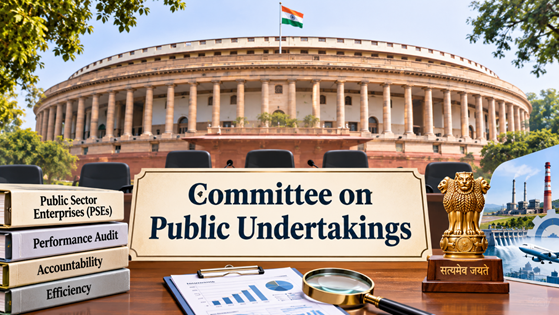
About the Committee on Public Undertakings
- It is one of the three financial standing committees of Parliament.
- It is constituted annually under Rules 312A and 312B of the Rules of Procedure.
- It comprises 22 members (15 from Lok Sabha and up to 7 from Rajya Sabha) elected through proportional representation using the single transferable vote.
- The Chairperson is appointed by the Speaker of the Lok Sabha (presently Shri Baijayant ‘Jay’ Panda).
- Ministers are strictly barred from serving on the Committee; appointment as a Minister leads to automatic disqualification.
Key Functions of the Committee
- Examine the reports and accounts of public undertakings listed in the Fourth Schedule.
- Review Comptroller and Auditor General (CAG) findings related to PSU performance.
- Assess whether PSU management aligns with prudent commercial practices and business principles.
- Ensure operational autonomy, efficiency, and responsible financial conduct in public enterprises.
- Exercise functions of the Public Accounts Committee and Estimates Committee where specifically assigned by the Speaker.
Working Methodology of the Committee
- Seeks detailed information and documents from relevant ministries and undertakings.
- Forms study groups for intensive subject-wise examination of specific PSUs.
- Undertakes field visits and on-site assessments of projects and facilities.
- Holds informal discussions during tours without recording evidence.
- Conducts formal evidence sessions in Delhi with officials and experts.
- Maintains strict confidentiality of all discussion proceedings.
- Prepares reports with findings and recommendations and presents them to both Houses.
Conclusion
The Committee on Public Undertakings plays a crucial role in bringing PSU operations under systematic parliamentary oversight. By identifying inefficiencies and driving managerial reforms, it ensures transparency and accountability within India’s public sector enterprises.
| This concept has been mentioned in the following article: The Public Accounts Committee |