
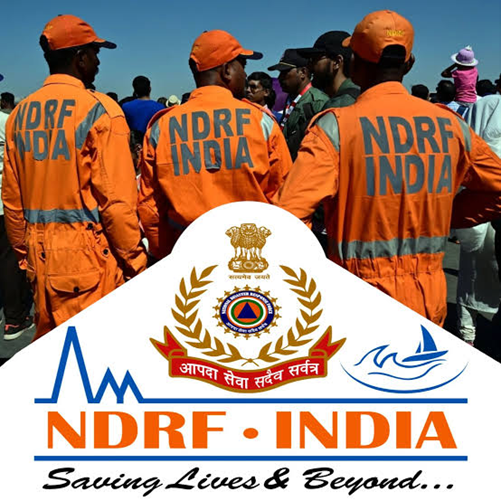
About NDRF
- The National Disaster Response Force (NDRF) is a specialised force established for providing an effective response to natural and man-made disasters.
- It was constituted under Section 44 of the Disaster Management Act, 2005.
- It functions under the Ministry of Home Affairs (MHA), Government of India.
- The force was formally constituted in 2006.
- It is responsible for conducting specialised search, rescue, evacuation and relief operations during disasters.
- The National Disaster Management Authority (NDMA) lays down policies, plans and guidelines for disaster management, while the NDRF undertakes specialised disaster response operations.
Organisation of NDRF
- The NDRF initially started with 8 battalions in 2006 and has expanded to 16 battalions.
- These battalions are drawn from the Central Armed Police Forces (CAPFs), including:
- Border Security Force (BSF)
- Central Reserve Police Force (CRPF)
- Central Industrial Security Force (CISF)
- Indo-Tibetan Border Police (ITBP)
- Sashastra Seema Bal (SSB)
- Assam Rifles.
- Each battalion comprises 18 specialised Search and Rescue (SAR) teams, equipped with trained personnel, engineers, technicians, dog squads and medical staff.
- The force is headed by a Director General (DG) and operates under a unified command structure.
Key Areas of Operation
- Flood Rescue: Rescue and evacuation of people affected by floods and waterlogging.
- Earthquake Response: Search and rescue operations in collapsed buildings and damaged structures.
- Cyclone Response: Evacuation, rescue and relief operations in cyclone-affected areas.
- Landslide Rescue: Search and rescue operations in landslide-affected regions.
- Chemical, Biological, Radiological and Nuclear (CBRN) Emergencies: Response to hazardous chemical, biological, radiological and nuclear incidents.
- Urban Search and Rescue (USAR): Rescue operations during building collapses and industrial accidents.
Major Functions and Mandates
- To conduct specialised search, rescue and evacuation operations during disasters.
- To provide immediate assistance and relief to disaster-affected communities.
- To ensure pre-positioning of specialised teams in vulnerable areas before anticipated disasters.
- To strengthen disaster preparedness through training, mock exercises and community awareness programmes.
- To coordinate with State Disaster Response Forces (SDRFs), local authorities and other emergency response agencies.
- To provide specialised assistance during CBRN emergencies and other complex disaster situations.
Conclusion
The NDRF plays a crucial role in strengthening India’s disaster response capabilities. Through specialised rescue operations, technological advancement, trained personnel and inter-agency coordination, it contributes to saving lives, reducing disaster risks and building a disaster-resilient India.
| This concept has been mentioned in the following article: EXERCISE TIGER TRIUMPH 2026 |