
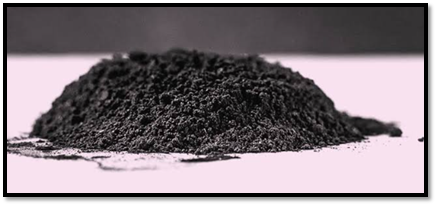
About Lithium-Ion Battery Black Mass
- Nature: A powdery material obtained from the shredding and processing of end-of-life lithium-ion batteries and battery manufacturing waste.
- Composition: Contains recoverable critical minerals, including lithium, cobalt, nickel and manganese.
- Source: Used lithium-ion batteries, discarded battery cells and battery manufacturing waste.
- Purpose: Serves as a secondary source of critical minerals through recycling and refining.
- Importance: Supports domestic battery manufacturing, electric mobility, energy storage and clean-energy technologies.
Major Features and Characteristics
- Critical Mineral Recovery: Contains valuable metals such as lithium, cobalt, nickel and manganese, which can be recovered through specialised recycling processes.
- Secondary Resource: Acts as an alternative source of critical minerals, reducing dependence on primary mining and imported raw materials.
- Battery Recycling: Undergoes further processing to separate and recover valuable materials for reuse in battery manufacturing.
- Circular Economy: Promotes resource recovery from discarded batteries and reduces waste generation.
- Urban Mining: Enables the extraction of valuable minerals from discarded electronic products and industrial waste rather than relying entirely on natural mineral deposits.
- Industrial Applications: Recovered materials are used in electric vehicle batteries, advanced chemistry cell batteries, energy storage systems and electronics.
Major Processes Involved in Black Mass Recovery
- Collection and Discharging: Used lithium-ion batteries are collected and discharged to minimise safety risks before processing.
- Dismantling and Shredding: Batteries are dismantled and mechanically shredded to separate different components.
- Separation: Physical processes separate the black mass from other battery components, such as plastics, aluminium and copper.
- Hydrometallurgical Processing: Chemical solutions are used to extract valuable metals from black mass.
- Recovery and Refining: Recovered metals are processed into suitable forms for reuse in battery manufacturing.
Key Critical Minerals Recovered from Black Mass
| Mineral | Major Applications |
| Lithium | Lithium-ion batteries and energy storage |
| Cobalt | Battery cathodes and superalloys |
| Nickel | Battery cathodes and stainless steel |
| Manganese | Battery cathodes and steel production |
Government Initiatives Supporting Critical Mineral Recycling
1. National Critical Mineral Mission (NCMM)
- Aims to strengthen India’s self-reliance in critical mineral supply chains.
- Covers exploration, mining, processing, recycling and recovery of critical minerals.
2. Incentive Scheme for Critical Mineral Recycling
- Outlay: ₹1,500 crore.
- Approved: By the Union Cabinet.
- Objective: Develop domestic recycling capacity for the separation and production of critical minerals from secondary sources.
- Sources: Battery waste and electronic waste (e-waste).
Conclusion
Lithium-Ion Battery Black Mass represents an important secondary source of critical minerals. Its effective recycling and recovery can strengthen India’s resource security, promote a circular economy and support the country’s transition towards clean energy and electric mobility.
| This concept has been mentioned in the following article: DGFT Prohibits Export of Lithium-Ion Battery Black Mass to Strengthen Domestic Recycling |