
Context
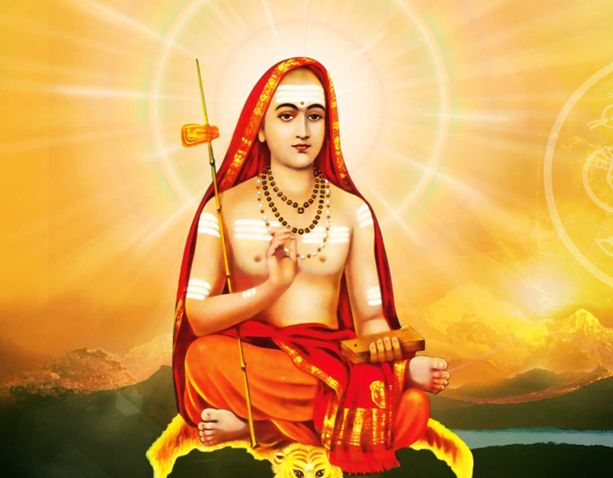
Recently, the 1238th birth anniversary of Jagadguru Adi Shankaracharya is being celebrated as Sri Shankara Jayanti Mahotsav on April 21, 2026 (Vaishakha Shukla Panchami). Major celebrations are organized by the Dakshinamnaya Sringeri Sharada Peetham from April 18 to April 21, 2026, highlighting the rediscovery of his birthplace, Kalady, and his role in the national and dharmic integration of India.
Life and Background
- Birthplace: Born in Kalady, Kerala, on the banks of the River Poorna (Periyar) to Aryamba and Shivaguru.
- Early Genius: At age 8, he set out to find a Guru, eventually studying under Sri Govinda Bhagavatpadacharya on the banks of the Narmada.
- The Rediscovery of Kalady: His birthplace had faded from public memory for centuries until it was rediscovered in the late 19th century by Sri Sacchidananda Shivabhinava Narasimha Bharati Mahaswamiji (the 33rd Shankaracharya of Sringeri).
- The Four Amnaya Peethams: To unify India spiritually and geographically, he established four main monasteries (Mathas) based on the Mathamnaya Stotra:
- Jyotir Math (North): Badrinath (Uttarakhand).
- Govardhan Math (East): Puri (Odisha).
- Dwarka Sharada Peeth (West): Dwarka (Gujarat).
- Sringeri Sharada Peeth (South): Sringeri (Karnataka).
Philosophy: Advaita Vedanta
Adi Shankaracharya is the most famous exponent of Advaita (Non-dualism).
- The Ultimate Reality: He taught that Brahman is the only truth (Satya), while the world (Jagat) is an appearance (Mithya) caused by the power of Maya.
- Concept of Liberation: True liberation (Moksha) comes from realizing that the individual soul (Atman) is identical to Brahman.
Key Contributions to National Integration
- Bridging Regional Identities: He fostered a shared national identity by appointing priests from specific regions to serve in distant corners (e.g., Kerala Nambudiri priests to serve at Badrinath in the North, and Maharashtra priests to conduct worship at Rameswaram in the South).
- Shanmata System: He resolved sectarian conflicts by reviving the Panchayatana Puja (Shanmata), encouraging the simultaneous worship of Shiva, Vishnu, Shakti, Ganesha, and Surya.
- Literary Gems: Apart from philosophical texts, he composed soul-stirring hymns like the Kanakadhara Stotram (composed as a young boy to help a poor household) and Bhaja Govindam.
- Role of Women: He demonstrated the importance of women in the Vedic tradition, notably evidenced by the appointment of Ubhaya Bharati (Mandana Mishra’s wife) to adjudicate his famous debate.
- Dashanami Sampradaya: He organized monks into ten orders to protect the Dharma: Giri, Puri, Bharati, Vana, Aranya, Tirtha, Ashrama, Saraswati, Parvata, and Sagara.
Comprehensive Literary Works
Shankaracharya’s literary output is categorized into three distinct types, all written in Sanskrit.
- Bhashyas (Commentaries)
These are his most scholarly works, interpreting the Prasthanatrayi (The three sources of authority):
• Brahmasutrabhashya: His commentary on the Brahma Sutras of Badarayana (the foundational text of Advaita).
• Gita Bhashya: Commentary on the Bhagavad Gita.
• Upanishad Bhashyas: Commentaries on the ten principal (Mukhya) Upanishads, including the Brihadaranyaka, Chandogya, and Taittiriya. - Prakarana Granthas (Introductory Treatises)
These texts simplify complex non-dualistic philosophy for students:
• Vivekachudamani (The Crest Jewel of Discrimination).
• Upadesasahasri (A Thousand Teachings).
• Atma Bodha (Self-Knowledge).
• Tattva Bodha (Knowledge of Truth). - Stotras (Devotional Hymns)
Though a philosopher of the “Abstract Brahman,” he composed many emotional hymns:
• Bhaja Govindam: Highlighting the futility of worldly attachments.
• Saundarya Lahari and Ananda Lahari: Tantric and devotional hymns in praise of Shakti.
• Nirvana Shatakam: A six-verse summary of the identity of the soul with Shiva (Brahman).
• Kanakadhara Stotram: Composed in his childhood to bring a rain of golden amlas to a poor woman.
Q. With reference to Adi Shankaracharya, consider the following statements:
1. He established the Govardhan Math in the eastern part of India, which is associated with the Rigveda.
2. The "Kanakadhara Stotram" is a philosophical commentary written by him on the Brahma Sutras.
3. He promoted the "Shanmata" system to harmonize the worship of different Hindu deities.
4. His birthplace, Kalady, was rediscovered in the 19th century by the 33rd Shankaracharya of Sringeri.

How many of the statements given above are correct?
A) Only one
B) Only two
C) Only three
D) All four

Answer: C) Only three

Solution:
STATEMENT 1 IS CORRECT: The Govardhan Math in Puri (Odisha) is the eastern peetham and is traditionally associated with the Rigveda.
STATEMENT 2 IS INCORRECT: The Kanakadhara Stotram is a devotional hymn (Stotra) requesting the Goddess of wealth for a poor woman; his commentary on the Brahma Sutras is titled Brahma Sutra Bhashya.
STATEMENT 3 IS CORRECT: He introduced the Shanmata (six-fold) system and Panchayatana Puja to unify various sects.
STATEMENT 4 IS CORRECT: According to recent historical records, Sri Sacchidananda Shivabhinava Narasimha Bharati Mahaswamiji was instrumental in identifying Kalady as the birth site.