
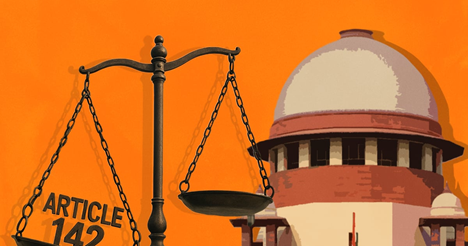
Context
- Recently, the Supreme Court utilized its extraordinary powers under Article 142 to overturn a 10-year POCSO prison sentence. The court observed that the couple fell in love while the victim was a minor and later married once she attained adulthood. Invoking Article 142 to ensure “complete justice” where existing statutory laws fell short, the court quashed the conviction to allow the couple to live peacefully as spouses.
What is Article 142 of the Indian Constitution?
Article 142 provides a unique, self-contained constitutional mechanism that empowers the Supreme Court of India to pass any decree or execute any order necessary for doing “complete justice” in any cause or matter pending before it.
Key Characteristics
- Extraordinary Power: It acts as an equitable, inherent safety valve that allows the apex court to transcend procedural gridlocks or legislative vacuums to rectify a manifest travesty of justice.
- Enforceability: Any decree passed or order made by the Supreme Court under this article is completely enforceable throughout the entire territory of India.
- Supplementary Nature: The provision complements existing laws rather than replacing them, enabling the court to provide a remedy when statutory laws are silent or insufficient.
Boundaries and Limitations of “Complete Justice”
While the phrase “complete justice” offers vast discretionary latitude, the Supreme Court has formulated explicit guidelines to ensure this power does not dilute the rule of law.
- Fundamental Rights: The Supreme Court cannot pass orders under Article 142 that directly violate the Fundamental Rights enshrined in Part III of the Constitution.
- Express Statutory Provisions: The court cannot completely ignore or override express, substantive statutory laws passed by the legislature; it fills gaps rather than replacing the legislative text.
- Non-Precedential: Specific orders passed under Article 142 are often tailored exclusively to the unique facts of a particular case and do not automatically serve as a binding legal precedent for lower courts.
Landmark Judgments
- Union Carbide Corporation v. Union of India (1991): The Supreme Court asserted that its power under Article 142 is independent of statutory limitations, allowing it to bypass specific legislative procedures to provide a quick financial settlement for the victims of the Bhopal Gas Tragedy.
- Supreme Court Bar Association v. Union of India (1998): The court established that Article 142 cannot be used to replace existing substantive laws. It ruled that the power to punish an advocate for professional misconduct rests with the Bar Council, not the court’s extraordinary powers.
- Shilpa Sailesh v. Varun Sreenivasan (2023): A Constitution Bench ruled that the Supreme Court can use Article 142 to grant a divorce decree on the ground of an irretrievable breakdown of marriage, bypassing the mandatory six-month cooling-off period required under the Hindu Marriage Act, 1955.
High Courts vs. Supreme Court Jurisdiction
| Parameter | Supreme Court (Article 142) | High Courts (Article 226) |
| Explicit Power | Holds explicit, distinct constitutional power to pass any order or decree to deliver “complete justice.” | Does not possess an explicit constitutional mandate for “complete justice” equivalent to Article 142. |
| Inherent Jurisdiction | Possesses broad plenary powers that can bypass procedural laws when a legislative vacuum exists. | Possesses wide inherent powers to prevent abuse of the court’s process, but operates within stricter statutory limits. |
| Geographical Reach | Orders are enforceable across the entire territory of India. | Orders are limited to its specific state or multi-state territorial jurisdiction. |
Q. Consider the following statements regarding the constitutional powers of the judiciary in India:
Statement I: Article 142 of the Constitution provides the Supreme Court with an extraordinary, plenary power to pass any decree or order to ensure "complete justice," which can be exercised to completely override express statutory prohibitions.
Statement II: The constitutional power to deliver "complete justice" under Article 142 is a unique, residuary jurisdiction explicitly granted to the Supreme Court of India, and an identical explicit provision does not exist for the High Courts under Article 226.
Select the correct answer using the options given below:
(a) Both Statement I and Statement II are correct and Statement II is the correct explanation for Statement I
(b) Both Statement I and Statement II are correct and Statement II is not the correct explanation for Statement I
(c) Statement I is correct but Statement II is incorrect
(d) Statement I is incorrect but Statement II is correct
Correct Answer: (d) Statement I is incorrect but Statement II is correct
Detailed Structural Solution
• STATEMENT I IS INCORRECT: While Article 142 vests the Supreme Court with broad, extraordinary powers to deliver complete justice, this power is not unchecked. The Supreme Court has repeatedly clarified in landmark rulings (such as Supreme Court Bar Association v. Union of India) that Article 142 cannot be used to replace or completely ignore express, substantive statutory provisions passed by the legislature. It is meant to complement the law where there is a regulatory vacuum, not to run entirely counter to explicit statutory mandates.
• STATEMENT II IS CORRECT: The explicit power to issue decrees for "complete justice" is an exclusive, residuary jurisdiction granted solely to the Supreme Court under Article 142. Although High Courts possess broad writ jurisdictions and inherent powers under Article 226 to prevent the abuse of judicial processes, they do not have a parallel constitutional mandate to deliver "complete justice" that allows them to move beyond strict procedural rules in the same way.