
Context
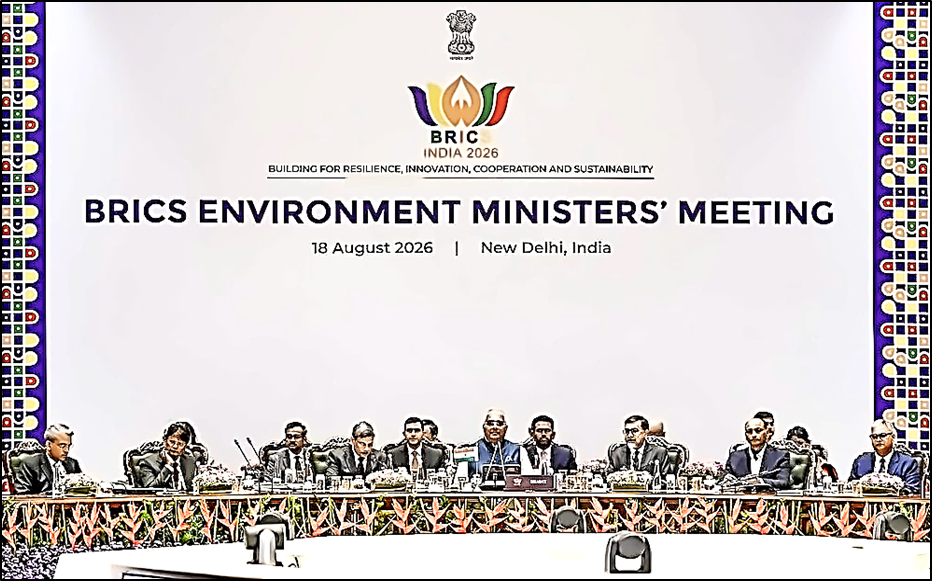
Recently, BRICS countries criticised the European Union’s Carbon Border Adjustment Mechanism (CBAM) as unilateral and protectionist, arguing that it could increase the burden on developing countries’ exports; they also called for greater and predictable adaptation finance from developed countries.
What is Carbon Border Adjustment Mechanism (CBAM)?
- CBAM is an EU mechanism to impose a carbon-related cost on certain carbon-intensive goods imported into the European Union.
- It aims to prevent carbon leakage and ensure that imported goods face a carbon cost comparable to goods produced within the EU.
How does CBAM Work?
Carbon-intensive goods imported into EU
↓
Embedded emissions are calculated
↓
Importer purchases CBAM certificates
↓
Carbon-related cost is imposed
If a carbon price has already been paid in the exporting country, the corresponding amount can be deducted under the mechanism.
Sectors Covered under CBAM
The current CBAM framework covers six sectors:
| Sector | Examples/Significance |
| Iron & Steel | Major carbon-intensive industrial sector |
| Aluminium | Energy-intensive production |
| Cement | High process emissions |
| Fertilisers | Emissions-intensive production |
| Electricity | Carbon intensity varies by energy source |
| Hydrogen | Important for industrial decarbonisation |
Why are Developing Countries Critical of CBAM?
- Trade Competitiveness: Higher carbon-related costs may make exports from developing countries less competitive in the EU market.
- Development Concerns: Developing countries argue that they require greater policy space to balance economic development with climate action.
- Climate Justice: Developing countries emphasise their relatively lower historical contribution to cumulative greenhouse-gas emissions while facing significant climate impacts.
- Unilateral Climate Measures: BRICS countries have raised concerns that unilateral trade-related climate measures could undermine multilateral approaches to climate change.
| Important CTC from This Article for UPSC 1. Carbon Border Adjustment Mechanism (CBAM) 2. European Union (EU) 3. BRICS |
Q. With reference to the European Union’s Carbon Border Adjustment Mechanism (CBAM), consider the following statements:
1. CBAM seeks to address the problem of carbon leakage.
2. Iron and steel, aluminium, cement, fertilisers, electricity and hydrogen are among the sectors covered under CBAM.
3. CBAM is designed to replace the EU Emissions Trading System (EU ETS) for carbon-intensive industries within the European Union.
Which of the statements given above are correct?
(a) 1 and 2 only
(b) 3 only
(c) 2, 3 only
(d) 1, 2 and 3 only
Answer: (b) 1 and 2 only
Explanation
• Statement 1 – Correct: CBAM aims, among other things, to address carbon leakage.
• Statement 2 – Correct: CBAM covers cement, iron and steel, aluminium, fertilisers, electricity and hydrogen.
• Statement 3 – Incorrect: CBAM does not replace the EU ETS. It complements the EU ETS by applying a carbon-related adjustment to specified imports entering the EU.