
Context
- The Ministry of Rural Development has announced an interim allocation of ₹95,962 crores to implement the Viksit Bharat-Guarantee for Rozgar and Ajeevika Mission Gramin (VB-GRAM G) Act, 2025.
About the VB-GRAM G Act 2025
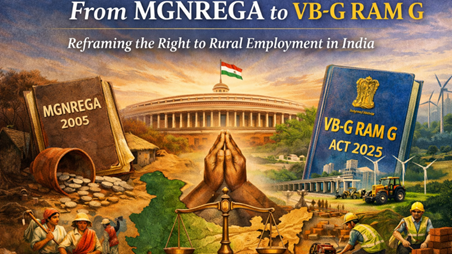
- The Viksit Bharat-Guarantee for Rozgar and Ajeevika Mission Gramin (VB-GRAM G) Act, 2025, is a major legislative measure that officially repeals and replaces the MGNREGA Act of 2005 to transition India’s rural employment framework from basic manual labor to durable national asset creation.
- Nodal Ministry: Ministry of Rural Development.
- Core Objective: Providing a statutory guarantee of wage employment while creating high-quality, durable infrastructure (specifically water security).
Key Provisions
- Employment Guarantee: The Act statutorily mandates 125 days of guaranteed wage employment per rural household annually.
- Funding Framework: It establishes a 60:40 Centre-State cost-sharing model for the wage bill, significantly increasing the fiscal responsibility of State governments.
- Wage Disbursement: The framework stipulates a weekly wage payment cycle to improve financial liquidity for workers.
- Agricultural Alignment: Public works can be officially paused for up to 60 days during peak agricultural seasons to ensure adequate farm labour availability.
- Technological Integration: The implementation requires mandatory biometric authentication and AI-enabled analytics to ensure transparency and monitor fund utilization.
Key Departures from MGNREGA
| Feature | MGNREGA (2005) | VB-GRAM G Act (2025) |
| Guaranteed Work Days | 100 days per household annually | 125 days per household annually |
| Unskilled Wage Funding | 100% funded by the Central Government | 60:40 cost-sharing (Centre : State) |
| Wage Payment Cycle | Maximum of 15 days | Weekly payments |
| Agricultural Seasonality | Continuous work available year-round | Provision to pause for up to 60 days during peak harvest seasons |
| Nature of Entitlement | Justiciable legal right to work | Schematic entitlement based on “Normative Allocation” (subject to budget caps) |
| Infrastructure Integration | Standalone local asset creation | Integrated with PM Gati Shakti via Viksit Gram Panchayat Plans |
| Technology Mandate | Basic MIS and Aadhaar-linked payments | Mandatory biometric authentication and AI-enabled analytics |
MCQ
With respect to the Viksit Bharat-Guarantee for Rozgar and Ajeevika Mission Gramin (VB-GRAM G) Act, 2025, consider the following statements:
I. It increases the guaranteed wage employment to 125 days per rural household annually.
II. The Central Government provides 100 percent funding for the unskilled wage bill under this Act.
III. It introduces a provision to temporarily suspend public works during peak agricultural seasons.
Which of the statements given above is/are correct?
 (a). I and III only
(b) II only
(c) I and II only
(d) I, II, and III
Answer: A
Explanation:
Statement I is correct: The VB-GRAM G Act statutorily increases the guaranteed wage employment from 100 days to 125 days per household annually to enhance rural incomes.
Statement II is incorrect: The legislation marks a structural shift by introducing a 60:40 Centre-State cost-sharing model for the wage bill, explicitly replacing the previous 100 percent central funding framework for unskilled wages.
Statement III is correct: The framework includes a mandate to pause public works for up to 60 days during peak agricultural seasons, specifically ensuring that farmers have access to necessary agricultural labour when demand is highest.