
Context
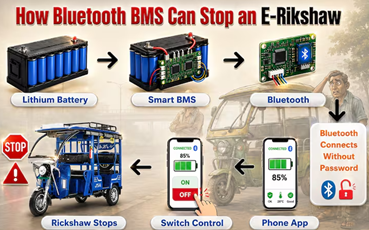
- A recent investigation has highlighted cybersecurity vulnerabilities in imported e-rickshaw battery systems, particularly in Battery Management Systems (BMS) equipped with Bluetooth connectivity.
- Security researchers found that these vulnerabilities could allow unauthorized access to battery diagnostics and control functions, raising concerns about the cybersecurity of India’s rapidly expanding Electric Vehicle (EV) ecosystem.
What is a Battery Management System (BMS)?
A Battery Management System (BMS) is an electronic control system that monitors, protects, and optimizes the performance of rechargeable batteries, especially in Electric Vehicles (EVs).
Functions of BMS
- Monitors battery voltage, current, and temperature.
- Prevents overcharging and deep discharge.
- Balances battery cells to improve efficiency.
- Protects against overheating and short circuits.
- Estimates battery health and remaining charge (State of Charge).
Why are E-rickshaw Batteries Vulnerable?
- Many imported batteries use Bluetooth-enabled BMS for diagnostics.
- Some systems have weak authentication and poor encryption.
- Users often rely on third-party mobile applications for monitoring batteries.
- Imported batteries may not undergo adequate cybersecurity testing.
- Lack of standardized cybersecurity protocols increases the risk of exploitation.
Potential Cybersecurity Risks
- Unauthorized access to battery data.
- Manipulation of battery charging or discharging parameters.
- Battery overheating or damage due to malicious control.
- Theft of user or device information.
- Disruption of vehicle operation and public safety concerns.
- Experts emphasize that the vulnerabilities arise primarily from poorly secured hardware and software design, not from the mobile applications alone.
Major Government Initiatives for Electric Vehicle (EV) Promotion
- PM E-DRIVE Scheme (2024–2026)
- Launched with an outlay of ₹10,900 crore to accelerate EV adoption.
- Provides incentives for electric two-wheelers, three-wheelers, e-buses, e-ambulances, and e-trucks.
- Also supports the expansion of public EV charging infrastructure across India.
- PM e-Bus Sewa–Payment Security Mechanism (PSM) Scheme
- Aims to facilitate the deployment of over 38,000 electric buses in urban transport.
- Provides a payment security mechanism to encourage private investment and ensure timely payments to bus operators.
- Promotes clean, efficient, and sustainable public transport.
- Production Linked Incentive (PLI) Scheme for Advanced Chemistry Cell (ACC) Batteries
- Outlay of ₹18,100 crore to promote domestic manufacturing of advanced battery cells.
- Reduces dependence on battery imports and strengthens the EV supply chain.
With reference to the Battery Management System (BMS) used in Electric Vehicles (EVs), consider the following statements:
1. It monitors battery voltage, current, and temperature.
2. It helps balance individual battery cells to improve efficiency.
3. It is primarily responsible for controlling the vehicle's braking system.
Which of the statements given above are correct?
(a) 1 and 2 only
(b) 2 and 3 only
(c) 1 and 3 only
(d) 1, 2 and 3
The correct answer is A. 1 and 2 only.
Explanation:
• Statement 1 is correct: A Battery Management System (BMS) continuously monitors the critical operating parameters of a rechargeable battery pack. This includes tracking individual cell and pack voltages (protecting against overvoltage and undervoltage conditions), monitoring current flow, and regulating temperature to ensure the battery operates within a safe environment.
• Statement 2 is correct: To maximize the lifespan, capacity, and overall efficiency of a multi-cell lithium-ion battery pack, a BMS performs cell balancing. This process ensures that all individual cells are charged and discharged uniformly, preventing any single cell from becoming a bottleneck or safety hazard.
• Statement 3 is incorrect: The BMS is dedicated exclusively to managing the electronic parameters and health of the battery pack. Controlling the vehicle's mechanical or regenerative braking systems is the responsibility of other dedicated electronic control units (ECUs), such as the Electronic Braking System (EBS) or the central vehicle control unit, not the BMS.