
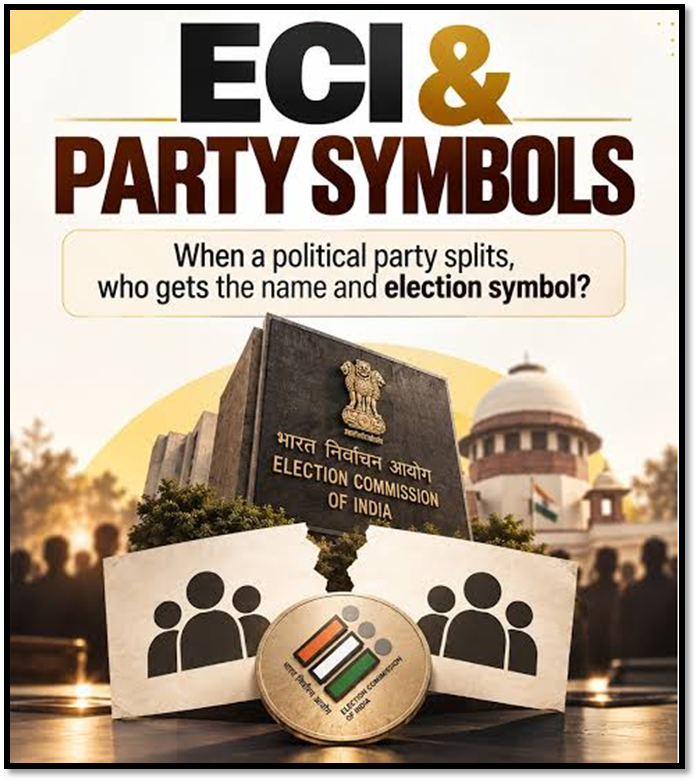
Context
- Recently, a petition was filed in the Supreme Court by a political leader challenging the Election Commission’s (ECI) interim decision to freeze a political party’s symbol and allot separate temporary names and symbols to rival factions under the Election Symbols (Reservation and Allotment) Order, 1968.
Allotment and Freezing of Election Symbols
- Statutory Framework: The allocation, reservation, and freezing of party symbols are governed by the Election Symbols (Reservation and Allotment) Order, 1968.
- Power of the Election Commission: Under Paragraph 15 of the 1968 Order, the ECI is the sole authority to decide disputes regarding recognized political parties that split into rival groups or factions.
- Binding Decision: The decision of the Election Commission in such disputes is legally binding on all rival sections/factions.
How Does the ECI Resolve Party Symbol Disputes?
- The Election Commission of India (ECI) derives its authority from:
- Article 324 – Gives the ECI superintendence, direction and control over elections.
- Representation of the People Act, 1951 – Provides the framework for political parties.
- Election Symbols Order, 1968 – Governs party recognition and symbol allotment. Paragraph 15 empowers the ECI to decide which faction represents a recognised party and is entitled to its reserved symbol; the decision is subject to judicial review.
When a Party Dispute Cannot Be Resolved Before an Election
- If the ECI cannot decide a party dispute before an imminent election, it may freeze the existing party name and reserved symbol temporarily.
- Neither faction can use the frozen name or symbol.
- Factions receive separate temporary names.
- Each is allotted/allowed to choose a different free symbol.
- The arrangement remains in force until the dispute is finally decided.
How Does the ECI Decide the “Real” Party?
- The Supreme Court held that when determining which faction constitutes the party, the numerical strength of the rival groups is an important factor, as the Commission has to determine which group substantially constitutes the party.
- The ECI may consider:
- Party Constitution – Compliance with organisational rules.
- Organisational Support – Support among office-bearers, members and delegates.
- Legislative Support – Support among elected MPs and MLAs.
What Happens to the Losing Faction?
- The recognised faction retains the party name and reserved symbol.
- The other faction cannot use that reserved identity.
- It may continue as a separate party with a new name and symbol.
- Future State or National party recognition depends on its subsequent electoral performance.
| Important CTC from this article for UPSC: ELECTION COMMISSION OF INDIA (ECI) |
Q. Consider the following statements regarding disputes over the name and election symbol of a political party:
1. Under Paragraph 15 of the Election Symbols (Reservation and Allotment) Order, 1968, the Election Commission of India can decide which faction of a recognised political party is entitled to its name and reserved symbol.
2. While deciding such disputes, the Election Commission may consider the organisational as well as legislative support enjoyed by rival factions.
3. If the dispute cannot be finally resolved before an imminent election, the Election Commission may freeze the disputed symbol and allow rival factions to contest using temporary names and free symbols.
Which of the statements given above is/are correct?
(a) 1 and 2 only
(b) 2 and 3 only
(c) 1 and 3 only
(d) 1, 2 and 3
Answer: (d) 1, 2 and 3
• Statement 1 is correct: Paragraph 15 empowers the ECI to determine which rival faction of a recognised National or State party is entitled to the party’s name and reserved symbol.
• Statement 2 is correct: The ECI can examine organisational strength and legislative support, along with other relevant factors.
• Statement 3 is correct: Where an early election makes a final decision impracticable, the ECI can freeze the disputed symbol and provide temporary arrangements for the rival factions.