

Context
- The Supreme Court held that an arrested person is entitled to immediate release if they are kept in the dark about the grounds of arrest or denied access to a lawyer of their choice, as guaranteed under Article 22(1) of the Constitution.
What is Article 22(1)?
- Article 22(1) provides constitutional protection to a person who is arrested.
- It states that an arrested person:
- Must be informed of the grounds of arrest as soon as possible.
- Has the right to consult and be defended by a legal practitioner of their choice.
Why Must Grounds of Arrest Be Given?
- Understand why they have been arrested.
- Consult a lawyer effectively.
- Challenge the legality of the arrest before a court.
- Exercise other constitutional and legal remedies.
- Therefore, communicating the grounds is not merely a procedural formality, but an important safeguard for personal liberty.
Supreme Court’s Key Observations
The Court clarified that:
- Written communication of the grounds of arrest is necessary.
- Simply telling the accused the grounds orally is not enough.
- The grounds should be communicated in a manner and language that the accused can understand.
- If the constitutional requirement is violated, the arrest can be held illegal and the person may be entitled to release.
What if Police Want to Re-arrest?
- Release due to violation of Article 22(1) does not permanently protect an accused from arrest.
- For re-arrest:
- The written grounds of arrest must first be furnished.
- Police must approach the concerned Judicial Magistrate.
- The application must explain why the grounds were not supplied during the first arrest.
- The Magistrate must be satisfied that there are bona fide reasons and that re-arrest is necessary.
- The investigation must be transferred to another officer.
- Departmental inquiry can be initiated against the officer responsible for the violation.
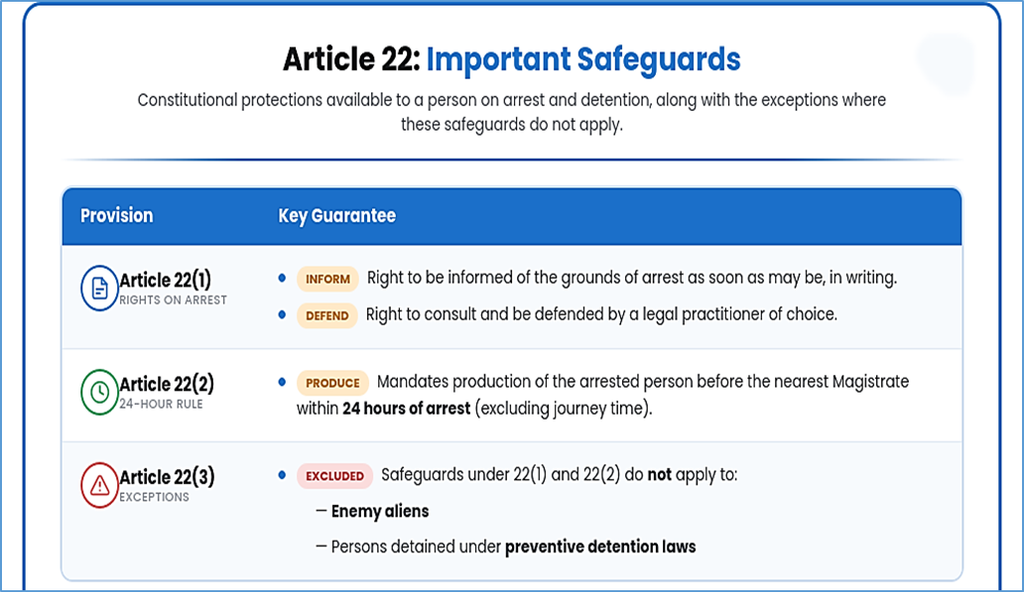
| Important Current to Concept (CTC) from this article for UPSC: Constitutional Limits on Arrest: Balancing Police Power and Personal Liberty |
Q. With reference to Article 22(1) of the Indian Constitution and the recent Supreme Court judgment, consider the following statements:
1. The right to know the grounds of arrest in writing and access to legal counsel of choice are mandatory safeguards under Article 22(1).
2. The subsequent filing of a chargesheet automatically regularizes an arrest made in violation of Article 22(1).
3. Probe agencies enjoy complete immunity from judicial oversight when re-arresting a person for grave offenses.
Which of the statements given above is/are correct?
(a) 1 only
(b) 1 and 2 only
(c) 2 and 3 only
(d) 1, 2, and 3
• Statement 1 is Correct: Informing the grounds of arrest in writing (in a familiar language) and allowing access to a legal counsel of choice are non-negotiable fundamental rights under Article 22(1). Denying these rights makes the arrest unconstitutional, requiring immediate release from illegal custody.
• Statement 2 is Incorrect: A fundamental breach cannot be cured later. Filing a chargesheet or court cognizance after an illegal arrest does not validate or regularize the detention.
• Statement 3 is Incorrect: Police agencies do not have complete freedom to re-arrest. To re-arrest an individual whose previous arrest was declared illegal, agencies must get prior specific sanction from a Magistrate with recorded reasons.