
Context
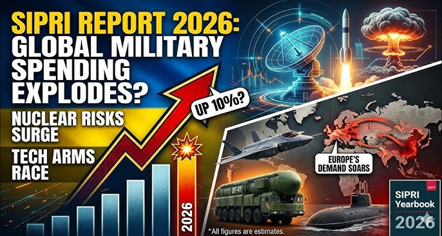
The Stockholm International Peace Research Institute (SIPRI) Yearbook 2026 highlights India’s ongoing nuclear arsenal expansion, its shift in strategic focus, and its consistent position as one of the world’s top military spenders and arms importers.
India’s Nuclear Arsenal & Strategic Shift
- Arsenal Expansion: India’s nuclear stockpile expanded to approximately 190 warheads by early 2026, an increase from 180 warheads in 2025.
- Strategic Reorientation: The nuclear modernisation programme is increasingly prioritizing the development of longer-range weapons capable of reaching targets across China, while concurrently maintaining its deterrence posture against Pakistan.
Where does India Stand in Global Defence Economics?
- Military Expenditure (2025): India ranks as the fifth-largest military spender globally ($92.1 billion). The top four spenders are the United States, China, Russia, and Germany.
- Arms Imports (2021-25): India is the second-largest importer of major arms globally, accounting for 8.2% of global imports.
- Top 5 Importers: Ukraine holds the top spot, followed by India, Saudi Arabia, Qatar, and Pakistan. Together, they account for 35% of all global arms transfers.
What is the Global Nuclear Landscape?
- Nuclear-Armed States: There are exactly nine countries possessing nuclear weapons: the US, Russia, the UK, France, China, India, Pakistan, North Korea, and Israel.
- Modernisation: All nine states are actively expanding and modernising their nuclear delivery systems, reinforcing nuclear weapons as primary instruments of national power.
About SIPRI
- Core Mandate: SIPRI is an independent international institute dedicated to research into conflict, armaments, arms control, and disarmament.
- Data Source: The institute’s rigorous assessments, data sets, and policy recommendations are based exclusively on open sources.
- Global Authority: It serves as an authoritative and widely cited reference for policymakers, diplomats, scholars, and journalists regarding international security dynamics.
Global Nuclear Governance Architecture
1. Treaty on the Non-Proliferation of Nuclear Weapons (NPT)
- The Nuclear Matrix: The NPT separates states into Nuclear-Weapon States (NWS)—defined strictly as those that manufactured and exploded a nuclear device before January 1, 1967 (the US, Russia, UK, France, and China)—and Non-Nuclear-Weapon States (NNWS).
- Non-Signatory Realities: India, Pakistan, Israel, and North Korea possess functional nuclear stockpiles completely outside the NPT framework.
2. Bilateral Arms Control Disruption: Expiry of New START
- Strategic Cap Removal: The New START Treaty was the primary bilateral mechanism regulating and limiting the deployed strategic nuclear weapons of the United States and Russia.
- February 2026 Expiry: The treaty officially expired in February 2026 without any successor agreement or replacement framework being negotiated. This legal vacuum eliminates formal limits on strategic deployments, directly correlating with the global modernization trends reported by SIPRI.
3. Treaty on the Prohibition of Nuclear Weapons (TPNW)
● Entering into force in 2021, the TPNW acts as a legally binding multilateral instrument that completely prohibits the possession, development, and deployment of nuclear weapons.
4. International Atomic Energy Agency (IAEA)
- Established in 1957 in Vienna, the International Atomic Energy Agency (IAEA) is an autonomous UN nuclear watchdog operating under the mandate “Atoms for Peace and Development.” It enforces global non-proliferation safeguards, sets nuclear safety standards, and promotes peaceful nuclear applications in healthcare and energy. India, a founding member, subjects only its civilian reactors utilizing imported uranium to IAEA oversight.
With respect to the global military and nuclear landscape, consider the following statements:
 I. India was the world's largest importer of major arms during the 2021-25 period.
 II. The integration of cyberoperations into active military conflict was observed for the first time between India and Pakistan during Operation Sindoor.
 III. There are exactly nine globally recognized nuclear-armed states that are currently modernising their arsenals.
How many of the above statements are correct?
(a) Only one
(b) Only two
(c) All three
(d) None
Answer: B
Explanation:
Statement I is incorrect: During the 2021-25 period, India remained the second-largest importer of major arms, accounting for 8.2% of global imports, closely following Ukraine.
Statement II is correct: During the May 2025 military crisis known as Operation Sindoor, India and Pakistan integrated cyberoperations into an active military conflict for the first time, highlighting the evolving nature of warfare.
Statement III is correct: There are nine nuclear-armed states globally—the United States, Russia, the United Kingdom, France, China, India, Pakistan, North Korea, and Israel—all of which are actively modernising their nuclear arsenals.