
After Reading This Article You Can Solve This UPSC Mains Model Question:
India–Belgium relations are evolving beyond traditional trade and investment towards a broader strategic and technology partnership. Discuss the significance of this transformation for India’s strategic autonomy and engagement with Europe. 15 marks (GS 2, International Relations)
Why in News?
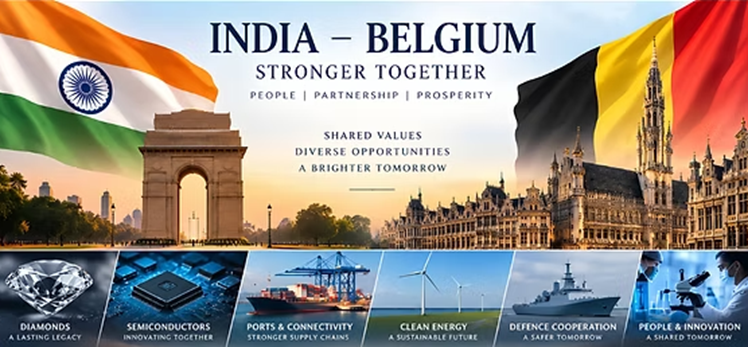
Belgian PM Bart De Wever’s India visit, the first by a Belgian PM in nearly two decades, has revitalised bilateral ties. India and Belgium agreed to deepen cooperation in defence, intelligence, trade, fintech, semiconductors, renewable energy and maritime security, signalling a shift from trade-centric ties to a broader strategic and technology partnership.
Introduction
For over a century, Antwerp’s diamonds connected Belgium with Mumbai–Surat. Today, the relationship is moving beyond diamonds towards defence, semiconductors, fintech, maritime security and renewable energy, making Belgium an important partner in India’s wider Europe strategy and pursuit of strategic autonomy.
Historical Foundations & Shared Legacy
- WWI Legacy: India remembers the sacrifice of 9,000+ Indian soldiers in Flanders Fields; institutional links connect the Flanders Fields Museum with India’s CAFHR.
- Early Diplomatic Ties: Belgium was among the earliest European countries to establish diplomatic relations with India in 1947.
- People-to-People Connect: Historical ties have evolved into enduring cultural, academic and diaspora linkages.
- Institutional Continuity: Historical cooperation provides a foundation for expanding today’s economic, defence and strategic partnership.
From Economic Partnership to Strategic & Technology Cooperation
1. Economic & Trade Partnership
Partnership So Far
- Strong trade ties: Bilateral trade reached around US$13.01 billion in 2025–26, with Belgium being an important European economic partner for India.
- Diamond value chain: Belgium’s Antwerp and India’s Mumbai–Surat form a complementary global diamond-trading, cutting and polishing ecosystem.
Current Agreement / New Direction
- Trade diversification: Both sides aim to double bilateral trade over the next five years, moving beyond dependence on diamonds.
- New sectors: Focus is expanding towards fintech, semiconductors, manufacturing, renewable energy and advanced technology.
2. Defence & Defence-Industrial Cooperation
Partnership So Far
- Belgium possesses specialised capabilities in ammunition, drones, radar, electro-optical systems, naval technologies and mine-countermeasure systems.
- Indian and Belgian defence industries have already explored cooperation in ammunition, rockets, counter-drone systems, sensors and autonomous maritime systems.
Current Agreement / New Direction
- Letter of Intent: Both sides agreed to establish structured cooperation covering military exchanges, training, R&D, joint exercises and defence-industrial cooperation.
- Co-development: Around 15 Belgian defence companies engaged with Indian industry, signalling greater emphasis on joint production, technology transfer and manufacturing.
3. Maritime Security
Partnership So Far
- Cooperation is emerging around naval technologies, autonomous systems and mine-countermeasure capabilities.
- Belgian expertise complements India’s requirement for advanced underwater systems, sensors and maritime technologies.
Current Agreement / New Direction
- Greater focus on mine countermeasures, underwater robotics and autonomous maritime systems.
- Cooperation can help protect ports, subsea cables, pipelines and maritime trade routes, strengthening supply-chain resilience.
4. Intelligence & Internal Security
Partnership So Far
- Growing security engagement reflects the increasing importance of European cooperation in combating transnational threats.
- Belgium’s location within Europe provides opportunities for cooperation against cross-border criminal networks.
Current Agreement / New Direction
- Both sides agreed to strengthen intelligence-sharing and cooperation between security agencies.
- Focus includes combating transnational crime, organised crime, terror financing and emerging security threats.
5. Semiconductors & Strategic Technology
Partnership So Far
- India and Belgium possess complementary technological and industrial strengths, creating scope for deeper technology cooperation.
- Semiconductors are increasingly important for electronics, automobiles, AI, defence and digital infrastructure.
Current Agreement / New Direction
- Both sides agreed to deepen cooperation in semiconductors and related technology ecosystems.
- This can support India’s efforts to build resilient domestic semiconductor supply chains and reduce excessive dependence on concentrated global sources.
6. Fintech & Digital Economy
Partnership So Far
- India’s strength lies in its Digital Public Infrastructure, digital payments and large fintech ecosystem.
- Belgium and the wider European ecosystem provide opportunities for financial expertise, innovation and regulatory cooperation.
Current Agreement / New Direction
- Cooperation is being expanded among financial institutions, fintech companies and regulators.
- Potential areas include digital payments, financial inclusion, RegTech and cross-border financial services.
7. Renewable Energy & Green Transition
Partnership So Far
- Energy transition has emerged as a promising area for India–Belgium economic and technological cooperation.
- Belgium’s technological capabilities can complement India’s growing renewable-energy market and manufacturing capacity.
Current Agreement / New Direction
- Both sides are working towards a renewable-energy partnership/pact.
- Cooperation can cover clean-energy technologies, renewable energy and green industrial solutions.
8. Institutional & EU-Level Cooperation
Partnership So Far
- The India–Belgium–Luxembourg Economic Union Joint Commission, established in 1997, provides an institutional mechanism for economic cooperation.
- Belgium’s position as an EU member and major European economic hub gives the bilateral relationship wider strategic relevance.
Current Agreement / New Direction
- Belgium can serve as an important gateway for strengthening India–EU economic, technological and strategic cooperation.
- The expanding bilateral agenda creates opportunities to connect India’s interests with broader European supply chains, technology and security frameworks.
Geopolitical & Strategic Significance of India–Belgium Relations
- Gateway to the European Union
- As an important EU member, Belgium can facilitate India’s wider engagement with the EU on trade, FTA, technology and resilient supply chains.
- It strengthens India’s access to the broader European strategic and economic ecosystem.
- Strategic Autonomy & Diversification
- Cooperation reflects India’s approach of diversifying economic, technological and strategic partnerships amid geopolitical fragmentation and supply-chain vulnerabilities.
- It supports India’s goal of strategic autonomy without alignment with any single bloc.
- Issue-Based Strategic Convergence
- Despite differences over issues such as the Russia–Ukraine conflict, India and Belgium continue to deepen cooperation.
- This demonstrates that strategic partnerships do not require complete geopolitical convergence, reflecting India’s preference for issue-based alignment over alliance-based foreign policy.
Challenges in India–Belgium Relations
1. Limited Scale of Trade
- Bilateral trade remains relatively modest compared with India’s major European and global trading partners.
- Greater diversification into technology, manufacturing and services is needed to unlock the full economic potential.
2. Diamond Concentration
- India–Belgium trade has traditionally been heavily linked to the diamond industry, creating sectoral concentration.
- Expanding cooperation into fintech, semiconductors, technology and green energy is essential for a more resilient partnership.
3. EU Regulatory Barriers
- Differences in standards, regulations and market-access norms can increase compliance costs for Indian exporters.
- Greater regulatory coordination is needed to facilitate trade and deeper India–EU economic integration.
4. Technology Transfer
- Defence cooperation will be meaningful only if it results in technology transfer and domestic capability building.
- India needs greater emphasis on co-development, joint production and strengthening indigenous defence manufacturing.
5. Geopolitical Differences
- India and Belgium/Europe may differ on issues such as Russia, China and wider strategic priorities.
- Managing these differences through issue-based cooperation and strategic dialogue is essential.
6. Implementation Gap
- MoUs and Letters of Intent can have limited impact if they do not translate into actual investments and joint projects.
- Effective implementation requires clear timelines, private-sector participation and institutional monitoring.
Way Forward for India–Belgium Relations
1. Diversify Economic Relations
- Move beyond the traditional diamond-centric trade model towards semiconductors, fintech, renewable energy and advanced manufacturing.
- Promote greater investment, services trade and technology partnerships to build a balanced economic relationship.
2. Promote Defence Co-development
- Shift from defence procurement towards joint R&D, technology transfer and joint production.
- Increase Indian value addition and private-sector participation to strengthen domestic defence capabilities.
3. Leverage the India–EU FTA
- Use the FTA to improve market access and reduce trade barriers for Indian businesses.
- Integrate Indian firms into European value chains, particularly in manufacturing and technology.
4. Build Resilient Supply Chains
- Develop partnerships in semiconductors, critical technologies, clean energy and defence.
- Reduce excessive dependence on concentrated global supply chains through diversification and trusted partnerships.
5. Strengthen Maritime Cooperation
- Expand cooperation in underwater robotics, autonomous systems, mine countermeasures and maritime-domain awareness.
- Jointly protect critical infrastructure such as ports, subsea cables and pipelines to enhance maritime resilience.
6. Deepen Technology & Green Cooperation
- Expand collaboration in semiconductors, fintech, renewable energy and other emerging technologies.
- Combine Belgian/European technological expertise with India’s market, talent and manufacturing capabilities.
7. Preserve Strategic Autonomy
- India should maintain multi-alignment, engaging with Europe, Russia, the US, Japan and other partners based on national interests.
- Differences on geopolitical issues should be managed through issue-based cooperation rather than rigid bloc politics.
Conclusion
India–Belgium relations are evolving from a transactional partnership to a more strategic and future-oriented engagement. The growing convergence reflects India’s effort to diversify partnerships, strengthen resilience and deepen its presence in Europe.
| Important Current to Concept (CTC) from this Article for UPSC Semiconductors Memorandum of Understanding (MoU) |