
Context
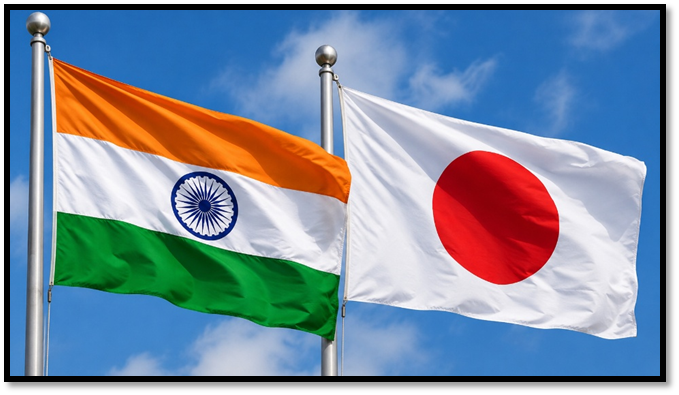
- Japanese Defence Minister Shinjiro Koizumi is visiting India and is holding talks with Defence Minister Rajnath Singh on strengthening bilateral defence and security cooperation, including defence equipment and technology, maritime security and cooperation in the Indo-Pacific. The visit comes soon after the 8th India–Japan Defence Policy Dialogue held in Tokyo in July 2026.
1. India–Japan Strategic Partnership
- India and Japan share a Special Strategic and Global Partnership, upgraded to this level in 2014.
- The partnership is based on convergence over a free, open and rules-based Indo-Pacific.
- India’s Act East Policy and SAGAR vision complement Japan’s Free and Open Indo-Pacific (FOIP) approach.
- Both countries are also partners in the Quad along with the United States and Australia.
2. Key Areas of Defence Cooperation
A. Defence Equipment & Technology
India and Japan have cooperation in:
- Defence equipment and technology transfer
- Joint research, development and potential co-production
- Maritime technology
- Defence industrial cooperation
- Advanced and emerging technologies
The 2015 Agreement on Transfer of Defence Equipment and Technology Cooperation provided an important foundation for this cooperation.
B. Logistics & Interoperability
- The Acquisition and Cross-Servicing Agreement (ACSA) was signed in 2020.
- It facilitates reciprocal provision of: Supplies, Services, Logistical support between the Indian Armed Forces and Japan’s Self-Defense Forces.
C. Maritime Security
Maritime cooperation is a major pillar because both countries have strong interests in the Indo-Pacific and sea lanes of communication.
Areas include:
- Maritime domain awareness
- Naval cooperation
- Anti-piracy cooperation
- HADR
- Capacity building
- Freedom of navigation and rules-based maritime order
The July 2026 Defence Policy Dialogue specifically reviewed maritime cooperation, exercises, defence equipment and technology cooperation and military-to-military engagement.
3. Important Defence Exercises
A. JIMEX
- Bilateral naval exercise.
- Focus: maritime cooperation and interoperability.
B. Dharma Guardian
- Bilateral Army exercise
- Enhances interoperability and joint operational capabilities.
C. Malabar
- Multilateral naval exercise.
- Participants: India, Japan, USA and Australia
- Japan’s participation strengthens maritime cooperation among the Quad countries.
D. Veer Guardian
- Bilateral Air Force exercise.
- Conducted between the Indian Air Force and Japan Air Self-Defense Force.
4. Institutional Mechanisms
- 2+2 Dialogue: Foreign Ministers + Defence Ministers
- Defence Policy Dialogue: Defence establishments of both countries
Military-to-Military Talks: Armed forces cooperation
- Coast Guard-to-Coast Guard cooperation: The 8th Defence Policy Dialogue in July 2026 reviewed the entire spectrum of bilateral defence engagement.
5. Why Japan Matters for India?
A. Strategic
- Strengthens India’s position in the Indo-Pacific.
- Supports a rules-based maritime order.
- Enhances strategic balance in the wider Indo-Pacific.
B. Defence
- Access to advanced Japanese defence technology.
- Greater interoperability through exercises and logistics cooperation.
- Scope for defence-industrial collaboration.
C. Economic & Technological
- Japan is an important source of investment and technology.
- Cooperation extends to infrastructure, high technology, connectivity, clean energy and advanced transportation.
| Important CTC from this article for UPSC: Strategic Partnership in the Indo-Pacific |
Q. Consider the following pairs regarding India–Japan defence cooperation:
Exercise/Agreement	Nature
1. JIMEX	                        Naval Exercise
2. Dharma Guardian	Army Exercise
3. Veer Guardian	        Air Force Exercise
4. ACSA	                        Defence Logistics Agreement
Which of the pairs given above are correctly matched?
(a) 1 and 2 only
(b) 1, 2 and 3 only
(c) 2, 3 and 4 only
(d) 1, 2, 3 and 4
Answer: (d) 1, 2, 3 and 4
• JIMEX → India–Japan Naval exercise.
• Dharma Guardian → India–Japan Army exercise.
• Veer Guardian → India–Japan Air Force exercise.
• ACSA → facilitates reciprocal provision of supplies and services/logistical support between the armed forces.