
Context
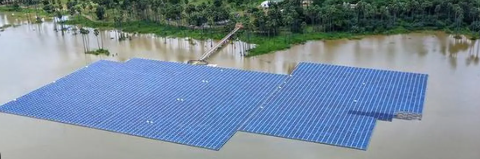
- The National Institute of Solar Energy (NISE), an autonomous institute under the Ministry of New and Renewable Energy (MNRE), has released the first comprehensive national assessment report titled “Solar PV Potential of India (Floating Solar)”.
- The report highlights that India’s reservoirs have the potential to host approximately 102 Gigawatts (GW) of floating solar capacity, offering a major solution to the sector’s biggest constraint: land acquisition.
Key Findings of the Report
1. Total Estimated Capacity & Geographic Distribution
- Total Potential: 102.18 GW across India’s inland water bodies.
- Top Contributing States: Five states account for the bulk of this potential:
- Maharashtra (16.28 GW)
- Madhya Pradesh (14.89 GW)
- Karnataka (13.69 GW)
- Odisha (12.81 GW)
- Telangana (10.72 GW)
2. Flagship Projects
- Omkareshwar Floating Solar Park: Located on the River Narmada in the Khandwa district of Madhya Pradesh.
- Status: It is currently India’s flagship floating solar project with a capacity of 278 MW, with plans to scale it up to 600 MW.
3. Methodology & Criteria Used
To calculate the total feasible area, NISE filtered India’s inland water bodies using six distinct criteria:
- Type & Size: Lakes and reservoirs larger than 10 hectares.
- Water Availability: Water must be present for at least 11 months/year.
- Depth: Water depth must be between 3 to 30 meters.
- Logistics: Proximity within 10 km of existing roads and substations.
- Self-Imposed Ecological Cap: The calculation restricts solar panel coverage to a maximum of 20% of any reservoir’s surface area to minimize ecological impact.
- Example Case Study: At Odisha’s Hirakud reservoir, these filters whittled down 499 sq. km. of total water surface to 99.5 sq. km. of usable surface area.
Comparative Analysis: Floating Solar vs. Ground-Mounted Solar
- Land Use Efficiency: Ground-mounted systems need 3–4 times more area per megawatt (MW) than the panels themselves occupy. Floating solar bypasses this issue entirely, mitigating land acquisition conflicts with agriculture and habitation.
- Cost Factor: Floating solar units cost about 25% more upfront than ground-mounted counterparts (based on a 2021 U.S. National Renewable Energy Laboratory benchmark).
Global Scenario
- Globally, floating solar reached about 9.6 GW by 2024.
- Asia dominates the sector, holding almost 90% of the global share.
- Key Global Examples:
- China: Leads with mega-installations, including a 120 MW plant on a fish farm in Poyang Lake.
- Singapore: Features a 1 MW Tengeh Reservoir test-bed that provides vital performance data.
- Netherlands: Accounts for about 3/4th of Europe’s capacity, built largely on quarry lakes.
India’s Solar Surge
- The solar sector has expanded at an unprecedented pace over the past decade, growing from just 3 GW in 2014 to 150.26 GW in March 2026.
- According to the IRENA Renewable Energy Statistics 2025, India stands 3rd in solar energy, 4th in wind energy, and 4th globally in total installed renewable energy capacity.
Related Concepts for Prelims
1. Agri-photovoltaics (Agri-PV)
- Definition: The practice of co-developing the same area of land for both solar photovoltaic power and agriculture.
- Mechanism: Solar panels are mounted on elevated structures sheltering farm beds below, allowing crops to grow underneath while generating electricity.
Q. With reference to the recent NISE report "Solar PV Potential of India (Floating Solar)", consider the following statements:
1. India’s inland water bodies have the potential to host more than 100 GW of floating solar capacity.
2. Maharashtra has been identified as the state with the highest floating solar potential in India.
3. The NISE assessment permits solar panel coverage of up to 50% of a reservoir's surface area.
4. Floating solar projects help overcome the challenge of land acquisition associated with ground-mounted solar projects.
Which of the statements given above are correct?
(a) 1 and 2 only
(b) 1, 2 and 4 only
(c) 2, 3 and 4 only
(d) 1, 2, 3 and 4
Answer: B. 1, 2 and 4 only
Explanation:
• Statement 1 is correct: NISE estimates a floating solar potential of 102.18 GW.
• Statement 2 is correct: Maharashtra (16.28 GW) has the highest estimated potential.
• Statement 3 is incorrect: NISE imposed an ecological cap of 20%, not 50%, of reservoir surface coverage.
• Statement 4 is correct: Floating solar avoids major land acquisition issues faced by ground-mounted solar installations.