
After Reading This Article You Can Solve This UPSC Mains Model Questions:
Balancing nuclear energy expansion with public safety remains one of the biggest governance challenges for India. In the light of the SHANTI Act, 2025, analyse the key challenges and suggest suitable reforms. 15 Marks (GS-2, Governance)
Context
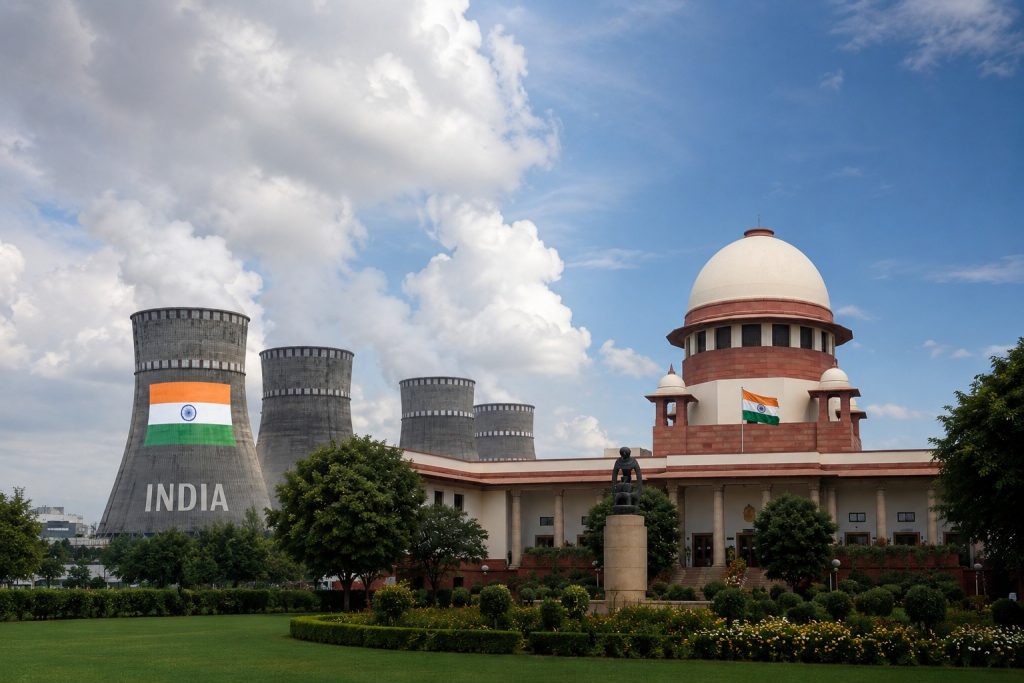
- The Supreme Court of India is currently examining the constitutional validity of the Sustainable Harnessing and Advancement of Nuclear Energy for Transforming India (SHANTI) Act, 2025, which introduces private participation in the nuclear sector.
- The legal challenge centers on whether the financial liability caps and supplier exemptions provided in the new law violate the Fundamental Right to Life guaranteed under Article 21 of the Constitution.
About India’s Existing and Historical Nuclear Liability Landscape
Before the introduction of the SHANTI Act, India followed a more restrictive regime that primarily prioritized state control and rigorous accountability.
- Atomic Energy Act of 1962: This historical framework ensured that nuclear energy remained an exclusive state monopoly, managed by public sector undertakings like the Nuclear Power Corporation of India Limited (NPCIL).
- Civil Liability for Nuclear Damage Act (CLNDA Act) of 2010: Previous regulations, such as the Civil Liability for Nuclear Damage Act of 2010, included a “Right of Recourse” that allowed operators to sue suppliers for defective equipment, a provision now heavily diluted.
- Shift to Private Markets: The transition under the SHANTI Act signals a move from publicly funded energy security to a market-driven approach involving global private capital.
Overview of the SHANTI Act, 2025
The SHANTI Act represents a paradigm shift in India’s atomic energy governance, effectively repealing the Atomic Energy Act of 1962 and the Civil Liability for Nuclear Damage Act of 2010. It seeks to modernize the legal framework to meet India’s goal of achieving net-zero emissions by significantly scaling up nuclear power capacity.
- End of State Monopoly: For the first time, the law permits private sector companies and foreign corporations to build, own, and operate nuclear power plants in India.
- Tiered Liability Structure: The Shanti Act introduces a graduated liability system based on the thermal capacity of the reactor. Large reactors (above 3,000 Megawatts thermal) have a liability cap of approximately ₹ 3,000 crore to ₹ 4,000 crore.
- Supplier Indemnity: A major departure from the 2010 law is the removal of the “Right of Recourse” against suppliers. Under the new regime, equipment suppliers are generally exempt from liability unless there is an express written contract or proven intent to cause harm.
- Consolidated Regulation: The Shanti Act grants statutory status to the Atomic Energy Regulatory Board and establishes a Nuclear Liability Fund to address damages that exceed the operator’s financial cap.
Why Strategic Support Has Been Extended by the Government to the SHANTI Act?
- Energy Security and Rising Electricity Demand: India’s growing economy, industrial expansion, and rising electricity needs have made continuous expansion of power generation necessary. Nuclear energy has therefore been promoted as a stable and long term source of electricity capable of reducing dependence on imported fossil fuels and protecting India from global fuel price instability and geopolitical tensions.
- Climate Commitments and Clean Energy Transition: India’s commitment to achieving Net Zero emissions by 2070, has strengthened support for nuclear power expansion. Since nuclear energy produces relatively low greenhouse gas emissions, it has been considered an important part of India’s clean energy and sustainable development strategy.
- Need for Foreign Investment and Advanced Technology: Large nuclear projects require advanced technology, massive investment, and sophisticated safety systems. Through foreign participation, access to modern reactors, technical expertise, and improved safety mechanisms has been expected.
- Global Experience and Strategic Competitiveness: Countries such as France, United States, Russia, and China have successfully expanded nuclear energy through international collaboration and private investment and therefore, it has been viewed as necessary for strengthening India’s future energy security, technological capacity, and strategic competitiveness.
Key Challenges Emerging from the SHANTI Act, 2025
The enactment of the Sustainable Harnessing and Advancement of Nuclear Energy for Transforming India (SHANTI) Act, 2025 has introduced several deep-rooted structural and legal challenges.
1. Dilution of the Constitutional “Absolute Liability” Standard
A major challenge is the Act’s departure from the landmark Absolute Liability doctrine established in the 1986 Oleum Gas Leak Case.
- The 1986 Oleum Gas Precedent (M.C. Mehta versus Union of India): Following the Bhopal gas tragedy of 1984, the Supreme Court formulated the progressive doctrine of Absolute Liability, ruling that an enterprise engaged in an inherently dangerous or hazardous industrial activity owes an absolute, non-delegable duty to the community to ensure that no civilian harm occurs, and must provide unconditional compensation if a failure takes place.
- The SHANTI Act Conflict: By capping liability at less than ₹ 4,000 crore, the new law effectively replaces this “absolute” duty with a limited one, potentially allowing massive corporations to escape the full financial weight of a disaster.
- The Deep Pocket Principle: Historical jurisprudence mandates that the larger and more prosperous an enterprise is, the higher the compensation must be; however, the Act’s flat liability cap of less than ₹ 4,000 crore at treats all large-scale operators the same, regardless of their wealth.
2. Fiscal Risks and the “Socialization of Losses”
The Act creates a significant fiscal challenge by potentially shifting the financial burden of a nuclear disaster from private polluters to the public exchequer.
- Taxpayer Vulnerability: If a catastrophic accident occurs (similar in scale to Chernobyl or Fukushima), the costs will likely exceed the ₹ 4,000 crore limit.
- Residual Burden: Because the private operator’s liability is capped, any additional billions required for cleanup and victim relief must be provided by the Indian government and its taxpayers.
- Subversion of Polluter Pays: A major systemic challenge is the explicit subversion of the globally accepted Polluter Pays Principle, which is an integral part of environmental jurisprudence under Article 21 because the entity responsible for the risk is not held accountable for the full extent of the potential damage.
3. Supplier Immunity and the Moral Hazard Challenge
The complete exemption of technology and equipment suppliers under the SHANTI Act poses a severe risk to long-term safety standards.
- Removal of Recourse: Under previous laws, an operator could sue a supplier for defective equipment; however, the new Act shields these vendors from such claims.
- Lack of Incentive: This exemption creates a moral hazard, as foreign or domestic manufacturers may be less motivated to ensure the highest possible safety grades if they face no legal or financial consequences for design flaws.
- Safety Blind Spots: Without supplier accountability, the legal system fails to address the root cause of accidents that stem from faulty industrial components.
4. The “Race to the Bottom” for Foreign Direct Investment (FDI)
The Act reflects a difficult challenge in balancing the need for advanced technology with the protection of public safety.
- Minimizing Risk to Attract Capital: The low liability caps were specifically designed as interconnected strategies to attract foreign private investors who were previously hesitant to enter the Indian market.
- Global Double Standards: This creates a situation where international firms enjoy capped liability in India while being subject to much higher accountability standards in their home countries.
- Prioritizing Policy over Safety: Critics argue that this approach sacrifices the Right to Life (Article 21) on the “altar of policy” to secure foreign technological collaboration.
5. Erosion of Institutional and Regulatory Oversight
The shift to a private-driven nuclear sector raises challenges regarding the independence and transparency of safety regulators.
- Regulatory Capture: There is a heightened risk that the pressure to maintain a “business-friendly” environment could lead to weakened safety inspections or “softer” oversight of private operators.
- Accountability of Private Entities: Since these firms perform vital state functions, the lack of a strong mechanism to treat them as “State” agents under Article 12 limits the ability of citizens to hold them directly accountable for fundamental rights violations.
- Opaque Decision Making: The “sensitive” nature of nuclear policy can lead to a lack of public transparency, making it harder for communities living near plants to assess the true risks they face.
Way Forward
- Revision of the Liability Cap: The liability ceiling under the SHANTI Act must be reviewed and significantly raised in consultation with independent nuclear safety experts, legal scholars, and civil society groups, so that it reflects the realistic scale of damage that a nuclear accident in India could cause.
- Restoration of Supplier Liability: A proportionate and defined level of supplier liability must be restored into the legal framework to ensure that equipment and technology providers have a commercial and legal incentive to maintain the highest possible safety standards.
- Establishing an Independent Nuclear Regulatory Authority: India must create a fully autonomous, well-resourced, and technically capable regulatory body to oversee the licensing, operations, and safety audits of all nuclear plants, including those operated by private and foreign entities.
- Multi-Party Insurance and Compensation Pool: A dedicated national nuclear compensation fund, contributed to by operators, suppliers, and the Government of India, must be established on the lines of international best practices to ensure that adequate resources are available for victims without delay in the event of an accident.
- Parliamentary Review: The SHANTI Act should be referred to a Parliamentary Standing Committee for a comprehensive review involving independent nuclear scientists, constitutional lawyers, environmentalists, and representatives of communities living near proposed nuclear plant sites.
- Joining International Liability Conventions: India should consider ratifying the Convention on Supplementary Compensation for Nuclear Damage, which would bring it into alignment with global standards and provide an additional layer of internationally pooled compensation for victims.
Conclusion
The debate surrounding the SHANTI Act, 2025 highlights that while expansion of nuclear energy may be important for India’s energy security and climate goals, public safety, environmental protection, constitutional rights, and strong corporate accountability must remain the core principles guiding India’s nuclear governance framework.