
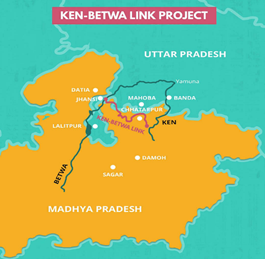
Context
- Recently, tribal villagers, predominantly women, in Madhya Pradesh’s Chhatarpur and Panna districts intensified protests against the Ken–Betwa River Linking Project (KBLP), demanding fair compensation and better rehabilitation through a symbolic “hanging satyagraha.”
Key Facts: Ken-Betwa Link Project (KBLP)
- KBLP is the first initiative to be implemented under the National Perspective Plan (NPP) for the interlinking of rivers.
- Objective: It aims to transfer “surplus” water from the Ken River in Madhya Pradesh to the water-deficit Betwa River in Uttar Pradesh to address the chronic drought issues of the Bundelkhand region.
- Beneficiary States: Jointly benefits Madhya Pradesh and Uttar Pradesh.
- Nodal Agency: Implemented by the National Water Development Agency (NWDA) under the Ministry of Jal Shakti.
- Core Infrastructure:
- Phase I: Includes the construction of the Daudhan Dam complex, a 221-km long link canal, and a low-level tunnel.
- Phase II: Includes the Lower Orr Dam (across the Orr River), the Bina Complex project, and the Kotha Barrage.
Geography & Hydrology Related Facts
| Attribute | Ken River | Betwa River |
| Origin | Kaimur Hills (Jabalpur district, Madhya Pradesh) | Vindhya Range (north of Hoshangabad, Madhya Pradesh) |
| Outflow | Confluence with the Yamuna River at Chilla village, UP | Confluence with the Yamuna River at Hamirpur, UP |
| Major Tributaries | Bawas, Dewar, Kaith, Baink, Kopra, Bearma | Newan, Orr, Dhasan |
| Key Highlights | Known for the rare, semi-precious Sajhar stone. | Historically known as the Vetrawati. |
Environmental and Ecological Concerns
- Habitat Fragmentation: Environmentalists warn that the construction of the Daudhan Dam will submerge over 4,000 hectares of forest land inside the Panna Tiger Reserve, impacting critical wildlife corridors for tigers, vultures, and gharials.
- Forest Loss: The project expects the clearance/felling of over 23 lakh trees, raising major conservation challenges.
- Clearance Bodies Involved: The project requires complex statutory clearances from the National Board for Wildlife (NBWL), the National Green Tribunal (NGT), and Forest Advisory Committees.
Institutional & Strategic Framework
1. National Perspective Plan (NPP)
- Launched: 1980 by the Ministry of Irrigation (now Ministry of Jal Shakti) for inter-basin water transfers.
- Components:
- Himalayan Component: 14 river links.
- Peninsular Component: 16 river links, including the Ken–Betwa River Linking Project (KBLP).
2. National Water Development Agency (NWDA)
- Established: 1982 as an autonomous society under the Ministry of Jal Shakti.
- Role: Conducts water balance studies, prepares Feasibility Reports (FRs) and Detailed Project Reports (DPRs), and coordinates river-linking projects.
3. Constitutional & Legal Framework
- Article 262: Provides for adjudication of inter-state river water disputes.
- Seventh Schedule:
- Entry 17 (State List): Water supply, irrigation, canals, and drainage.
- Entry 56 (Union List): Regulation and development of inter-state rivers in the public interest.
- Key Clearances: Governed by the Wildlife (Protection) Act, 1972, Environment (Protection) Act, 1986, and Forest Rights Act, 2006 (including Gram Sabha consent for forest diversion).
Consider the following statements regarding Ken-Betwa river linking project:
1.The project aims to transfer the surplus water from Betwa basin to Ken basin.
2.Both the Ken and Betwa rivers are tributaries of the Chambal river.
3.The Baghelkhand region is expected to benefit the most from the Project.
How many of the above statements are correct?
(a) Only one
(b) Only two
(c) All three
(d) None of the above
Answer: (d) None of the above
Statement 1 is incorrect: It is a river interlinking project designed to transfer surplus water from the Ken River (Madhya Pradesh) to the water-scarce Betwa basin (Uttar Pradesh).
Statement 2 is incorrect: The Ken and Betwa rivers are tributaries of the Yamuna river.
Statement 3 is incorrect: It is expected to bring prosperity to the drought-prone Bundelkhand region.