
Context
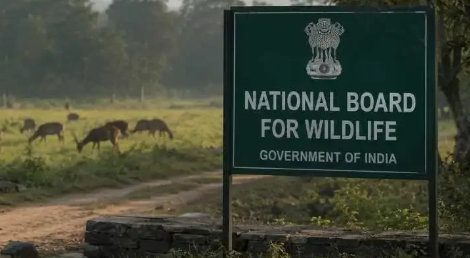
- Recently, a group of retired forest and wildlife officials and conservationists filed a Public Interest Litigation (PIL) before the Delhi High Court, alleging that the National Board for Wildlife (NBWL) has increasingly prioritized infrastructure and development projects over wildlife conservation.
Key Highlights
- The petition alleges that the National Board for Wildlife (NBWL) has deviated from its statutory mandate of wildlife conservation and habitat protection.
- According to the petitioners, the Board approved more than 97% of the proposals related to infrastructure and development projects between 2014 and 2026.
- The petition argues that the current approach could adversely affect protected areas, forests, biodiversity, and long-term conservation efforts.
- The petition seeks judicial guidelines on how the NBWL should perform its statutory functions under the Wildlife (Protection) Act, 1972.
About National Board for Wildlife (NBWL)
- The NBWL is a statutory body constituted under the Wildlife (Protection) Act, 1972.
- It is chaired by the Prime Minister of India, while the Union Minister for Environment, Forest and Climate Change serves as the Vice-Chairperson.
- The Board advises the Central Government on policies and measures for wildlife conservation and protection.
- The NBWL consists of 47 members, including government officials, Members of Parliament, scientists, environmentalists, and representatives of non-governmental organizations.
Standing Committee of NBWL
- The Standing Committee of the NBWL is responsible for considering proposals involving diversion of forest land and activities within or around protected areas.
- Between 2014 and 2026, the Standing Committee reportedly considered more than 1,100 proposals.
- It plays an important role in granting clearances for projects located within National Parks, Wildlife Sanctuaries, Conservation Reserves, and Eco-Sensitive Zones (ESZs).
| About Wildlife (Protection) Act, 1972 Enacted in 1972 to provide legal protection to wild animals, birds, and plants. Provides for the creation of: National Parks Wildlife Sanctuaries Conservation Reserves Community Reserves The Act establishes various authorities, including the National Board for Wildlife. |
With reference to the National Board for Wildlife (NBWL), consider the following statements:
1. The National Board for Wildlife is a statutory body constituted under the Wildlife (Protection) Act, 1972.
2. The Prime Minister of India serves as the Chairperson of the NBWL.
3. The Standing Committee of the NBWL grants clearances for projects located within or around protected areas and Eco-Sensitive Zones.
4. The Wildlife (Protection) Act, 1972 provides for the creation of Biosphere Reserves and Ramsar Sites.
Which of the statements given above are correct?
(a) 1, 2 and 3 only
(b) 1 and 4 only
(c) 2, 3 and 4 only
(d) 1, 2, 3 and 4
Answer: (a) 1, 2 and 3 only
Explanation:
• Statement 1: Correct. The National Board for Wildlife (NBWL) is a statutory body constituted under the Wildlife (Protection) Act, 1972.
• Statement 2: Correct. The Prime Minister of India is the Chairperson of the NBWL, while the Union Minister for Environment, Forest and Climate Change serves as the Vice-Chairperson.
• Statement 3: Correct. The Standing Committee of the NBWL considers proposals involving activities within or around protected areas and Eco-Sensitive Zones (ESZs).
• Statement 4: Incorrect. The Wildlife (Protection) Act, 1972 provides for National Parks, Wildlife Sanctuaries, Conservation Reserves, and Community Reserves. Biosphere Reserves and Ramsar Sites are not created under this Act.