
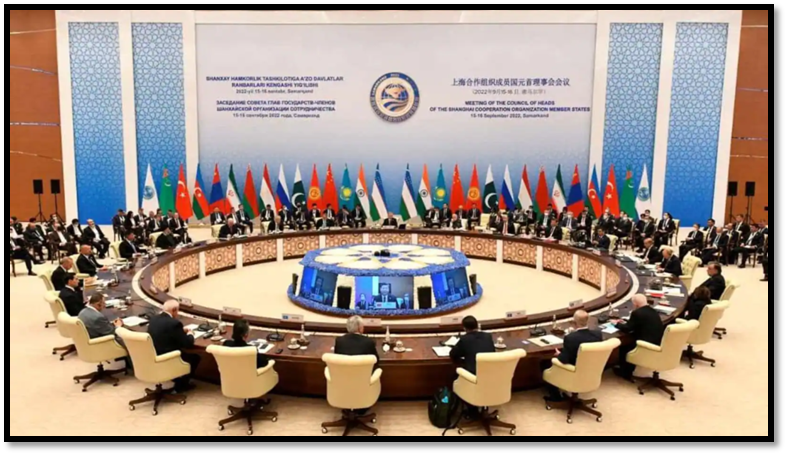
Context
- Recently, at the 26th SCO Summit in Bishkek, Kyrgyzstan, Prime Minister of India called for dismantling the entire ecosystem of terrorism, including terror financing, recruitment, radicalisation and safe havens.
- The year 2026 marks the 25th anniversary of the SCO, with leaders discussing its future roadmap for peace, security, stability and prosperity in the region.
Key Outcomes & Highlights
- Bishkek Declaration: Adopted alongside 4 MoUs and over 20 decisions/statements covering climate action, energy conservation, nuclear safety, and combating drug trafficking.
- SCO Chairmanship Transition: Kyrgyzstan concluded its presidency, handing over the SCO Chairmanship for 2026–27 to Pakistan.
- Stand on Global & Regional Security:
- Afghanistan: Called on the Taliban administration in Kabul to establish an inclusive government representing all ethnopolitical groups and highlighted drug trafficking as a regional security threat.
- West Asia & Persian Gulf: Expressed deep concern over instability in West Asia, noting its adverse impacts on maritime safety, global supply chains, and energy security.
- Global Defense Initiatives: Criticized the unilateral deployment of global missile defense systems by certain nations as a factor destabilizing international security.
India’s Core Agenda & Proposals
- Pillars of Engagement: Reaffirmed commitment to the vision of Security, Connectivity, and Opportunity across Eurasia.
- Zero-Tolerance on Terrorism: Demanded dedicated international action to dismantle the terror ecosystem (financing, recruitment, and safe havens) with no double standards.
- Sovereignty in Connectivity: Supported infrastructure and economic trade corridors while emphasizing that all connectivity initiatives must strictly respect national sovereignty and territorial integrity.
- India-Led Flagship Initiatives Finalized:
- Inclusion of English as an Official Language in the SCO Charter.
- Launch of the SCO Civilisation Dialogue Forum (First edition to be hosted by India).
- Establishment of the SCO Young Scientist Forum and Young Author’s Conclave.
About Shanghai Cooperation Organization (SCO)
- Establishment: SCO was established in 2001 in Shanghai.
- Founding Members: China, Kazakhstan, Kyrgyzstan, Russia, Tajikistan and Uzbekistan.
- Expanded Members: India (2017), Pakistan (2017), Iran (2023), Belarus (2024).
- Headquarters: Beijing, China.
- Nature: SCO is a permanent intergovernmental international organization focused on regional cooperation.
- Core Focus: Cooperation in areas such as security, counter-terrorism, economic cooperation, connectivity and cultural exchanges.
- Official Languages: Chinese and Russian have traditionally been the official languages of the SCO; the 2026 Bishkek Summit supported/endorsed the inclusion of English as an official language.
- Highest Decision-Making Body: The Council of Heads of State (CHS) is the highest decision-making body. It determines the priorities and major directions of SCO activities and meets once a year.
- Regional Anti-Terrorist Structure (RATS): Located in Tashkent, Uzbekistan; facilitates cooperation against the “Three Evils” — terrorism, separatism and extremism.
| Important CTC from this article for UPSC: SHANGHAI COOPERATION ORGANISATION (SCO) |
Q. With reference to the Shanghai Cooperation Organisation (SCO), consider the following statements:
1. India became a full member of the SCO in 2017.
2. The SCO Secretariat is located in Beijing, while its Regional Anti-Terrorist Structure (RATS) is based in Tashkent.
3. The SCO is a military alliance established primarily to counter NATO.
Which of the statements given above is/are correct?
A. 1 and 2 only
B. 2 and 3 only
C. 1 and 3 only
D. 1, 2 and 3
Answer: A. 1 and 2 only
• Statement 1 – Correct: India became a full member of the SCO in 2017.
• Statement 2 – Correct: The SCO Secretariat is in Beijing, while RATS is headquartered in Tashkent, Uzbekistan.
• Statement 3 – Incorrect: SCO is a regional intergovernmental organisation, not a military alliance like NATO. It focuses on security, economic, political and regional cooperation.