
Context
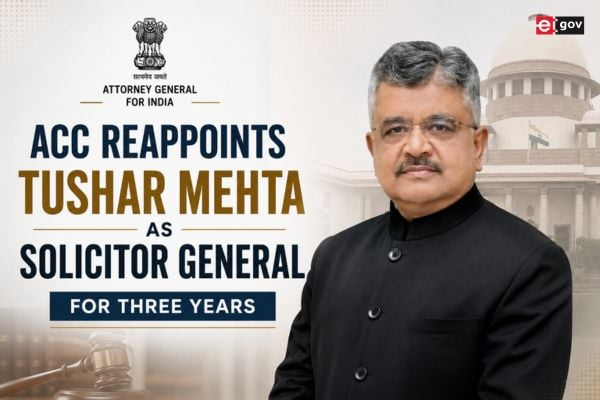
The Appointments Committee of the Cabinet (ACC) has approved the reappointment of Tushar Mehta as the Solicitor-General (SG) of India for an additional three-year term. Alongside the SG, five Additional Solicitors-General (ASGs) for the Supreme Court were also reappointed for a matching tenure to ensure continuity in the Union government’s legal representation before constitutional courts.
Constitutional Status & Evolution
- Nature of Post: Unlike the Attorney General (AG), the Solicitor General of India is a statutory post governed under the Law Officers (Conditions of Service) Rules.
- Rank: The SG acts as the second-highest-ranking law officer in the country and functions subordinate to the AG.
- Colonial Roots: The office originated during British rule to represent the interests of the Crown and was appointed by the Governor-General.
Appointment, Tenure & Removal Rules
- Appointing Authority: Appointed by the President of India on the explicit recommendation of the Prime Minister-led Appointments Committee of the Cabinet (ACC).
- Qualifications: Not explicitly detailed in the Constitution or statutory law; however, selection requires a senior advocate with extensive legal practice.
- Tenure & Location: Holds office for a three-year term and is eligible for reappointment. The official headquarters is located in New Delhi.
- Exit Mechanism: The SG can voluntarily resign by addressing a letter to the President or can be removed by the President on government advice due to misconduct, incompetence, or structural policy shifts following a general election.
Primary Legal Duties
- Advisory & Representation: Advises the Government of India on critical legal matters and appears in the Supreme Court or High Courts on its behalf.
- Presidential References: Represents the Union in the Supreme Court during constitutional references made by the President under Article 143.
- Institutional Support: Collaborates closely with and assists the Attorney General while coordinating with various Union ministries to streamline litigation.
Service Limitations & Prohibitions
- Non-Binding Character: The legal advice rendered by the SG is strictly advisory and does not bind the executive.
- Private Practice Ban: Barred from private practice or representing any private party against the Government of India or Public Sector Undertakings (PSUs).
- Holding Outside Offices: Cannot accept outside appointments, join any Ministry/Department, or accept a role in any PSU/statutory body without formal clearance via the Department of Legal Affairs.
The Comparative Matrix: Solicitor General vs. Attorney General
| Parameter | Solicitor General of India (SG) | Attorney General for India (AG) |
| Status | Statutory Post (Subordinate Rank) | Constitutional Post (Article 76) |
| Hierarchy | Second-highest law officer in the country | Highest law officer in the country |
| Parliamentary Rights | No right to participate in Parliamentary proceedings | Holds the right to speak and take part in Parliamentary proceedings |
| Primary Function | Assists the AG and coordinates specific litigation | Oversees broader national legal affairs and advises on vast constitutional issues |
Historical Trivia
- The Pioneer: C.K. Daphtary was the first Solicitor General of India (appointed in 1950) and remains the longest-serving SG (13 years).
- The Incumbent: Tushar Mehta (appointed originally in 2018) holds the distinction of being the second longest-serving Solicitor General of India.
With respect to the Solicitor General of India, consider the following statements:
I. The Solicitor General of India is a statutory post subordinate to the Attorney General of India.
 II. The Solicitor General possesses the right to participate in parliamentary proceedings.
III. The Solicitor General is mandated to represent the government in the Supreme Court for references made by the President under Article 143.
(A.) I and II
(B) I and III
(C) II and III
(D) I, II and III
Answer: B
Explanation:
Statement I is correct: The Solicitor General is a statutory post established under the Law Officers (Conditions of Service) Act, 1968, and functions as the second-highest-ranking law officer subordinate to the Attorney General.
Statement II is incorrect: Unlike the Attorney General, the Solicitor General does not have the right to participate in parliamentary proceedings.
Statement III is correct: It is a designated duty of the Solicitor General to represent the government in the Supreme Court in any reference made by the President under Article 143.