
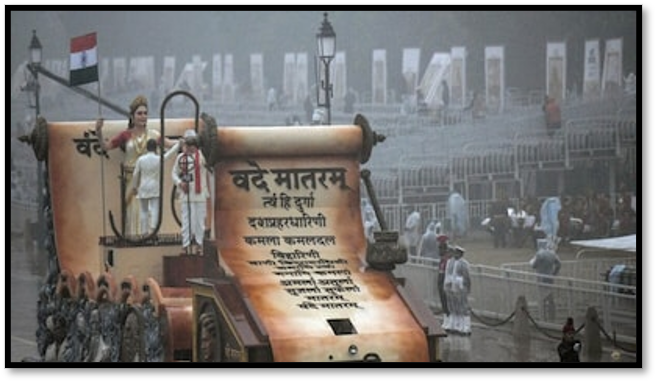
Context
- Recently, the Supreme Court held that refusing to sing or recite the National Song on grounds of conscience or religious belief cannot by itself justify criminal prosecution, and it has sought the Union Government’s response to a petition challenging the Prevention of Insults to National Honour (Amendment) Act, 2026 along with related Home Ministry directions.
Supreme Court’s Observations
- The Court observed that while the National Song is not in dispute, the State cannot infringe the fundamental rights under Articles 25 and 26 relating to religious freedom.
- A conscientious objector cannot be compelled to sing or recite one or more stanzas of the National Song by subjecting them to criminal prosecution.
- The Court referred to the 1986 Supreme Court judgment in Bijoe Emmanuel v. State of Kerala, which upheld the right to religious freedom of students who respectfully declined to sing the National Anthem.
Constitutional Provisions Involved
- Article 25: Freedom of conscience and the right to freely profess, practise and propagate religion.
- Article 26: Freedom to manage religious affairs, subject to constitutional limitations.
- Article 19: Protects specified freedoms, including freedom of speech and expression.
- The issue involves balancing respect for national symbols with fundamental rights and freedom of conscience.
About Prevention of Insults to National Honour Act, 1971
- The Act provides legal protection to:
- National Flag
- Constitution
- National Anthem
- 2026 Amendment: The amendment expanded Section 3 to include the National Song, Vande Mataram, along with the National Anthem.
- It provides punishment for intentionally:
- preventing the singing of the National Anthem or National Song, or
- causing disturbance to an assembly engaged in such singing.
- Punishment: Imprisonment up to 3 years, or fine, or both.
About Vande Mataram
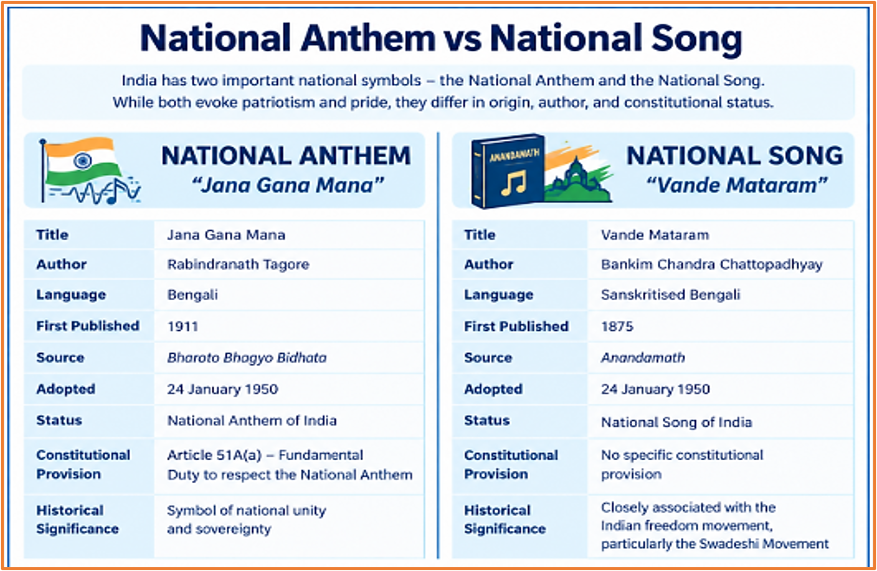
| Aspect | Fact |
| Composer | Bankim Chandra Chattopadhyay |
| Language | Sanskritised Bengali |
| First published | 1875 |
| Novel | Anandamath |
| First Sung | It was first sung at the 1896 session of the Indian National Congress in Calcutta, by Rabindranath Tagore. |
| Freedom movement | Associated particularly with the Swadeshi Movement |
| Status | The first two stanzas were adopted as the National Song of India. |
| National Recognition | On 24 January 1950, Dr Rajendra Prasad stated in the Constituent Assembly that Vande Mataram would be honoured equally with Jana Gana Mana. |
| Important CTC from this article for UPSC: Article 25 Article 26 |
Q. Consider the following statements regarding the legal and constitutional status of National Symbols in India:
1. The Supreme Court recently held that a democratically elected government has the authority to define the National Song and determine its scope or length.
2. Refusing to sing the National Song or the National Anthem can be subjected to criminal prosecution and penal consequences under Article 51A (Fundamental Duties).
3. The protection extended to conscientious objectors who refuse to sing based on religious freedom or conscience is rooted in the principles laid down in the Bijoe Emmanuel v. State of Kerala (1986) case.
Which of the statements given above is/are correct?
(a) 1 only
(b) 1 and 3 only
(c) 2 and 3 only
(d) 1, 2 and 3
Correct Answer: (b) 1 and 3 only
Statement 1 is correct: The Supreme Court observed that a democratically elected state has the prerogative to give shape and aspiration to what the National Song is, whether it be two or four stanzas.
Statement 2 is incorrect: The Court explicitly ruled that individuals cannot be subjected to criminal prosecution or penal consequences for refusing to sing one or all stanzas of the National Song on grounds of conscience or religion. Fundamental Duties (Article 51A) cannot override individual Fundamental Rights (Articles 25 and 26).
Statement 3 is correct: The Court reaffirmed that the precedent set in the Bijoe Emmanuel v. State of Kerala (1986) case regarding religious freedom, constitutional tolerance, and the right to silent objection continues to hold true.