
After Reading This Article You Can Solve This UPSC Mains PYQ 2020:
Quadrilateral Security Dialogue (Quad)’ is transforming itself into a trade bloc from a military alliance, in present times – Discuss. 15 Marks, (GS-2, International Relation)
Context
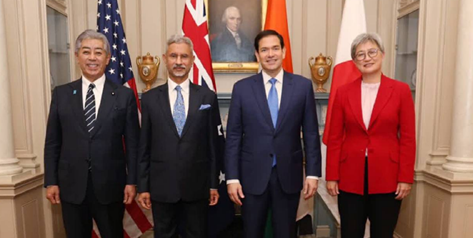
The recent meeting of the Quad Foreign Ministers highlighted both the grouping’s growing institutional agenda and emerging internal contradictions amid shifting global geopolitics.
Evolution of the Quad
- 2007 – Initial formation at official level.
- 2017 – Revived amid growing Indo-Pacific concerns.
- 2021 – Elevated to leader-level summits.
- 2024 – India assumed Quad chairmanship.
Key Outcomes of Recent Quad Foreign Ministers’ Meeting
- Upgraded Maritime Transparency: Formalized the IPMSC and IPMDA surveillance frameworks to pool radar/satellite assets, actively tracking “dark shipping” and countering grey-zone coercion.
- Operational Interoperability: Launched the Quad-at-Sea Ship Observer Mission to embed naval personnel on partner vessels, building deep tactical trust for regional humanitarian or security standoffs.
- Strategic Infrastructure Alternative: Initiated the Quad’s first-ever joint physical infrastructure project to build a commercial port in Fiji, offering transparent financing over predatory debt models.
- Supply Chain De-risking: Finalized a critical minerals cooperation initiative to secure parallel, non-Chinese extraction and processing lines for critical green-tech and defense manufacturing.
- Rules-Based Geopolitical Alignment: Reaffirmed absolute diplomatic commitments to UNCLOS, freedom of navigation, and territorial integrity, while issuing explicit, joint counter-terror statements naming localized threats.
Major Challenges Facing the Quad
1. Strategic Divergence Among Members
- U.S. Unilateralism vs. Minilateral Consensus:
- Washington’s unpredictable foreign policy shifts—such as sudden diplomatic re-engagements with China and Russia, alongside unilateral military operations in West Asia—often bypass regional consultations.
- During the 2026 West Asia crisis, the US engaged in direct hostilities with Iran (including intercepting an Iranian ship in the Indian Ocean) and initiated backchannel mediation via Pakistan without briefing its Quad allies.
- This selective transparency forces partners like India and Japan (who are deeply dependent on West Asian oil and trade lanes) to absorb security shocks blindly, causing a distinct trust deficit.
2. Lack of Consensus on China
- Asymmetric Threat Perceptions:
- The four members have vastly different geopolitical constraints regarding Beijing. Japan and Australia are formal, treaty-bound military allies of the US, viewing the Quad as an extension of a hard security containment strategy against China.
- India shares a direct, contested land border (LAC) with China. Bound by its foundational policy of strategic autonomy, New Delhi completely avoids formal military alliances, preferring defensive balancing and keeping the Quad’s official focus strictly on non-military, inclusive “public goods” delivery.
- This structural mismatch makes it difficult for the grouping to agree on hard-power red lines or clear collective security protocols when China behaves aggressively.
3. Institutional Weakness
- Ad-Hoc Structural Framework:
- Unlike traditional security alliances like NATO, the Quad is fundamentally a loose, minilateral consultative forum. It possesses no permanent headquarters, no central secretariat, and lacks any legally binding treaty foundation.
- Without a formal administrative core, the tracking and implementation of complex joint initiatives (such as Open RAN telecom rollouts or the Fiji port construction) depend entirely on changing political administrations and bureaucratic momentum in individual capitals.
4. Delayed Summit Diplomacy
- The Institutional Impasse:
- The Quad’s highest level of commitment is demonstrated through its annual Leader-Level Summit. However, complex bilateral frictions have repeatedly derailed this mechanism during India’s current chairmanship cycle.
- India-US ties suffered setbacks due to diplomatic standoffs (e.g., the Pannun-Nijjar case in 2024), disruptive tariff and trade policies introduced by the Trump administration in 2025, and deep differences over security claims like “Operation Sindoor.”
- With the summit remaining unscheduled well into mid-2026, failing to convene the four heads of state forces India to pass the Chair to Australia without holding a summit. This risks signaling a permanent, functional downgrade of the alliance back to a basic ministerial dialogue.
5. Perception Problem
- The “Asian NATO” Narrative vs. Regional Acceptance:
- The Quad struggles with a severe branding crisis. Beijing consistently weaponizes this, labeling the group an exclusive, anti-China containment clique or a “small circle” designed to destabilize regional peace.
- Central groupings like ASEAN (Association of Southeast Asian Nations) view the Quad with deep suspicion, worrying that its heavily security-centric, maritime-dominated focus will turn the Indo-Pacific into a dangerous arena for great-power competition. This hesitance severely restricts the Quad’s ability to gain broad diplomatic buy-in from smaller, critical neutral states.
Why the Quad Still Matters (Significance for India)
- Net Maritime Security Provider: It serves as a vital hard-power multiplier that anchors India’s Indian Ocean dominance through intelligence-sharing networks like IPMDA to counter grey-zone coercion and dark shipping.
- Defensive Strategic Balancing: It provides India with a formidable diplomatic and maritime shield to balance China’s aggressive expansionism along the Line of Actual Control (LAC) and the wider Indo-Pacific without forcing New Delhi into a formal military alliance.
- Geo-Economic Resilience: It secures India’s economic future by building parallel, trustworthy supply chains for critical minerals and semiconductors, drastically reducing a vulnerable reliance on Chinese manufacturing.
- Alternative Infrastructure Vehicle: It enables India to co-fund high-quality connectivity projects—such as the Fiji port—offering regional states a transparent, sustainable alternative to China’s predatory Belt and Road Initiative (BRI) debt diplomacy.
- Global Anti-Terror Alignment: It elevates India’s national security imperatives to the global stage, leveraging joint platforms to secure explicit international condemnation of cross-border terrorism following flashpoints like the Pahalgam attack.
Way forward
- Institutionalize with Flexibility: Establish a fixed, predictable annual Summit calendar backed by a rolling joint secretariat to immunize functional cooperation from passing bilateral frictions.
- Commit to a “No-Surprise” Doctrine: Create dedicated crisis-communication hotlines to ensure prior strategic consultation and eliminate unilateral geopolitical moves that shock partner economies.
- Broaden the Non-Military Agenda: Prioritize tangible regional public goods like climate resilience funding, critical mineral supply lines, and deep-sea connectivity infrastructure over pure military alignment.
- De-escalate “Containment” Rhetoric: Rebrand the Quad as an inclusive, positive-agenda developmental platform to clear regional anxieties and win the trust of neutral blocs like ASEAN.
- Operationalize Asymmetric Convergence: Respect individual national policy frameworks—like India’s strategic autonomy and US formal treaty networks—allowing flexible national approaches toward China while remaining united on a rules-based order.
Conclusion
The Quad’s strength lies not in complete strategic convergence, but in its shared vision of a rules-based order. For the grouping to realize its worthy objectives, partners must engage in collective reflection, ensuring that tactical divergence does not overpower strategic