
Context
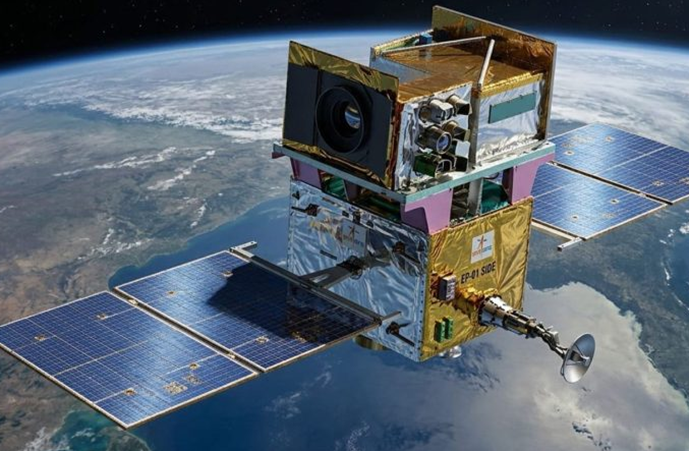
- India and France are jointly developing TRISHNA (Thermal infraRed Imaging Satellite for High-resolution Natural Resource Assessment), an Earth-observation mission of ISRO and CNES. The mission is currently targeted for launch in 2027.
Key Features
- Partners: ISRO (India) and Centre National d’Etudes Spatiales (CNES)/ (France).
- Objective: High-resolution monitoring of Earth’s surface temperature and energy balance.
- Orbit: Planned 761-km Sun-synchronous orbit.
- Spatial resolution: Around 60 metres.
- Revisit: About every 3 days at the equator.
- Mission life: Approximately 5 years, with possible extension.
- Launch vehicle: ISRO’s PSLV is planned for the launch.
Payloads
| Payload | Agency | Function |
| Thermal Infrared (TIR) | CNES/France | Measures surface temperature and emissivity |
| The Visible – Near Infra-Red – ShortWave Infra-Red (VNIR-SWIR) | ISRO/India | Observes visible, near-infrared and short-wave infrared bands |
Significance
- Agriculture: Monitoring crop water stress and improving irrigation efficiency.
- Water management: Assessing evapotranspiration and surface-water dynamics.
- Climate studies: Monitoring surface energy balance and temperature variations.
- Urban studies: Mapping urban heat islands.
- Cryosphere: Monitoring glaciers, snow and ice.
- Coastal and inland waters: Studying thermal characteristics and hydrology.
- Disaster/environmental monitoring: Detecting temperature anomalies, including those associated with volcanic activity.
- Global Contributions
- Supports international platforms like GEOGLAM (for agricultural monitoring), Global Water Watch, and the UN’s Sustainable Development Goals by generating Essential Agricultural Variables (EAVs) and Essential Climate Variables (ECVs).
| Important CTC from this article for UPSC Trishna Mission ISRO |
Q. Which two space agencies are collaborating on the TRISHNA satellite mission?
(a) ISRO and CNES
(b) ISRO and NASA
(c) CNES and ESA
(d) ISRO and JAXA
Answer: (a) ISRO and CNES
Explanation: TRISHNA (Thermal Infra-Red Imaging Satellite for High-resolution Natural Resource Assessment) is a collaborative mission between ISRO (Indian Space Research Organisation) and CNES (National Centre for Space Studies, France).