
Important for GS Prelims: Economy
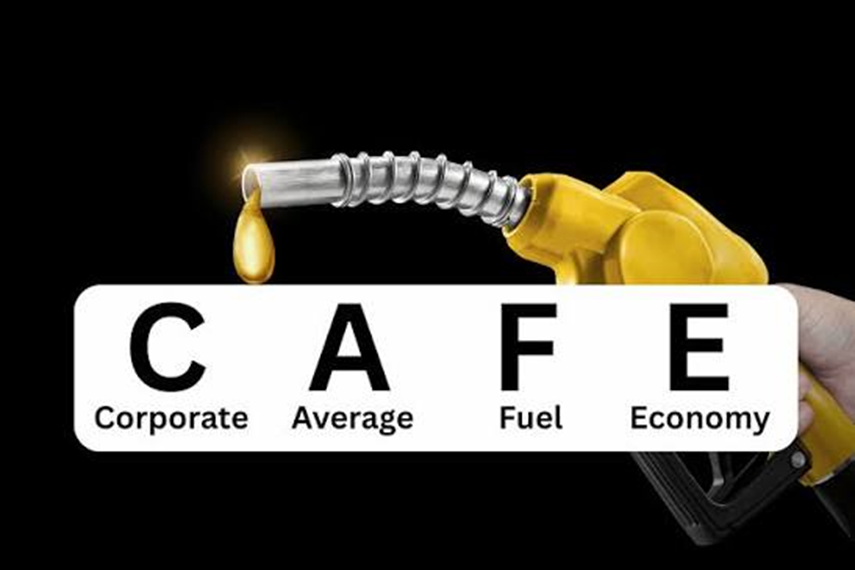
About CAFE Norms
- What are CAFE Norms? Government-mandated regulatory standards that limit the weighted average fuel consumption and CO₂ emissions of an automaker’s entire vehicle fleet, rather than evaluating individual car models.
- Nodal Agency: Established and monitored by the Bureau of Energy Efficiency (BEE) under the Ministry of Power.
- Applicability: Applies strictly to M1 category passenger vehicles (vehicles designed to seat up to nine individuals and weighing under 3,500 kg).
CAFE-III: Timeline & Emission Targets
- Implementation Period: Scheduled to be active from April 1, 2027, through March 31, 2032.
- Stricter Fleet Targets: Automakers are mandated to drastically reduce their average fleet CO₂ emissions from roughly 113 g/km (the FY27 baseline at the end of CAFE-II) down to 78.9 g/km by FY32.
- Removal of Small Car Exemptions: An earlier proposal offering a 3g/km emission relief specifically for lightweight petrol cars (under 909 kg) has been scrapped to ensure a flatter, fairer regulatory curve.
Key Mechanisms
- The ‘Super Credit’ Scheme: Manufacturers are awarded mathematical multipliers for selling green vehicles, directly lowering their fleet average:
- Battery EVs (BEV): 3.0 multiplier (one EV sale counts as three clean vehicles).
- Plug-in Hybrids (PHEV): 2.5 multiplier.
- Strong Hybrids: 1.6 multiplier.
- Energy-Efficiency Tech Incentives: Automakers earn discounts on their emission scores by integrating any of 12 specified energy-efficient technologies (e.g., start-stop systems, 6-speed transmissions, high-efficiency air conditioning).
- Compliance Flexibility: The framework legally permits carbon credit trading between manufacturers and the carry-forward of excess compliance to subsequent years.
Conclusion
Formulated by the Bureau of Energy Efficiency, CAFE-III norms mandate a sharp reduction in passenger fleet CO₂ emissions to 78.9 g/km between 2027 and 2032. By utilizing super-credits and compliance flexibilities, the framework accelerates the adoption of EVs, CNG, and hybrids to strengthen India’s energy security and achieve its climate goals.
| This concept has been elaborately discussed in the following article: Transitioning to Sustainable Mobility: Evaluating India’s Draft CAFE III Norms |