
Important for GS Prelims: Science and Technology
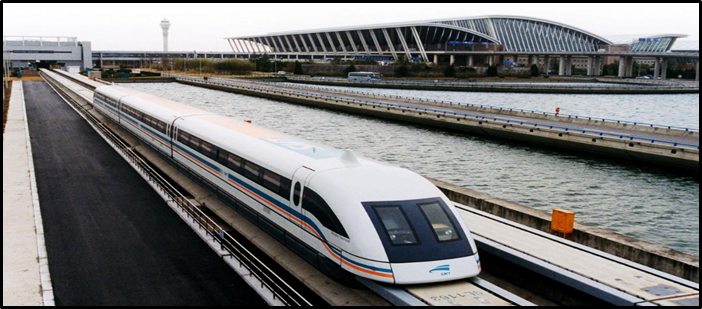
About Maglev trains
- A contactless land transit technology using powerful magnetic fields to levitate and propel high-speed vehicles.
- Conceptualized in the early 1900s; eliminates wheel-on-rail friction to enable speeds exceeding conventional rail systems.
- Relies on precision-engineered guideways with electromagnets and coils to govern levitation, stabilization, and propulsion.
Importance of Electrodynamic Suspension (EDS) in Maglev technology
- Electrodynamic Suspension (EDS) uses repulsive force from superconducting magnets cooled to minus 269°C, enabling a larger ~100 mm levitation gap and self-stabilizing operation that supports very high speeds — tested at 603 km/h on Japan’s Yamanashi line, well above EMS’s ~431 km/h (Shanghai Maglev).
- This makes EDS the technological benchmark for next-generation high-speed rail, though its cryogenic cooling requirement makes it costlier and more complex than the commercially dominant EMS system.
Key Features of Maglev technology
Achieves levitation through opposing magnetic fields; lateral stability maintained via guidance magnets.
- It Generates forward thrust through an integrated guideway linear motor system with shifting magnetic poles.
- Controls acceleration/deceleration by varying alternating current frequency; braking uses magnetic field reversal with regenerative energy capture.
- Operation Control System (OCS) divided into vital Automatic Train Protection (ATP) and non-vital Automatic Train Operation (ATO).
- India’s Ministry of Railways floated an EoI on 6th September 2016 for a 500 km/h PPP corridor (200–500 km); six firms including BHEL and Swissrapide AG participated, but the initiative concluded without agreement.
| Particular | Details |
| EMS (Shanghai Maglev) | Attractive force; ~10 mm (8–12 mm) gap; up to 431 km/h; Transrapid (Siemens/ThyssenKrupp) since Jan 2004 |
| EDS (Yamanashi Line, Japan) | Repulsive force; superconducting magnets at minus 269°C; ~100 mm (10 cm) gap; tested at 603 km/h |
| India EoI | Floated 6th September 2016; target 500 km/h over 200–500 km corridor |
Conclusion
Originating in the early 1900s, Maglev technology achieves frictionless, ultra-high speeds by utilizing Electromagnetic Suspension (EMS) or superconducting Electrodynamic Suspension (EDS), as demonstrated in China and Japan. In India, a 2016 initiative by the Ministry of Railways to develop a 500 km/h Maglev corridor was ultimately shelved without a final agreement.