
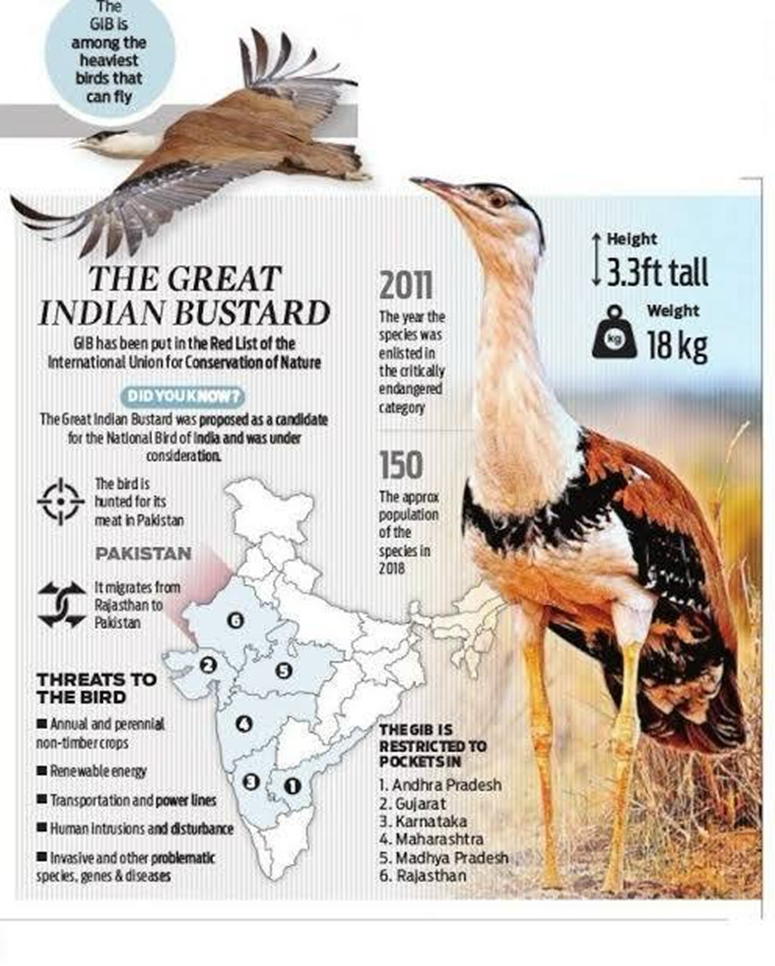
Context : The Supreme Court is reviewing its 2021 order that mandated the blanket undergrounding of all power lines in the Great Indian Bustard’s (GIB) habitat. This review comes after the Centre cited practical and technical impossibilities in implementing the order, especially for high-voltage lines.
What is the Core Conflict?
The issue pits energy infrastructure against the survival of a critically endangered species.
- The Threat: Overhead power lines are the primary cause of GIB mortality due to collisions.
- The Centre’s Stance: Undergrounding high-voltage lines is unfeasible due to high transmission losses, maintenance challenges, and safety concerns.
Key Facts: Great Indian Bustard (GIB)
- Scientific Name: Ardeotis nigriceps
- Habitat: Dry grasslands and scrublands; primarily found in the Thar Desert (Rajasthan).
- Key Threat: Collision with power transmission lines.
- Conservation Status:
- IUCN Red List: Critically Endangered
- Wildlife (Protection) Act, 1972: Schedule I
- CITES: Appendix I
What is the Path Forward?
The Supreme Court has established a new seven-member expert committee.
- Mandate: To identify critical areas where undergrounding is mandatory.
- Objective: To suggest feasible, area-specific solutions for conservation, potentially including bird diverters in other areas, balancing GIB protection with practical energy transmission.