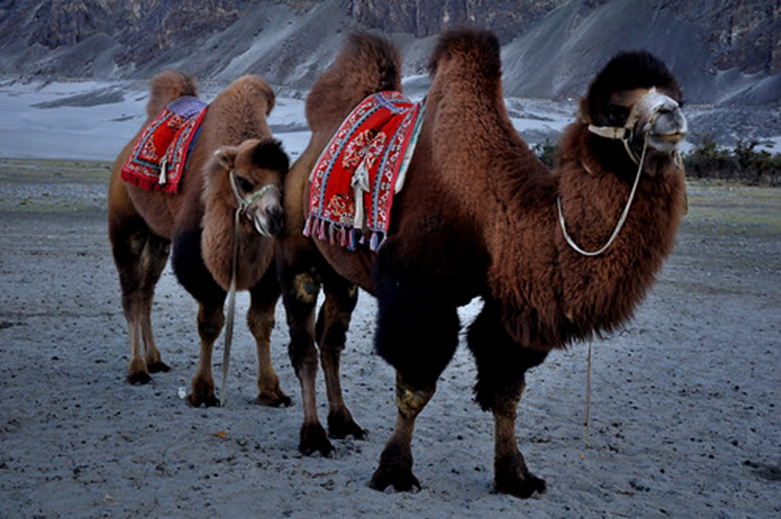
Why In the News?
Recently, the double-humped Bactrian camels made a historic debut at the 77th Republic Day Parade on Kartavya Path. Two camels, named Galwan and Nubra, were featured as part of the Indian Army’s animal contingent, symbolizing their formal induction into the military for operational logistics in the high-altitude terrains of Eastern Ladakh.
This development follows extensive trials by the Defence Institute of High-Altitude Research (DIHAR), a unit of the DRDO, confirming the species’ ability to outperform traditional pack animals like mules in extreme sub-zero temperatures.
1. Species Profile: Double-Humped Bactrian Camel
The Bactrian camel (Camelus bactrianus) is a large, even-toed ungulate native to the steppes of Central Asia. It is distinguished from its cousin, the Dromedary camel, by having two humps on its back.
A. Anatomical and Physiological Adaptations
- The Humps: Contrary to popular belief, the two humps store fat, not water. This fat can be converted into energy and metabolic water, allowing the camel to survive for up to two weeks without food.
- Cold Resistance: They possess a thick, shaggy coat that insulates them against temperatures as low as -40°C. They shed this coat in summer when temperatures can exceed 30°C.
- Water Efficiency: These camels are among the few mammals capable of eating snow to meet their hydration needs in winter. They can also drink saline or brackish water that most other animals would find toxic.
- Physical Protection: They have sealable nostrils and double rows of long eyelashes to protect against blowing sand and snow. Their broad, cushioned feet act like natural snowshoes, preventing them from sinking into soft sand or snow.
2. Distribution and Habitat
- In India: They are found exclusively in the Nubra Valley of the Ladakh Union Territory. They were originally brought to India via the ancient Silk Route by traders from Yarkand (China).
- Global Range: They are native to Central Asia, including Mongolia, China, Kazakhstan, Turkmenistan, and Uzbekistan.
- Habitat: They thrive in cold, arid deserts, rocky mountain massifs, and stony plains at altitudes ranging from 9,000 to 17,000 feet.
3. Conservation Status
It is critical to distinguish between the domesticated and wild species:
- Wild Bactrian Camel (Camelus ferus): This is a genetically distinct species from the domestic one. It is categorized as Critically Endangered on the IUCN Red List. It is found in only a few locations in the Gobi and Taklamakan deserts.
- Domestic Bactrian Camel (Camelus bactrianus): While their population in Ladakh is small (approx. 300–400), they are not considered critically endangered globally due to large domestic populations in Central Asia.
- Threats: Habitat loss, illegal hunting for subsistence, and potential hybridization with domestic camels (which dilutes the wild gene pool).
4. Comparison: Bactrian vs. Dromedary Camel
| Feature | Bactrian Camel | Dromedary Camel |
| Humps | Two (Shape of ‘B’) | One (Shape of ‘D’) |
| Climate | Cold Deserts (Ladakh/Gobi) | Hot Deserts (Rajasthan/Sahara) |
| Coat | Shaggy, thick long hair | Short, sparse hair |
| Gait | Moves both legs of one side together | Moves both legs of one side together |
| Load Capacity | Up to 250 kg (High altitude) | Approx. 150-200 kg (Low altitude) |
Q. With reference to the Bactrian camel, consider the following statements:
1. In India, it is found naturally only in the cold deserts of the Nubra Valley in Ladakh.
2. The humps of the Bactrian camel are specialized organs that store water to survive long droughts.
3. While the domestic Bactrian camel is widespread, the Wild Bactrian camel (Camelus ferus) is listed as 'Critically Endangered' by the IUCN.
4. It is an even-toed ungulate that can survive by consuming saline water and snow.

How many of the statements given above are correct?
(a) Only one
(b) Only two
(c) Only three
(d) All four

Solution: (c)
STATEMENT 1 IS CORRECT: In India, the double-humped camel is found only in the Nubra Valley, Ladakh.
STATEMENT 2 IS INCORRECT: The humps store fat (adipose tissue), not water. This fat is metabolized for energy and water during scarcity.
STATEMENT 3 IS CORRECT: The Wild Bactrian camel is a separate species and is one of the most endangered large mammals on Earth.
STATEMENT 4 IS CORRECT: They are even-toed ungulates (Artiodactyla) and possess unique physiological adaptations to drink saline water and eat snow.
Practice Today’s MCQs