
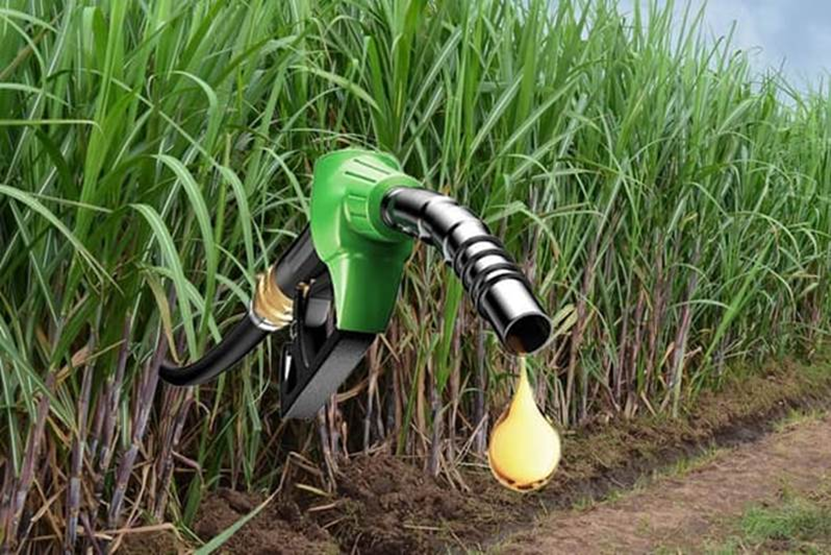
Context
Recently, the Economic Survey 2025-26 has provided a comprehensive review of the Ethanol Blending Programme (EBP), highlighting that India has saved over ₹1.44 lakh crore in foreign exchange and substituted approximately 245 lakh metric tonnes of crude oil as of August 2025.
While the Survey celebrates these “tangible gains” and the achievement of the 20% blending target (E20) ahead of schedule, it also raises a critical “early warning signal.”
It flags an emerging tension between energy security and food security, noting that aggressive ethanol pricing is distorting cropping patterns by incentivizing maize at the expense of pulses and oilseeds.
1. About Ethanol and the Ethanol Blended Petrol (EBP) Programme
- Definition: Ethanol is a high-octane bio-alcohol produced primarily through the fermentation of sugars by yeast or via petrochemical processes.
- The Programme: Launched in 2003, the EBP Programme seeks to mix ethanol with petrol to reduce the consumption of fossil fuels.
- Nodal Ministry: Ministry of Petroleum and Natural Gas (MoP&NG).
- Implementation: Public Sector Oil Marketing Companies (OMCs) procure ethanol from domestic distilleries at prices fixed by the government.
2. National Policy on Biofuels, 2018 (Amended 2022)
The policy provides a framework to promote the use of biofuels in India.
Key Amendments in 2022:
- Target Advancement: The target of 20% ethanol blending in petrol (E20) was moved forward from 2030 to ESY 2025-26.
- Feedstock Expansion: The policy expanded the list of permitted raw materials to include sugarcane juice, sugar-containing materials (sugar beet, sweet sorghum), starch-containing materials (corn, cassava), and damaged food grains (broken rice, rotten potatoes) unfit for human consumption.
- Production in SEZs: It allows the production of biofuels by units located in Special Economic Zones (SEZs) and Export Oriented Units (EoUs).
- NBCC: The National Biofuel Coordination Committee, chaired by the Minister of Petroleum and Natural Gas, oversees the implementation and diversion of surplus food grains.
3. Categorization of Biofuels
- 1st Generation (1G): Produced from edible sources like sugar, starch, and vegetable oils.
- 2nd Generation (2G): Produced from non-edible sources and agricultural residues like rice straw, wheat straw, corn cobs, and bamboo (e.g., Panipat and Numaligarh refineries).
- 3rd Generation (3G): Produced from algae and other microbes grown in various environments.
- 4th Generation (4G): Involves carbon capture and storage (CCS) combined with genetically engineered crops to improve yield.
4. Significance of the Programme
| Benefit | Description |
| Energy Security | Reduces India’s 85% dependence on imported crude oil. |
| Environmental Impact | Ethanol contains oxygen, leading to more complete combustion and a 30% reduction in Carbon Monoxide emissions. |
| Farmer Income | Provides a remunerative market for sugarcane and maize; farmers are now being called “Urjadaatas” (Energy Givers). |
| Forex Savings | Significant reduction in the current account deficit by saving billions in foreign exchange. |
5. Challenges and Concerns
- Food vs. Fuel: Diversion of food grains like maize and rice can lead to food inflation and potential shortages.
- Water Intensity: Sugarcane is a water-guzzling crop; producing one liter of ethanol from sugarcane requires roughly 2,860 liters of water.
- Vehicle Compatibility: Older vehicles (pre-BS VI) may face corrosion of rubber and plastic parts when using E20 fuel without modifications.
- Interstate Movement: Complex tax structures and restrictions on the movement of ethanol between states can hinder supply chains.
Q. With reference to the Ethanol Blending Programme (EBP) in India, consider the following statements:
1. The National Biofuel Coordination Committee (NBCC) is chaired by the Prime Minister of India.
2. The 2022 amendment to the National Policy on Biofuels permits the use of damaged food grains and surplus rice from FCI for ethanol production.
3. Ethanol has a higher energy content than gasoline, which leads to improved vehicle mileage in higher blends.

How many of the statements given above are correct?
(a) Only one
(b) Only two
(c) All three
(d) None

Correct Answer: (a)
Solution
STATEMENT 1 INCORRECT: The NBCC is chaired by the Union Minister of Petroleum and Natural Gas, not the Prime Minister.
STATEMENT 2 CORRECT: The 2022 amendment specifically expanded feedstocks to include damaged food grains and surplus rice with the approval of the NBCC.
STATEMENT 3 INCORRECT: Ethanol actually has about 27% lower energy content than gasoline, which can lead to a slight reduction in mileage (approx. 6-7% for E20) unless engines are specifically tuned.