
Context
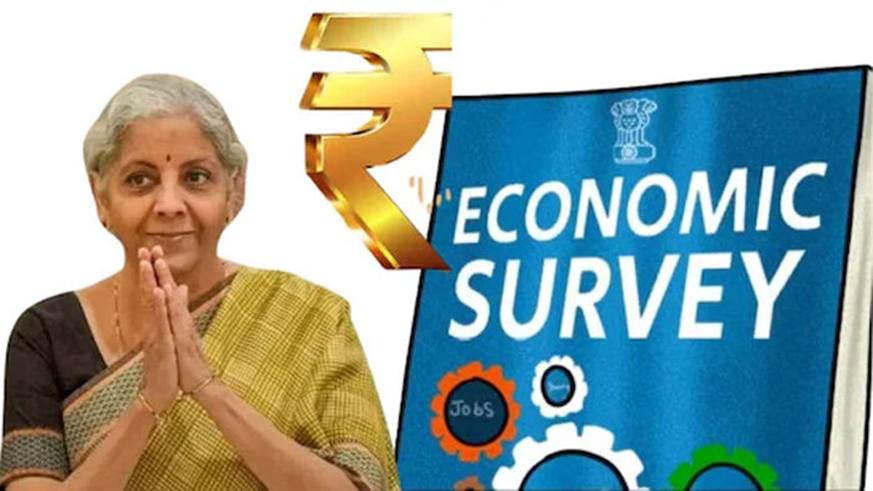
Recently, the Union Minister for Finance and Corporate Affairs, Smt. Nirmala Sitharaman, tabled the Economic Survey 2025-26 in the Parliament. This document serves as the official annual report of the Ministry of Finance, reviewing the developments in the Indian economy over the past financial year while providing an outlook for the upcoming fiscal. It is prepared by the Economics Division of the Department of Economic Affairs under the guidance of the Chief Economic Advisor (CEA). The survey is a critical precursor to the Union Budget as it provides the analytical foundation and statistical data required to understand the country’s macroeconomic stability and sectoral performance.
Economic Survey 2024-25 & 2025-26: Key Highlights
1. Growth and Macroeconomic Stability
- GDP Growth: The First Advance Estimates for FY26 place the real GDP growth at 7.4%, reaffirming India’s status as the fastest-growing major economy for the fourth consecutive year.
- GVA Growth: The Real Gross Value Added (GVA) is estimated to grow by 7.3% in FY26, following a steady 6.4% growth in FY25.
- Viksit Bharat Path: The Survey emphasizes that to achieve the vision of Viksit Bharat by 2047, India needs to sustain an average growth rate of 8% at constant prices for the next two decades.
2. Fiscal and Monetary Developments
- Fiscal Deficit: The government achieved a fiscal deficit of 4.8% of GDP in FY25, surpassing the budgeted target of 4.9%. The target for FY26 is further reduced to 4.4%.
- Banking Health: The Gross Non-Performing Assets (GNPA) ratio of Scheduled Commercial Banks dropped to a 12-year low of 2.6% as of September 2024.
- Monetary Policy: In December 2024, the Cash Reserve Ratio (CRR) was reduced from 4.5% to 4% to inject liquidity into the system, while the Repo Rate remained stable at 6.5% for much of the period.
3. Inflation Dynamics
- Headline Inflation: Retail headline inflation (CPI) softened significantly, averaging 1.7% for the April-December 2025 period, a sharp decline from 4.9% in the previous year.
- Food Inflation: While headline inflation stayed low, food inflation remained a point of monitoring in earlier quarters due to supply chain disruptions and weather vagaries affecting pulses and vegetables.
4. Sectoral Performance
- Agriculture: This sector recorded a rebound growth of 3.8% in FY25. Total foodgrain production for 2024-25 reached a record 1647.05 Lakh Metric Tonnes (LMT).
- Industry: The industrial sector grew by 6.2% in FY25, supported by construction and utility services. Notably, 99% of smartphones sold in India are now manufactured domestically.
- Services: The services sector remains the strongest driver, contributing 55% to the GVA. Services exports reached an all-time high of USD 387.6 billion in FY25.
5. External Sector and Infrastructure
- Forex Reserves: India’s foreign exchange reserves rose to USD 701.4 billion as of January 2026, providing a cover for 11 months of imports.
- Remittances: India remains the world’s largest recipient of remittances, hitting a record USD 135.4 billion in FY25.
- Energy Transition: Renewable energy capacity saw a year-on-year increase of 15.8%, driven primarily by solar and wind power.
6. Social Sector and New Concepts
- Healthcare: Out-of-pocket expenditure as a percentage of total health expenditure has declined from 62.6% (FY15) to 39.4% (FY22).
- Systemic Deregulation: The Survey advocates for Ease of Doing Business 2.0, focusing on reducing the “compliance burden” at the grassroots level.
- Mittelstand: The Survey introduces the concept of creating a “viable Mittelstand” (referring to the German model of high-quality SME sectors) to bolster India’s manufacturing ecosystem.
Q. With reference to the Economic Survey 2024-25 and 2025-26, consider the following statements:
1. The Gross Non-Performing Assets (GNPA) ratio of Scheduled Commercial Banks has reached its lowest level in over a decade.
2. India's services export growth in FY25 was lower than the growth recorded in FY24 due to global geopolitical tensions.
3. The Survey suggests that for India to become a 'Viksit Bharat' by 2047, it must maintain an average real GDP growth of at least 8% for the next decade or two.

Which of the statements given above is/are correct?
(a) 1 and 2 only
(b) 2 and 3 only
(c) 1 and 3 only
(d) 1, 2 and 3

Correct Answer: (C)
Explanation
STATEMENT 1 CORRECT: The GNPA ratio declined to a 12-year low of 2.6% as of September 2024, reflecting improved banking sector health.
STATEMENT 2 INCORRECT: Services export growth actually surged significantly. In FY25, services exports reached an all-time high of USD 387.6 billion, growing by 13.6%, which was higher than the previous year's growth rate.
STATEMENT 3 CORRECT: The Survey explicitly states that a sustained 8% growth rate is necessary to reach the 2047 developmental goals.