
Context
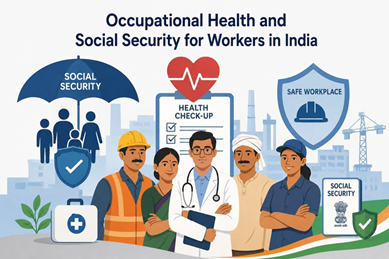
Recently, the Union Ministry of Labour and Employment has announced a program to provide free annual health check-ups for workers aged 40 years and above. This initiative is rooted in the provisions of the new Labour Codes and is implemented via the Employees’ State Insurance Corporation (ESIC).
I. Key Features of the Initiative
- Target Group: Workers aged 40 years or older.
- Mandatory Provision: Check-ups are compulsory for workers in hazardous conditions (e.g., handling toxic chemicals, operating heavy machinery).
- Treatment: If an illness is detected during the check-up, treatment will be provided free of cost at ESIC hospitals and dispensaries.
- Funding: Financed through the ESI Fund, supplemented by beds and doctors from PM-JAY (Ayushman Bharat) empanelled facilities.
II. Legislative Framework for Worker Health in India
- Factories Act, 1948: Focuses on health and safety within factory premises.
- ESI Act, 1948: Provides for health insurance and medical benefits.
- Occupational Safety, Health and Working Conditions (OSH) Code, 2020: Consolidates laws relating to safety and health standards.
III. Key Government Schemes at a glance
1. Employees’ State Insurance (ESI) Scheme
- Type: A multidimensional Social Security System tailored to provide socio-economic protection to the worker population.
- Statutory Body: Managed by the ESIC, a statutory body under the Ministry of Labour and Employment.
- Applicability: Generally applies to factories and establishments employing 10 or more persons.
- Funding: Contributory scheme (both employer and employee contribute a percentage of wages).
2. e-Shram Portal
- Ministry: Launched by the Ministry of Labour and Employment on 26th August 2021.
- Aims and objective: It is designed to create a comprehensive centralised National Database of Unorganised Workers (NDUW).
- Benefits: Helps in delivering social security benefits to migrant workers, construction workers, gig workers, etc. It assigns a Universal Account Number (UAN).
- Significance: It serves as a single-point reference for the government to reach out to the informal sector during crises or for welfare distribution.
- Eligibility for Registering on E-Shram Portal
- Age: Between 16 and 59 years.
- Not be a member of the Employees’ Provident Fund Organization (EPFO) or Employees’ State Insurance Corporation (ESIC).
3. Pradhan Mantri Jan Arogya Yojana (PM-JAY)
- Component of: Ayushman Bharat.
- Objective: Provides a health cover of Rs. 5 lakhs per family per year for secondary and tertiary care hospitalization.
- Target: Bottom 40% of the poor and vulnerable population based on SECC 2011 data.
- Coverage: ₹5 lakh per year per family (no limit on family size or age).
- Update (2024-25): Coverage expanded to senior citizens above 70 years of age, benefiting 6 crore more people.
4. Occupational Safety, Health and Working Conditions Code, 2020
- Consolidation: It subsumes 13 central labour laws.
- Provision for Health: Mandates the setting up of National and State Occupational Safety and Health Advisory Boards.
- Applicability: Broadened to include establishments with 10 or more workers, and all mines and docks.
- Women-centric: Can work all hours with consent and transport; crèche mandatory for establishments with 50+ workers (gender-neutral now).
- Safety committees: Mandatory for factories (500+ workers), mines (100+).
Consider the following statements regarding the Employees’ State Insurance (ESI) Scheme:
1. It is administered by the Employees’ State Insurance Corporation (ESIC).
2. It is a non-contributory welfare scheme fully financed by the government.
3. It generally applies to establishments employing 10 or more persons.
Which of the statements given above is/are correct?
(a) 1 and 2 only
(b)1 and 3 only
(c) 2 and 3 only
(d) 1, 2 and 3
Answer: B
Explanation:
•  Statement 1 is correct: The ESI Scheme is indeed administered by the Employees’ State Insurance Corporation (ESIC). This is a statutory body established under the ESI Act, 1948, and it functions under the Ministry of Labour and Employment.
•  Statement 2 is incorrect: The ESI Scheme is not a non-contributory welfare scheme. It is a self-financing, contributory social security scheme. The funds are primarily generated from contributions made by both the employer and the employee as a fixed percentage of the employee's wages. The government does not fully finance the scheme, although it may provide administrative support or specific grants for infrastructure.
•  Statement 3 is correct: The ESI Act generally applies to factories and other specified establishments (like hotels, restaurants, cinemas, and road-motor transport undertakings) that employ 10 or more persons. Note that in some states, this threshold for certain types of establishments may be 20, but the standard benchmark under the Act is 10.