
Context
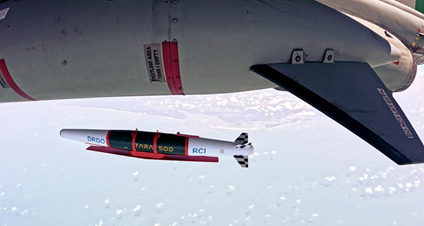
Recently, the Defence Research and Development Organisation (DRDO) and the Indian Air Force (IAF) successfully conducted the maiden flight-trial of the Tactical Advanced Range Augmentation (TARA) weapon system off the coast of Odisha on May 7, 2026. This development, marks the arrival of India’s first indigenous modular range extension kit designed to transform conventional unguided bombs into high-precision glide weapons.
1. Definition and Functional Utility
The Tactical Advanced Range Augmentation (TARA) is a glide weapon system designed to convert existing unguided warheads (gravity bombs) into precision-guided munitions (PGMs). It essentially acts as a “modular kit” that can be attached to standard bombs to provide them with guidance and extended range.
2. Key Technical Features
- Glide Technology: The system utilizes a modular range extension kit consisting of deployable wings. These wings allow the bomb to “glide” through the air, significantly increasing its standoff distance.
- Precision Guidance: By integrating state-of-the-art guidance systems, TARA ensures that low-cost unguided warheads can neutralize ground-based targets with extreme accuracy.
- Variants: The system is developed in multiple configurations to suit different payloads, including TARA 250, TARA 450, and TARA 500 (corresponding to 250kg, 450kg, and 500kg bomb classes).
- Low Cost: A primary objective of the TARA project is to provide a cost-effective solution for precision strikes compared to expensive dedicated missiles.
3. Development and Indigenization
- Agency: The system has been designed and developed by the Research Centre Imarat (RCI), Hyderabad, in collaboration with other DRDO laboratories.
- Industrial Collaboration: The project involves Development-cum-Production Partners (DcPP) and several private Indian industries, ensuring a robust supply chain under the Atmanirbhar Bharat framework.
- Platform Integration: While initial carriage trials were conducted using Jaguar fighter jets, the system is slated for integration with other frontline IAF aircraft like the Su-30MKI and Mirage 2000.
4. Strategic Importance
- Standoff Capability: By increasing the range, TARA allows IAF pilots to release weapons from a distance where they remain safe from enemy Ground-Based Air Defence (GBAD) systems.
- Lethality and Efficiency: It enhances the lethality of the existing stockpile of “dumb bombs” by ensuring they hit specific high-value targets rather than causing collateral damage.
Q. With reference to the Tactical Advanced Range Augmentation (TARA) system, consider the following statements:
Statement-I: TARA is a modular range extension kit designed to convert unguided warheads into precision-guided glide weapons.
Statement-II: It has been developed by the Research Centre Imarat (RCI) to provide a low-cost indigenous alternative for the Indian Air Force.
Which one of the following is correct in respect of the above statements?
(a) Both Statement-I and Statement-II are correct and Statement-II is the correct explanation for Statement-I.
(b) Both Statement-I and Statement-II are correct and Statement-II is not the correct explanation for Statement-I.
(c) Statement-I is correct but Statement-II is incorrect.
(d) Statement-I is incorrect but Statement-II is correct.
Solution: (a)
• STATEMENT I IS CORRECT: TARA is specifically designed as a modular kit that adds wings and guidance to unguided bombs, turning them into glide weapons.
• STATEMENT II IS CORRECT: The Research Centre Imarat (RCI), a premier DRDO lab, led the development to enhance strike accuracy at a low operational cost, explaining the functional necessity of the system mentioned in Statement I.