
Context
Recently, the Union Minister for Environment, Forest and Climate Change launched the website and logo for the inaugural International Big Cat Alliance (IBCA) Summit, which India is set to host from June 1 to 3, 2026, in New Delhi. The summit, themed ‘Save big cats, save humanity, save ecosystem’, is expected to witness the participation of 95 countries and culminate in the adoption of the first-ever global declaration on big cat conservation, titled the ‘Delhi Declaration’.
1. Origin and Launch
- Launched by: Prime Minister Narendra Modi on April 9, 2023.
- Occasion: Commemoration of 50 years of Project Tiger in Mysuru, Karnataka.
- Status: A treaty-based international intergovernmental organization.
- Headquarters: New Delhi, India.
2. The Seven Big Cats Covered
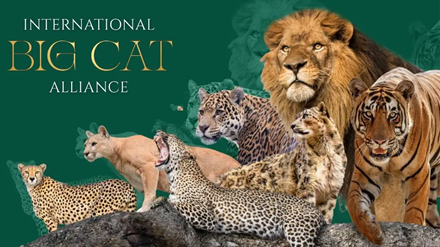
The alliance focuses on the protection and conservation of seven major big cat species. Out of these seven, five are found in India (Tiger, Lion, Leopard, Snow Leopard, and Cheetah).
| Species | IUCN Status (General) | Key Fact |
| Tiger | Endangered | Largest of all wild cats; India holds ~75% of global population. |
| Lion | Vulnerable | Asiatic Lions are restricted solely to Gir National Park, Gujarat. |
| Leopard | Vulnerable | Most adaptable; found across diverse habitats in Africa and Asia. |
| Snow Leopard | Vulnerable | “Ghost of the Mountains”; found in the high-altitude Himalayas. |
| Cheetah | Vulnerable | Declared extinct in India in 1952; reintroduced in 2022 (Project Cheetah). |
| Jaguar | Near Threatened | Largest cat in the Americas; famous for the strongest bite force. |
| Puma | Least Concern | Also known as Cougar or Mountain Lion; found in the Americas. |
3. Membership and Governance
- Eligibility: Open to 96 range countries (nations where these cats naturally occur) and non-range countries, intergovernmental organizations, and scientific bodies.
- Structure: Consists of a General Assembly, a Council (7 to 15 members), and a Secretariat.
- Model: It is modeled on the lines of the International Solar Alliance (ISA) and the Coalition for Disaster Resilient Infrastructure (CDRI), positioning India as a global leader in environmental diplomacy.
4. Funding and Objectives
- Initial Funding: The Government of India has committed ₹150 crore for the first five years (2023–2028).
- Primary Goals: To curb illegal wildlife trade and poaching through transboundary cooperation.
- Knowledge sharing and capacity building among range countries.
- Creating a centralized repository of successful conservation practices (like India’s Project Tiger).
- Integrating conservation with sustainable local livelihoods.
Q. With reference to the International Big Cat Alliance (IBCA), consider the following statements:
1. It is a treaty-based international organization headquartered in Mysuru, Karnataka.
2. The alliance aims to conserve seven big cats, all of which are naturally found in India.
3. The governance structure of IBCA is modeled after the International Solar Alliance (ISA).
Which of the statements given above is/are correct?
A) 1 and 2 only
B) 3 only
C) 2 and 3 only
D) 1, 2 and 3
Correct Answer: B) 3 only
Solution:
• STATEMENT 1 IS INCORRECT: While the alliance was launched in Mysuru, its Secretariat and Headquarters are established in New Delhi.
• STATEMENT 2 IS INCORRECT: The alliance covers seven big cats (Tiger, Lion, Leopard, Snow Leopard, Cheetah, Jaguar, and Puma). However, only five are naturally found in India. The Jaguar and Puma are native to the Americas and are not found in the wild in India.
• STATEMENT 3 IS CORRECT: The IBCA is indeed modeled after India's successful international initiatives like the International Solar Alliance (ISA) to provide a platform for global cooperation.