
Context
Recently, Defence Minister Rajnath Singh, while addressing the North Tech Symposium in Prayagraj, underscored the urgent necessity for India to accelerate innovation in high-tech warfare domains. He specifically urged the industry and academia to prioritize the development of emerging technologies, including Directed Energy Weapons (DEWs), hypersonic systems, and artificial intelligence, to ensure India maintains a strategic edge in a rapidly transforming global security landscape.
1. What are Directed Energy Weapons (DEWs)?
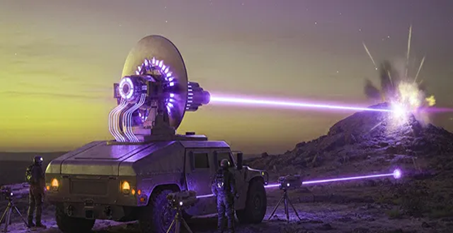
Directed Energy Weapons are a class of technologies that use concentrated electromagnetic energy rather than kinetic projectiles (bullets or missiles) to incapacitate, damage, or destroy enemy equipment and personnel. They operate at the speed of light, offering near-instantaneous engagement of targets.
2. Types of DEWs
- High-Energy Lasers (HEL): These weapons focus intense beams of light to physically burn through a target’s hull or destroy sensitive optical sensors (a process known as a “hard-kill”).
- High-Power Microwaves (HPM): These emit short pulses of microwave energy that penetrate electronic systems to “fry” circuits and disrupt internal electronics without necessarily causing physical structural damage.
- Particle Beam Weapons: These use accelerated subatomic particles (electrons or protons) to damage targets, though they remain largely experimental due to massive power requirements.
3. India’s Key DEW Projects
| Project Name | Type | Key Features |
| DURGA-II | High-Energy Laser | Standing for Directionally Unrestricted Ray-Gun Array, it is a 100-kW system intended for land, sea, and air platforms to neutralize drones and missiles. |
| KALI | High-Power Microwave | Standing for Kilo Ampere Linear Injector, it is a linear electron accelerator developed by DRDO and BARC to disrupt enemy satellite and missile electronics. |
| Project Tri-Netra | High-Energy Laser | Managed by the Laser Science and Technology Centre (LASTEC) for short-range aerial defense. |
4. Advantages vs. Challenges
- Cost-Effectiveness: A single “shot” from a laser costs only a few dollars (primarily the cost of electricity), compared to millions for an interceptor missile.
- Logistical Ease: There is no need for physical ammunition storage; as long as there is power, the weapon has an “infinite magazine.”
- Speed and Precision: They are unaffected by gravity or wind and can hit hypersonic targets instantly.
- Challenges: DEWs are heavily affected by atmospheric conditions (fog and rain scatter the beam) and require massive power sources and cooling systems.
Q. With reference to Directed Energy Weapons (DEWs), consider the following statements:
1. High-Energy Lasers (HEL) primarily damage targets by disrupting their electronic circuits through electromagnetic interference.
2. The KALI (Kilo Ampere Linear Injector) is an indigenous Indian project developed jointly by DRDO and the Bhabha Atomic Research Centre (BARC).
3. Atmospheric conditions such as heavy fog and rain do not impact the efficacy of Laser-based DEWs due to their high frequency.
Which of the statements given above is/are correct?
a) 1 and 2 only
b) 2 only
c) 2 and 3 only
d) 1, 2, and 3
Solution: (b)
• STATEMENT 1 IS INCORRECT: High-Energy Lasers (HEL) damage targets through thermal effects (burning/melting), whereas High-Power Microwaves (HPM) are the ones that disrupt electronic circuits.
• STATEMENT 2 IS CORRECT: KALI is a linear electron accelerator designed for generating high-power microwaves, developed as a collaboration between DRDO and BARC.
• STATEMENT 3 IS INCORRECT: Laser-based DEWs are highly sensitive to atmospheric attenuation; particles like water droplets (fog/rain) and dust scatter the light beam, significantly reducing its range and power.