
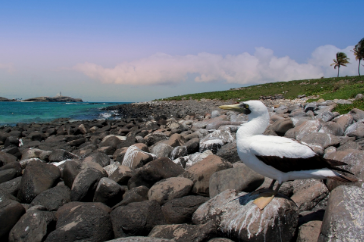
Context
Recently, the coral cover of Brazil’s Abrolhos reefs—the most biodiverse coral ecosystem in the South Atlantic—has fallen by around 15% over 18 years due to climate change and human activity.
1. About the Abrolhos Marine National Park
The Abrolhos Marine National Park (Parque Nacional Marinho dos Abrolhos) is a pristine archipelago and marine sanctuary located in the South Atlantic, roughly 70 kilometers off the coast of Bahia, Brazil. Established in 1983, it was the first of its kind in the country and protects the largest and most biodiverse coral reef system in the South Atlantic.
I. Unique Geological & Coral Formations
The park is world-renowned for its “Chapeirões”—mushroom-shaped coral pinnacles that rise up to 25 meters from the sandy seafloor.
- Endemic Species: It is the primary home of the Brain Coral (Mussismilia braziliensis), a species found only in Brazilian waters.
- Biodiversity: The area supports over 1,300 species, including sea turtles, reef sharks, and the endemic Parrotfish.
II. Seasonal Highlight: Humpback Whales
From July to November, the park becomes a critical nursery for Humpback Whales migrating from Antarctica.
- Whale Watching: The warm, shallow waters are ideal for mating and calving. Visitors during this time can frequently see breaches and hear “songs” from the males.
- Research Hub: It is considered the most significant breeding ground for these mammals in the entire South Atlantic.
2. About Coral Reefs
Coral reefs are underwater ecosystems formed by colonies of coral polyps held together by calcium carbonate. Often called the “rainforests of the sea,” they occupy less than 0.1% of the ocean floor but support over 25% of all marine species (National Marine Sanctuary Foundation, 2020).
I. Types of Coral Reefs
There are three primary types of coral reefs, distinguished by their formation and relationship to land:
- Fringing Reefs: The most common type, these grow seaward directly from the shore of islands or continents.
- Barrier Reefs: Similar to fringing reefs but separated from the shoreline by a deep lagoon (e.g., the Great Barrier Reef).
- Atolls: Rings of coral that surround a central lagoon, usually formed when a fringing reef grows around a volcanic island that eventually sinks (National Marine Sanctuary Foundation, 2020).
II. Impact of Climate Change on Coral Reefs
Climate change poses an existential threat to coral ecosystems through several mechanisms:
- Coral Bleaching: As ocean temperatures rise, corals experience thermal stress and expel the symbiotic algae (zooxanthellae) living in their tissues. These algae provide corals with food and their vibrant colors. Without them, the coral turns white (bleaches) and is at high risk of starvation and disease (The SEA People, 2024).
- Ocean Acidification: The ocean absorbs a significant portion of atmospheric CO2, which lowers the pH of seawater. This increased acidity reduces the availability of carbonate ions, making it difficult for corals to build and maintain their calcium carbonate skeletons (The SEA People, 2024).
- Sea Level Rise: Rapidly rising sea levels can lead to increased sedimentation. Silt and runoff can “smother” corals, blocking the sunlight needed for photosynthesis (The SEA People, 2024).
- Extreme Weather: Increased intensity of tropical storms can physically destroy reef structures, which take decades to regrow (The SEA People, 2024).
III. Conservation Efforts in India
India has four major coral reef regions: Andaman and Nicobar Islands, Lakshadweep, Gulf of Mannar, and Gulf of Kachchh (Madras School of Economics, 2018).
- Legal Protection: Corals are protected under Schedule I of the Wildlife Protection Act, 1972, granting them the highest level of legal protection in India.
- Marine Protected Areas (MPAs): India has established several MPAs, such as the Gulf of Mannar Marine National Park, to regulate human activities and prevent habitat destruction.
- Restoration Projects:
- In the Gulf of Mannar, authorities and researchers have successfully transplanted seized poached corals onto artificial reef modules with a survival rate of over 60%.
- Mineral Accretion Technology (Biorock): This technology has been piloted in the Gulf of Kachchh to accelerate coral growth using small electrical currents.
- Coastal Regulation Zone (CRZ): Specific rules (like CRZ4 for Andaman and Nicobar) prohibit the use of corals and beach sand for construction and restrict dredging near reef formations (Madras School of Economics, 2018).
IV. International Conservation Efforts
Global cooperation is essential given that climate change is a transboundary issue.
- CORDAP (Coral Research & Development Accelerator Platform): Launched by G20 nations in 2020, CORDAP is the only international organization solely dedicated to funding global R&D for coral restoration and conservation at scale (CORDAP, 2020).
- ICRI (International Coral Reef Initiative): An informal partnership among nations and organizations which strives to preserve coral reefs and related ecosystems worldwide.
- GCRMN (Global Coral Reef Monitoring Network): This network provides scientific data on the status and trends of coral reef ecosystems to help guide policy decisions.
- The Paris Agreement: By aiming to limit global warming to well below 2 degree above pre-industrial levels, this treaty is considered the single most important factor for the long-term survival of reefs (IUCN).
Consider the following statements regarding coral reefs:
1. Coral reefs occupy less than 1% of the ocean floor but support a large proportion of marine species.
2. Coral reefs are formed by calcium carbonate secreted by coral polyps.
3. Atolls are formed when volcanic islands subside and coral reefs grow around them.
Which of the statements given above are correct?
(a) 1 and 2 only
(b) 2 and 3 only
(c) 1 and 3 only
(d) 1, 2 and 3
Answer: D
Explanation:
•  Statement 1 is correct: While coral reefs cover a tiny fraction—approximately 0.1% to 1%—of the ocean's surface area, they are incredibly dense hubs of life. They provide habitat, food, and breeding grounds for roughly 25% of all marine species, including fish, mollusks, worms, crustaceans, and echinoderms.
•  Statement 2 is correct: Corals are colonial marine invertebrates. Most "hard" corals have a symbiotic relationship with algae called zooxanthellae. The coral polyps extract calcium and carbonate ions from seawater to secrete a hard calcium carbonate ($CaCO_3$) skeleton that forms the physical structure of the reef.
•  Statement 3 is correct: This describes the Darwinian Theory of Atoll Formation. It begins with a fringing reef growing around a volcanic island. As the island slowly subsides (sinks) due to tectonic shifts or erosion, the coral continues to grow upward toward the light. Eventually, the island disappears below sea level, leaving a ring-shaped reef (the atoll) surrounding a central lagoon.