
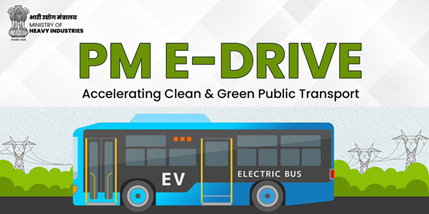
Context
Recently, the Central Government is considering the launch of a fresh electric bus scheme for States following the successful tendering and allocation of all 14,028 e-buses under the PM E-DRIVE programme.
1. Overview of PM E-DRIVE Scheme
The PM Electric Drive Revolution in Innovative Vehicle Enhancement (PM E-DRIVE) is a flagship Central Sector Scheme designed to accelerate the transition to electric mobility in India.
- Nodal Ministry: Ministry of Heavy Industries (MHI).
- Total Outlay: ₹10,900 crore.
- Duration: Initially launched for two years (October 2024 to March 2026), but recently extended for specific segments (e.g., e-2Ws until July 2026 and e-3Ws until March 2028).
- Subsumed Schemes: It subsumes the Electric Mobility Promotion Scheme (EMPS) 2024.
2. Key Components and Financial Allocation
The scheme focuses on both demand-side incentives and supply-side infrastructure development.
| Component | Allocation (Approx.) | Target/Details |
| Demand Incentives | ₹3,679 crore | Supports e-2Ws, e-3Ws, e-ambulances, and e-trucks. |
| Electric Buses | ₹4,391 crore | Procurement of 14,028 e-buses for 9 major cities (population >4 million). |
| Charging Infrastructure | ₹2,000 crore | Installation of ~72,300 public fast chargers. |
| Testing Agencies | ₹780 crore | Upgrading MHI testing agencies for emerging EV technologies. |
3. Salient Features
- E-Voucher Mechanism: To simplify the subsidy process, the government introduced Aadhaar-authenticated e-Vouchers. At the time of purchase, a digital voucher is generated for the buyer, which is signed and uploaded to the portal to claim the incentive.
- Focus on Public Transport: A major portion of the fund is dedicated to e-buses and e-ambulances (₹500 crore) to decarbonize public health and transport services.
- Advanced Batteries: Only vehicles fitted with advanced batteries (as per notified technical standards) are eligible for incentives to ensure safety and efficiency.
- Scrapping Linkage for Trucks: Incentives for e-trucks are specifically linked to the possession of a scrapping certificate from a MoRTH-approved Registered Vehicle Scrapping Facility (RVSF).
4. Comparison: PM E-DRIVE vs. FAME-II
| Aspect | PM E-DRIVE | FAME-II |
| Scope | Greater emphasis on public transport (buses, ambulances) and trucks | Focused more broadly on electric mobility, including smaller vehicles |
| Hybrid Vehicles | Supports only pure Electric Vehicles (EVs) | Supported Hybrid Electric Vehicles (HEVs) along with EVs |
| Efficiency | Targets higher volumes with lower per-unit subsidy | Higher per-unit subsidy with relatively lower volume focus |
Q. With reference to the ‘PM E-DRIVE’ scheme, consider the following statements:
1. It is a Central Sector Scheme implemented by the Ministry of Road Transport and Highways.
2. The scheme provides demand incentives for electric two-wheelers, three-wheelers, and hybrid cars.
3. The incentives for electric trucks under this scheme are mandatory to be linked with a vehicle scrapping certificate.
4. It introduces a physical paper-based voucher system to provide upfront discounts to buyers.
Which of the statements given above is/are correct?
A) 1 and 2 only
B) 3 only
C) 2, 3 and 4 only
D) 1, 3 and 4 only
Solution: B
• STATEMENT 1 IS INCORRECT: The scheme is implemented by the Ministry of Heavy Industries, not the Ministry of Road Transport and Highways.
• STATEMENT 2 IS INCORRECT: While it supports e-2Ws and e-3Ws, it does not provide incentives for hybrid cars; it focuses on pure electric vehicles and includes new segments like e-ambulances and e-trucks.
• STATEMENT 3 IS CORRECT: To promote the circular economy, demand incentives for e-trucks are only available to those who provide a scrapping certificate from an approved RVSF.
• STATEMENT 4 IS INCORRECT: The scheme uses an e-Voucher (digital), which is Aadhaar-authenticated and generated via a portal, not a physical paper-based system.