
Context
Recently, the Union Government notified the Central Armed Police Forces (General Administration) Act, 2026, which has sparked significant debate and protests by retired personnel and their families at Raj Ghat. These demonstrations, coinciding with CRPF Valour Day on April 9, highlight grievances regarding service conditions and the legal solidification of leadership roles for external cadres. The Act serves as a definitive legislative tool to streamline the administration of India’s internal security forces while addressing long-standing operational synergy requirements between central forces and state police departments.
1. Overview and Administrative Control
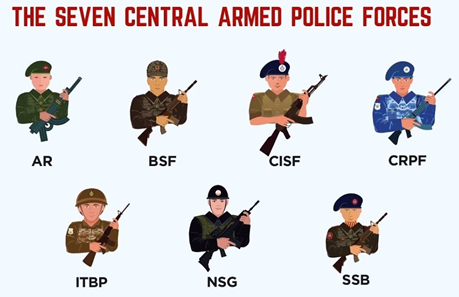
The Central Armed Police Forces (CAPF) is the collective term for seven security forces under the Ministry of Home Affairs (MHA).
- Administrative Body: The MHA is the sole defining administrative body for these forces.
- Dual Control of Assam Rifles: While all forces are under the MHA, the Assam Rifles remains unique as its operational control is vested with the Ministry of Defence (Indian Army).
- Leadership Change: The 2026 Act now provides a statutory basis for the recruitment and leadership structure that was previously governed by executive orders.
2. The Seven Forces and Their Primary Mandates
| Force | Primary Mandate | Operational Area |
| BSF | Border Protection | Indo-Pakistan and Indo-Bangladesh Borders. |
| CRPF | Internal Security | Counter-Naxal operations and Election duties. |
| CISF | Critical Infrastructure | Airports, Metros, and sensitive Government buildings. |
| ITBP | High-Altitude Security | Indo-China Border (LAC). |
| SSB | Border Security | Indo-Nepal and Indo-Bhutan Borders. |
| NSG | Counter-Terrorism | Federal Contingency Force for anti-terror/hijack. |
| Assam Rifles | Border & Insurgency | Indo-Myanmar Border and North-East security. |
3. Key Provisions of the CAPF (General Administration) Act, 2026
The 2026 Act introduces several critical mandates that define the career landscape for both cadre officers and deputed officers:
- Leadership Reservation for IPS: The Act legally cements the reservation of senior posts for Indian Police Service (IPS) officers across five CAPFs (BSF, CRPF, CISF, ITBP, and SSB).
- 50% of posts at the Inspector General (IG) rank are reserved for IPS officers.
- At least 67% of posts at the Additional Director General (ADG) rank.
- 100% of posts at the Special DG and Director General (DG) ranks are reserved for IPS officers.
- Legislative Supremacy: The Act states that any rules made under it regarding recruitment and service conditions will explicitly override any other existing laws, previous executive orders, or court judgments.
- Operational Synergy: The government rationale for this structure is that CAPFs must work in close coordination with state police and civil administrations, which are led by IPS and IAS officers; hence, IPS leadership ensures smoother coordination.
4. Major Concerns and Counter-Arguments
- Career Progression: Group A officers within the CAPF cadre often wait 15–18 years for promotions due to the limited number of senior-level “slots” available to them under the new Act.
- Judicial Friction: Critics argue the Act undermines a 2025 Supreme Court directive that recommended a progressive reduction of IPS deputation at the IG rank to boost internal force morale.
- Demands: Personnel are currently demanding the restoration of the Old Pension Scheme (OPS) and more time-bound promotions to ensure a dignified career path for those in combat roles.
Q. Consider the following statements regarding the Central Armed Police Forces (General Administration) Act, 2026:
Statement-I: The Act mandates that 100% of the posts at the level of Special Director General (SDG) and Director General (DG) in the CAPFs shall be occupied by officers from the Indian Police Service (IPS).
Statement-II: The Act was introduced to fulfill a 2025 Supreme Court directive which called for the permanent reservation of top leadership posts for deputed IPS officers to ensure operational synergy with state police.
Which one of the following is correct in respect of the above statements?
(a) Both Statement-I and Statement-II are correct and Statement-II is the correct explanation for Statement-I.
(b) Both Statement-I and Statement-II are correct and Statement-II is not the correct explanation for Statement-I.
(c) Statement-I is correct but Statement-II is incorrect.
(d) Statement-I is incorrect but Statement-II is correct.
Answer: (c)
Solution:
• STATEMENT I IS CORRECT: The CAPF (General Administration) Act, 2026, explicitly reserves 100% of the top leadership positions (Special DG and DG) for IPS officers.
• STATEMENT II IS INCORRECT: While the government justifies the Act using the "operational synergy" argument, the Act actually contradicts the 2025 Supreme Court directive, which had asked the Centre to reduce the reliance on IPS deputation at senior levels rather than cement it legally.