
Context
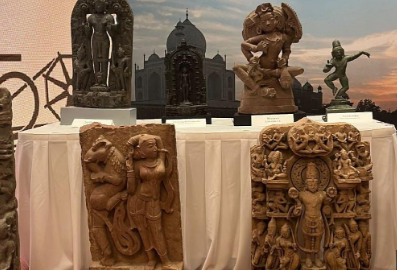
U.S. authorities have returned 657 antiquities to India, valued at nearly $14 million. These items were recovered following investigations into major international trafficking networks, specifically those led by Subhash Kapoor and Nancy Wiener.
Key Highlights of the Repatriated Artefacts
1. Red Sandstone Buddha Figure
- Significance: Valued at approximately $7.5 million.
- Iconography: Depicted in Abhaya Mudra (gesture of protection/fearlessness).
- Condition: Features a broken halo and feet damaged below the knees, typical of looted artefacts.
- Origin: Believed to be from Northern India (likely Mathura school, given the use of red sandstone).
| Buddha Mudras Bhumisparsha Mudra (Earth Witness): Right hand reaches down to touch the ground, palm inward, symbolizing Buddha’s enlightenment under the Bodhi tree and his triumph over Mara (temptation).Dhyana Mudra (Meditation): Hands rest in the lap, right hand over left with thumbs touching, representing concentration, inner peace, and balance.Abhaya Mudra (Fearlessness): Right hand raised to shoulder height, palm facing outward, symbolizing protection, peace, and the dispelling of fear.Varada Mudra (Charity/Compassion): Right hand extends downward, palm facing outward, symbolizing generosity and the granting of boons.Vitarka Mudra (Teaching/Discussion): Thumb and index finger touch to form a circle, with other fingers pointing up, representing the transmission of wisdom and the teaching of the Dharma.Dharmachakra Mudra (Turning the Wheel): Both hands are held at the chest, thumb and index finger of each hand forming a circle, representing the Buddha’s first sermon.Anjali Mudra (Greeting/Devotion): Both palms pressed together at the chest, representing respect, devotion, and a greeting. |
2. Bronze Avalokiteshvara
- Iconography: Seated on an inscribed double-lotus base over a lion-flanked throne.
- Artisan/Location: The inscription identifies the craftsman as Dronaditya of Sirpur (near modern-day Raipur, Chhattisgarh).
- Historical Link: Part of a large hoard of bronzes discovered near the Lakshmana Temple in 1939.
| Sirpur (ancient Sripura) in Chhattisgarh, India, is a major 6th-8th century archaeological site on the Mahanadi river, renowned for its dense concentration of Buddhist, Hindu, and Jain monuments. It was a major regional capital and intellectual center boasting 100+ monasteries, famously visited by Chinese traveler Xuanzang. Key sites include the 7th-century brick Lakshmana Temple, Surang Tila, and multiple excavated Viharas (monasteries). |
3. Legal framework
I. Regulatory Framework in India
- Antiquities and Art Treasures Act, 1972: This is the primary legislation. It makes it illegal for any person other than the Government or its authorized agencies to export any antiquity.
- Archaeological Survey of India (ASI): The nodal agency responsible for the protection and repatriation of cultural heritage.
II. Global Framework
- UNESCO Convention 1970: Prohibits and prevents the illicit import, export, and transfer of ownership of cultural property.
- Cultural Property Agreement (CPA): India and the U.S. recently signed a Cultural Property Agreement (July 2024) to streamline the return of stolen artefacts and prevent further trafficking.
Consider the following statements regarding the repatriation of Indian antiquities:
1. The Archaeological Survey of India (ASI) is the nodal agency responsible for the protection and repatriation of cultural heritage in India.
2. The UNESCO Convention of 1970 facilitates and promotes unrestricted international trade of cultural property among member countries.
Which of the following is correct?
a) Only 1 is correct
b) Only 2 is correct
c) Both 1 and 2 are correct
d) Neither 1 nor 2 is correct
Answer: A
Explanation:
Statement 1is correct:
The Archaeological Survey of India (ASI), an attached office under the Ministry of Culture, is indeed the nodal agency for all matters related to the protection, preservation, and repatriation of cultural heritage.
• Repatriation Role: When Indian antiquities are identified in foreign museums or private collections (often having been smuggled out), the ASI works alongside the Ministry of External Affairs and law enforcement agencies like the CBI to establish ownership and facilitate their return to India.
• Legal Framework: It operates primarily under the Antiquities and Art Treasures Act, 1972, which regulates the export and internal trade of antiquities to prevent illicit trafficking.
Statement 2 is incorrect:
The statement is incorrect because the UNESCO Convention of 1970 (Convention on the Means of Prohibiting and Preventing the Illicit Import, Export and Transfer of Ownership of Cultural Property) is designed to prohibit and prevent the illicit movement of cultural property, not to promote unrestricted trade.
• Purpose: It was established to ensure that member countries cooperate to protect their cultural heritage from theft and illegal export.
• Key Mechanism: It requires member states to take measures such as creating national inventories, establishing export certificates, and providing assistance in the recovery and return of stolen artifacts.