
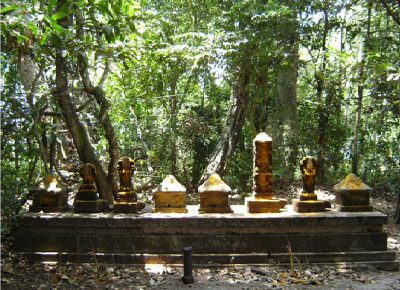
Context
Recently, the Kerala State Biodiversity Board (KSBB) has launched a pilot project to restore declining sacred groves across five districts (Ernakulam, Palakkad, Kozhikode, Kannur, and Kasaragod) to counter developmental pressures and invasive species.
I. Key Features of the Restoration Project
- Implementing Agencies: KSBB in collaboration with local Biodiversity Management Committees (BMCs).
- ‘Kavu Nurseries’: Establishment of specialized nurseries to propagate specific plant species native to these groves.
- Core Activities:
- Biodiversity assessment and identification of endangered/invasive species.
- Bio-fencing using native plants instead of artificial barriers.
- Rejuvenation of associated water bodies (ponds) and removal of plastic waste.
- Scope: Identification of over 100 native/threatened species and planting of nearly 3,000 saplings.
| Biodiversity Management Committees (BMCs) are local bodies mandated by India’s Biological Diversity Act, 2002, to promote conservation, sustainable use, and documentation of local biological resources. Operating under local self-governments (rural Panchayats or urban Municipalities), they prepare People’s Biodiversity Registers (PBRs) to document local flora, fauna, and traditional knowledge. |
II. What are Sacred Groves?
- Definition: These are patches of primeval forest that are communally protected, usually dedicated to a local deity or ancestral spirits.
- Ecological Significance:
- In-situ Conservation: They serve as repositories for rare, endemic, and medicinal plants.
- Ecosystem Services: They act as micro-watersheds, helping in soil conservation and groundwater recharge.
- Biogeographical Islands: They often represent the only remaining “climax vegetation” of a region amidst a modified landscape.
- Legal Status: Many sacred groves in India are now protected under the Wildlife (Protection) Amendment Act, 2002, categorized as ‘Community Reserves’.
| A Community Reserve is a legal category of protected area in India, introduced by the 2002 amendment to the Wildlife (Protection) Act, 1972 (Section 36C). It serves as a buffer or corridor between established national parks, sanctuaries, and forests, allowing local communities to voluntarily conserve biodiversity on private or communal land while maintaining ownership.Management: Managed by a Community Reserve Management Committee (CRMC) constituted by the State Government, allowing for sustainable resource use.Restrictions: Once declared, land use cannot be changed without a resolution from the Management Committee and approval by the State Government.Prevalence: There are over 219 community reserves in India. |
III. Regional Names of Sacred Groves
| State | Local Name |
| Kerala | Kavu / Sarpakavu |
| Meghalaya | Law Kyntang |
| Rajasthan | Orans / Kenri |
| Maharashtra | Deorais |
| Karnataka | Devarakadu |
| Tamil Nadu | Kovil Kadu |
| Himachal Pradesh | Deo Bhumi |
| Madhya Pradesh | Jahera / Sargi |
Consider the following statements
1. Community reserves are established under the Forest Conservation Act of 1980.
2. The Forest Rights Act (FRA) of 2006 is governed by the Ministry of environment, forest and climate change (MoEFCC).
Which of the statements given above is/are correct?
(A)1 only
(B) 2 only
(C) Both 1 and 2
(D) Neither 1 nor 2
Answer: D
Explanation:
•  Statement 1 is incorrect: Community Reserves (as well as Conservation Reserves) were introduced through the Wildlife (Protection) Amendment Act of 2002, which amended the Wildlife (Protection) Act of 1972. They are not established under the Forest Conservation Act of 1980. These reserves act as buffer zones or connectors between established national parks and wildlife sanctuaries.
•  Statement 2 is incorrect: The Scheduled Tribes and Other Traditional Forest Dwellers (Recognition of Forest Rights) Act, 2006 (commonly known as the FRA) is governed and administered by the Ministry of Tribal Affairs (MoTA), not the MoEFCC. While the Act deals with forest land, the nodal agency was specifically chosen to ensure the protection of the rights of tribal and forest-dwelling communities.